
Dangote Accuses Marketers Of Demanding Petrol Pump Price Hike By N75
BY ADEOLA ANIKE
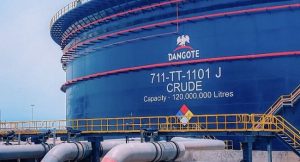
..As DAPPMAN Gives. Dangote 7 Days To Prove Smuggling Allegations
Dangote Petroleum Refinery has revealed that, the Depot and Petroleum Products Marketers Association of Nigeria (DAPPMAN) requested it to increase the price of petrol and diesel by N75 per litre, in order to allow its members to match the refinery’s gantry prices at their respective depots.
This is even as DAPPMAN has given the Dangote Petroleum Refinery a seven-day ultimatum to either withdraw its allegations of fuel smuggling or provide concrete evidence to back the claims.
If the N75 hike is implemented, this would result in the pump price of Premium Motor Spirit (PMS) and diesel rising to as high as N950 and N1,090 per litre respectively in some parts of Nigeria.
The refinery disclosed that, although it offers petroleum products to marketers at its gantry price, DAPPMAN insists on taking delivery via coastal logistics, an option that would add N75 per litre in extra costs. Based on daily consumption volumes of 40 million litres of Premium Motor Spirit (PMS) and 15 million litres of Automotive Gas Oil (AGO), this amounts to an additional annual cost of N1.505 trillion(N1,505,625,000,000),) whh they effectively asked the refinery to absorb and pass on to Nigerians.
“We wish to make it clear that we have no intention of increasing our gantry price to accommodate such demands, nor are we willing to pay a subsidy of over N1.5 trillion, a practice that historically defrauded the Federal Government for many years. DAPPMAN and other marketers are welcome to lift products directly from our gantry and benefit from our logistics-free initiative,” it said.
The refinery alleged that, its refusal to comply with DAPPMAN’s subsidy request is the core reason behind recent public criticisms and attacks. It reiterated that the refinery has sufficient capacity to meet domestic demand and support export as it consistently maintains a closing stock of 500 million litres of refined products in its tanks each month.
“Between June and September, the refinery exported a combined total of 3,229,881 metric tonnes of PMS, AGO, and aviation fuel, while marketers imported 3,687,828 metric tonnes over the same period, an action that amounts to dumping which is detrimental to the Nigerian economy and the wellbeing of its citizens,” it said.
Reaffirming its commitment to supporting the reform agenda of President Bola Ahmed Tinubu, the refinery stated that, through various strategic interventions, it has helped stabilise the Naira, cushion the effects of fuel subsidy removal, position Nigeria as a refining hub, boost foreign exchange earnings, and create employment opportunities across multiple sectors.
“We enjoy strong working relationships with government agencies and remain committed to supporting their efforts, while not hesitating to hold institutions accountable where necessary.
“Dangote Petroleum Refinery remains firmly committed to the progress and wellbeing of Nigeria, and is open to partnerships with patriotic and responsible stakeholders in pursuit of national development,” it noted.
The Refinery also reaffirmed its position regarding its recent statement on the DAPPMAN, which was published on Monday, 15 September, in several national dailies and reputable online platforms.
The refinery stressed that any party aggrieved by the content of the publication is free to seek redress through appropriate legal channels. It noted that it would not be swayed by threats or so-called seven-day ultimatums and is fully prepared to defend its position through all legitimate means.
Meanwhile, in a statement dated September 15, DAPPMAN described Dangote’s accusations as ‘misleading, factually incorrect, and harmful to Nigeria’s downstream sector.’ DAPPMAN argued that, such claims not only distort market realities but also undermine regulatory bodies and encourage monopoly.
Dangote had alleged that, some marketers were diverting petroleum products to neighbouring countries. But DAPPMAN dismissed the charge, insisting that, only Customs and security agencies have the mandate to investigate such matters.
“We issue a seven-day ultimatum to the refinery to either retract this allegation or provide documented proof. If neither occurs, we will seek legal redress,” the statement read.
The marketers also rejected Dangote’s suggestion that they were behind a planned strike by the Petroleum and Natural Gas Senior Staff Association of Nigeria (NUPENG). According to them, unions such as NUPENG, NARTO, MEMAN, and IPMAN act independently and are not influenced by DAPPMAN.
DAPPMAN argued that, recent cuts in petrol prices were due to wider economic factors, not Dangote’s refinery. These include a stronger naira, falling crude oil prices, and improved foreign exchange liquidity under the Central Bank of Nigeria.
The group defended Nigeria’s refined fuel exports to West Africa, saying they reflect an open market. It dismissed Dangote’s claim that marketers engage in “round-tripping” by re-importing products through Togo, explaining that Offshore Lome is a trading hub, not a blending site.
DAPPMAN further accused Dangote of double standards, alleging the refinery offers foreign buyers discounts of over $40/MT while restricting Nigerian marketers.
On fuel standards, the association said, Dangote itself sought approval from the Nigerian Midstream and Downstream Petroleum Regulatory Authority (NMDPRA) to distribute petrol with sulphur levels above legal limits. It stressed that only the NMDPRA has the authority to track supply volumes, not individual refineries.
DAPPMAN also raised alarm over Dangote’s plan to deploy 4,000 compressed natural gas (CNG) trucks, warning of road safety risks. It accused the conglomerate of a “history of fatal accidents” involving poorly trained drivers, adding that more trucks could worsen congestion on the Lekki–Epe Expressway.
The marketers insisted they are not opposed to competition but want a level playing field. They warned against rhetoric that undermines regulators and could derail President Bola Tinubu’s deregulation reforms.





