
Experts Back Tinubu’s Oil Revenue Remittance Reform, Warn of Operational, Fiscal Implications
BY CEES HARMON
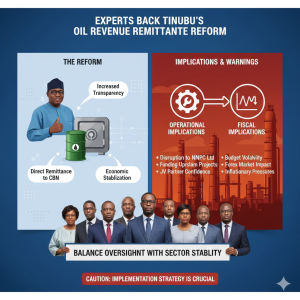
Economic and energy experts have largely described President Bola Tinubu’s executive order mandating the direct remittance of oil and gas revenues to the Federation Account as a bold fiscal reform, but caution that its implementation could significantly reshape the operations of NNPC Limited and alter monthly allocations from the Federation Account Allocation Committee.
The directive, which halts multiple layers of deductions under the Petroleum Industry Act framework, including the 30 per cent management fee on profit oil and gas and the 30 per cent Frontier Exploration Fund, is aimed at boosting net oil revenue inflows and restoring what the presidency calls constitutional entitlements of the three tiers of government.
Public finance economists say the reform signals a decisive shift toward revenue centralisation and fiscal consolidation at a time of mounting debt service pressures.
A Lagos-based fiscal policy analyst, Dr. Mohammed Yusuf, said, “It is undoubtedly a step in the right direction if the goal is to improve transparency and increase distributable revenue.
Oil receipts have been declining in net terms despite relatively stable production levels, largely due to layered deductions. Redirecting those funds to the Federation Account could immediately strengthen federal and subnational liquidity.”
Under the previous framework, NNPC Limited retained 30 per cent of profit of oil and gas as a management fee in addition to 20 per cent of its profits for working capital. It also controlled 30 per cent of profit oil and gas earmarked for frontier exploration.
Energy economist Dr. Emeka Nwosu noted that, “From a governance standpoint, having a commercial national oil company act simultaneously as concessionaire, cost influencer, and revenue custodian created opacity. The order attempts to correct that structural imbalance.”
However, he warned that “execution will determine whether this becomes genuine reform or merely a fiscal reallocation exercise.”
Analysts said, the order could accelerate the transformation of NNPC Limited into a strictly commercial entity, as envisioned under the PIA, but may also constrain its short-term liquidity.
“With the removal of the 30 per cent management fee and the Frontier Exploration Fund control, NNPC’s internally generated capital pool will shrink significantly. That could affect its capacity to independently finance upstream investments unless alternative funding structures are put in place,” said oil and gas consultant Tunde Bakare.
He added that the move may push NNPC further toward joint venture reforms, asset optimisation, and external financing, potentially improving efficiency but increasing exposure to market discipline.

Another concern is investor perception. “International partners will closely watch how contractual stability is maintained,” said a partner at an Abuja-based energy law firm who requested anonymity. “Any perception that fiscal terms are being altered retroactively could raise legal and investment risk concerns,” he said.
Nonetheless, governance advocates argue that repositioning NNPC strictly as a commercial operator removes conflict-of-interest concerns embedded in the prior framework. Perhaps the most immediate impact may be felt at monthly FAAC meetings.
Financial analysts estimate that eliminating layered deductions could substantially increase distributable oil revenue to the three tiers of government. If more profit oil, royalties, and gas flare penalties flow directly into the Federation Account, federal, state, and local governments could see a noticeable uptick in allocations.
“States are likely to experience short-term revenue relief. Higher FAAC inflows could ease salary arrears, support capital projects, and reduce subnational borrowing,” he said.
However, Okoro cautioned that the fiscal multiplier effect depends on expenditure quality. “If additional allocations are consumed by recurrent spending rather than productive investment, the macroeconomic benefit will be limited,” he added.
There are also inflationary considerations. Increased liquidity at the subnational level could stimulate economic activity, but may add pressure to inflation if not matched by supply-side improvements.
Debt sustainability analysts note that stronger oil remittances could reduce federal borrowing needs, potentially easing pressure on interest rates and improving fiscal credibility in the medium term.
Experts broadly agree that the executive order addresses structural concerns embedded in the PIA’s revenue architecture, particularly overlapping funds and duplicative deductions such as the Midstream and Downstream Gas Infrastructure Fund and the Frontier Exploration Fund.
Yet some argue that comprehensive legislative amendment may be necessary for long-term stability.
“Executive orders can initiate reform, but enduring fiscal certainty requires statutory clarity,” said Dr. Nwosu. “The promised review of the PIA will be critical,” he noted.
For now, economists view the reform as a significant recalibration of Nigeria’s oil revenue management framework. Whether it becomes a turning point for fiscal stability or simply a redistribution of constrained oil earnings will depend on transparent implementation, disciplined spending, and sustained production levels.
As one analyst put it, “If properly executed, this could strengthen monthly FAAC and improve fiscal space. But if governance gaps persist, the structural problems may simply resurface under a different arrangement.”





