
UPDATED: 2 Weeks To Go; Know Status Of Your Bank As Foreign Investors’ Interest Hits 28%
BY ZAKA KHALIQ
About two weeks to the March 31st, 2026 banking recapitalisation deadline, no fewer than 28% of foreign investors have taken stake in Nigeria’s banks, BUSINESSDIARY learnt.
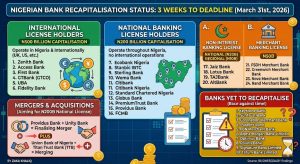
Recall that the International License must be capitalised to the tune of N500billion while that of National License goes for N200billion. For regional banks, they are only required to get N50billion capitalisation.
Merchant Banks are also required to capitalise to N50billion, Non-Intetest Bank with National License needs N20billion capitalisation while Non-Intetest Banks with a regional license only needed N10billion.
So, here is how your banks stand and what their status means for their operations going forward.
As it stands, Zenith Bank, Access Bank, First Bank, GTBank (GTCO), UBA,Fidelity Bank and FCMB have secured international banking licenses while Ecobank Nigeria, Stanbic IBTC, Sterling Bank, Wema Bank, Citibank Nigeria, Standard Chartered Nigeria, Globus Bank, PremiumTrust Bank, Providus Bank and NOVA Bank are now operating with National licenses.
For the non-interest banking license, Jaiz Bank, Lotus Bank, TAJBank and AltBank have secured approval in this regards.
For Merchant Bank, it must recapitalised to the tune of N50billion, which qualifies them to operate nationwide.
FSDH Merchant Bank, Greenwich Merchant Bank, Nova Merchant Bank and Rand Merchant Bank have scalled through the exercise with Merchant Banking licenses.
Providus Bank and Unity Bank are finalising their mergers after recapitalising to the tune of N200billion, of which an announcement, in this regards, is expected this week.
Similarly, Union Bank of Nigeria is merging with Titan Trust Bank Limited (TTB), of which the product has raised N200billion capitalisation but awaiting CBN final approval.
Analysts said, the recapitalisation exercise is already deepening activity in Nigeria’s capital market and boosting investor interest in banking stocks.
Financial economist at Auchi Polytechnic, Zakari Mohammed said, the policy would ultimately strengthen the financial system and expand banks’ capacity to support economic development.
“Stronger capital bases will enable banks to undertake bigger transactions and provide long-term financing for sectors such as infrastructure, manufacturing and energy,” Mohammed said.
According to him, Nigeria’s development goals require banks with stronger balance sheets that can fund large-scale projects and withstand economic shocks.
Similarly, Dr. Nelson Nkwo at Ebonyi State University, said, the recapitalisation programme could enhance banks’ risk-bearing capacity and improve credit creation in the economy.
“With larger capital buffers, banks will be able to take bigger exposures and support private-sector investments,” he said. “This is critical for economic expansion because credit is the fuel that drives growth.”
He added that, the exercise could also improve Nigeria’s attractiveness to foreign investors by strengthening confidence in the country’s financial system.
Economist and chief executive officer(CEO) of Centre for the Promotion of Private Enterprise, Muda Yusuf, said the recapitalisation exercise could provide a boost to the real sector if banks channel the additional capital into productive lending.

According to Yusuf, sectors such as manufacturing, agriculture and infrastructure require long-term financing that only well-capitalised banks can provide.
“The real benefit of this recapitalisation will depend on how much of the additional capital translates into increased lending to productive sectors of the economy,” he said.
However, Yusuf warned that, the reform could also create short-term challenges for some banks, particularly smaller lenders that may struggle to raise the required capital.
To address this, analysts said, some banks may consider mergers, acquisitions or strategic partnerships to meet the regulatory thresholds.
The recapitalisation programme has drawn comparisons with the landmark banking consolidation carried out in 2004 under former CBN governor, Charles Soludo, which raised the minimum capital base to N25 billion and reduced the number of banks from 89 to 25.
That reform produced stronger financial institutions capable of expanding across Africa and supporting larger transactions.
Economists believe the current exercise could produce similar outcomes.
Economic analyst at Cashlinks, Dr. Yemi Tella, said recapitalisation would help Nigerian banks remain competitive in an increasingly globalised financial environment.
“Nigeria’s economy is much larger today than it was in 2004, so it is necessary for banks to have stronger capital bases to support the scale of economic activity,” Tella said.
He added that well-capitalised banks would be better positioned to finance Nigeria’s infrastructure deficit and support the country’s industrialisation agenda.
Market analysts also note that the recapitalisation exercise could deepen Nigeria’s equity market as banks issue new shares to raise funds.
Research analysts at Cordros Capital said, the wave of capital raising in the banking sector could increase liquidity in the capital market and broaden investor participation.
However, they noted that the issuance of new shares may temporarily dilute earnings per share for existing investors.
Despite these concerns, industry groups have reassured depositors that the recapitalisation exercise will strengthen the financial system rather than weaken it.
The Bank Customers Association of Nigeria (BCAN) said the reform is expected to improve depositor confidence by ensuring that banks have sufficient capital buffers to withstand economic shocks.
As the March 2026 deadline approaches, regulators, investors and industry stakeholders are closely monitoring banks’ progress toward meeting the new capital thresholds.
- Economists said, the outcome of the recapitalisation exercise could shape the future of Nigeria’s banking industry and determine how effectively the sector supports economic growth in the coming years.





