
Nigerians Groan Over Transport Fare Hike
…..As Fuel Price Adjustment Continues Amidst Ongoing US-Israel-Iran War
BY CEES HARMON, MOBOLAJI OPEYEMI and EZENWA ECHEBIRI
With petrol pump price adjusted three times last week, Nigerians are now groaning over hike in transport fare that is now riding the price of food stuff, goods and services in the country, BUSINESSDIARY learnt.
Checks by our reporters in major cities on Saturday and Sunday showed that, fares on major routes have increased sharply by 20 to 30 per cent with transport operators citing the recent adjustment in pump prices, which have climbed to between N1,135 to N1,300 per litre in several locations across the country.
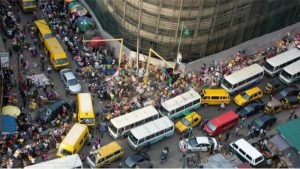
In Lagos, commercial bus operators popularly known as “danfo” drivers have raised fares on several busy routes, including Ikorodu–Ojota, Oshodi–Yaba, and Mile 2–CMS. Commuters said, fares that previously ranged between N300 and N500 have now risen by as much as 30 to 50 per cent, depending on the distance and time of travel.
“I paid N800 from Ikorodu to Ojota this morning. Last week it was id,500,” said Adeyemi Balogun, a private sector worker waiting for a bus at Ojota. “Every time fuel price changes, transport fare goes up immediately.”
Mr. Daniel Aliu, a civil servant waiting at a bus stop in Ekate, said: “It is no longer funny. Transport that used to cost less than N500 is now ranging between N700–N1000. Our salaries have not increased, but everything else is increasing every day.”
Mrs. Esther Omolara said: “Drivers increase the price the same day the price of fuel goes up, but experience has shown that even when the price drops, the fare will remain the same. To me, it feels unfair to passengers.”
For many commuters, however, the immediate concern is simply getting to work.
“Transport is becoming the biggest part of our daily expenses,” Balogun said in Lagos. “If fuel keeps rising, fares will keep rising too.”
A similar trend was observed in Port Harcourt, where commuters reportedly paying significantly higher fares on routes such as Rumuokoro–Mile 3 and Choba–Garrison.
Some residents said the increases have forced them to cut down on trips or walk part of the distance to their destinations.
“Transport from Rumuokoro to Garrison used to be around N300, but now drivers are asking for N500 or more,” said Blessing Tamuno, a trader. “If this continues, many people will start trekking.”
In Abuja, commuters along the Nyanya–Central Area and Kubwa–Wuse corridors also reported fare increases, with some commercial bus operators raising prices by between N200 and N400 per trip.
“I used to spend about N1,200 daily going to work and back,” said Ngozi Okeke, a civil servant who lives in Nyanya. “Now it is closer to N1,800. That is a big difference for someone on a fixed salary.”
A civil servant, Mrs. Chioma Okeke said the rising cost of transportation is eating deep into her monthly salary. “Transport fare has almost doubled on my route. What I used to spend in a week on transportation is now what I spend in about three days. It is becoming very difficult to cope,” she said.
She added that, she spends close to N10,000 daily on transportation to and from her workplace since the increment.

Similarly, students who commute to school by shuttle every day said they can no longer afford the fare. They now take a shuttle to school and trek back home due to the rising cost of transportation.
On their advice to the government, many Nigerians urged authorities to find sustainable solutions that would reduce the burden on citizens.
Nasiru, a trader, called on the government to support local refining to reduce reliance on imported fuel. “If we refine fuel locally and make it available at a cheaper price, transport fares will reduce, and everybody will benefit,” he said.
Mrs Adeyemi also urged the government to consider policies that would cushion the effects of fuel price increases on transport operators. “The government should look into ways to stabilize fuel prices and improve public transportation so that ordinary Nigerians will not continue to suffer,” she said.
Transport operators said, the adjustments are necessary to cover operating costs. A commercial driver at Oshodi Motor Park said the price of petrol now consumes a larger share of their daily earnings.
“If we continue to charge the old fares, we won’t even recover the cost of fuel. Everything about running a vehicle has become expensive, ” the driver said.
Transport unions in the Federal Capital Territory said the adjustments reflect the rising cost of petrol and vehicle maintenance.
A commercial driver, Mr. Zaza, around Chevron New Road, Lekki, said: “Fuel is the main thing we use for our job. If the petrol price increases, transport fares must go up too. Anything else, we will be operating at a loss.”
Another driver, Mr. Emeka, said: “People think we just wake up to increase the prices, or that we actually increase the price to make more money, but the truth is we are also struggling together in the same country.
A tricycle driver, Ibrahim Musa, operating along command to ile-epo route in Lagos, said the hike in petrol price has significantly increased his daily operating expenses.
“Before now, I could buy fuel and still make enough to take care of my family. But with the new price, everything has changed. Transport fares had to go up because we can not continue to run at a loss,” he said.
Another driver, Kunle Adeyemi, who operates a minibus in the Lagos- Abeokuta Expressway route, noted that, passengers often complain about the fare increase, but drivers have little choice.
“Passengers think we enjoy increasing the fare, but the truth is that fuel takes a large part of our daily income. If the price of petrol keeps going up, transport fare will also continue to rise,” he explained.
Many Nigerians believe that, without deliberate efforts to address the rising cost of fuel, transport fares may continue to increase, further deepening the economic hardship faced by citizens.
Industry analysts warned that, rising transport fares could further worsen the cost-of-living pressures already facing households, as higher mobility costs often translate into increased prices for food and other goods transported by road.
BUSINESSDIARY leant that, the ongoing conflict between United States of America (US), Israel and Iran is mostly responsible for the fuel price hike in the international market as well as Nigeria.
This forced Dangote Refinery to adjust pricing three times last week with each of those decision affecting fuel pump price either upward or downward.
The fluctuation in pricing will continue into this new week as the price of crude oil in the international market now trades above 100 dollars per barrel.





