
Experts Laud N68.32trn 2026 Budget, Flag Debt Burden, Capital Spending Risks
BY ZAKA KHALIQ and CEES HARMON
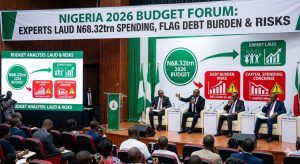
Economic experts have applauded President Bola Ahmed Tinubu’s signing of the N68.32 trillion 2026 Appropriation Act, even as some warned that, while the record budget size and strong capital allocation signal ambition, rising debt service costs and weak execution of previous budgets could undermine expected outcomes.
The 2026 budget provides N15.8 trillion for debt servicing, N15.4 trillion for recurrent expenditure, N4.799 trillion for statutory transfers, and N32.2 trillion, about 50 per cent for capital expenditure.
The development comes alongside an extension of the 2025 budget implementation, particularly, its capital component, from March 31 to June 30, 2026, raising fresh concerns about budget performance and fiscal discipline.
Analysts said, the allocation of N15.8 trillion to debt servicing, about 23 per cent of total expenditure, remains a major red flag.
“This is still a heavy burden. When you are spending almost a quarter of your budget on debt service, it limits fiscal space for development and social investment. When you combine recurrent spending and debt service, you are already consuming a large portion of the budget.
“That leaves limited room for discretionary and transformative spending,” noted a financial economist at Nnamdi Azikiwe University, Dr. Felix Echekoba.
Echekoba added that, macroeconomic stability will be critical. “If inflation, exchange rate volatility, and revenue challenges persist, they could undermine the effectiveness of the budget,” he said.
Nigeria’s public debt has risen steadily in recent years, crossing N120 trillion by 2025, with debt service-to-revenue ratios previously exceeding 90 per cent, according to fiscal data.
Commenting, the chief executive at the Center for the Promotion of Private Enterprise (CPPE), Dr. Muda Yusuf, said while the government’s intention to balance spending is commendable, but the sustainability question remains.
“The key issue is not just the size of the budget, but how much revenue the government is generating. If revenue underperforms, debt servicing will crowd out critical spending,” he cautioned..
“The budget is ambitious, but ambition must be matched with discipline. Without strong revenue mobilisation and efficient execution, the outcomes may fall short,” Yusuf said.
He added that, success will depend on more than intentions.
“The budget can work, but only if there is strict adherence to fiscal discipline, improved revenue generation, and a serious commitment to execution,” said another economist, Dayo Johnson.
The N32.2 trillion capital allocation, which is roughly half of the total budget, has been widely praised as a positive signal for infrastructure and growth.
“This is one of the most ambitious capital budgets Nigeria has ever seen. If implemented effectively, it could boost productivity, create jobs, and support economic expansion,” said a Lagos-based investment analyst, Kayode Sobowale.
However, experts caution that Nigeria’s long-standing challenge is not budget design but implementation.
The extension of the 2025 budget is seen as evidence of persistent execution gaps.

“Extending the 2025 capital budget tells you that implementation has been slow. We have seen this pattern repeatedly; capital releases are delayed, and projects spill into the next fiscal cycle,” stated Zakari Mohammed, a lecturer at Auchi Polytechnic.
Historically, Nigeria’s capital budget performance has averaged between 50 and 70 per cent, with many projects underfunded or abandoned due to revenue shortfalls and bureaucratic delaand
Despite the strong capital allocation, analysts note that recurrent expenditure of N15.4 trillion remains substantial, reflecting the high cost of governance.
Mohammed argued that without significant reforms to reduce the cost of governance, the impact of increased capital spending may be diluted.
The extension of the 2025 budget has also triggered scrutiny of its performance.
Analysts said, the move suggests that key infrastructure projects were not completed within the original timeline.
“Budget extensions are often a sign of underperformance. It indicates delays in fund releases, procurement challenges, or capacity constraints within MDAs,” said Shola Oduode, a public finance expert.
Data from previous fiscal cycles show that capital releases are often back loaded toward the end of the year, limiting effective utilisation.
Oduode added that the 2026 budget is broadly well-structured but faces significant risks.
On the positive side, the increased capital allocation aligns with the government’s growth objectives, while the emphasis on infrastructure and development spending could stimulate economic activity.
However, concerns remain around revenue assumptions, debt sustainability, and implementation capacity.
The federal government has pledged disciplined and transparent implementation, with a focus on value for money and timely project delivery.
As Nigeria embarks on its largest-ever spending plan, the coming months will test whether increased allocations can translate into tangible improvements in infrastructure, jobs, and living standards—or whether familiar challenges will once again limit impact.
Meanwhile, President Bola Ahmed Tinubu had, at the weekend, assented to the 2026 Appropriation Bill, which provides for an aggregate expenditure of N68.32 trillion.
This is even as he has also signed the bill extending implementation period for the 2025 budget from March 31, 2026, to June 30, 2026.
The N68.32 trillion budget for this year earmarks N4.799 trillion for statutory transfers and N15.8 trillion for debt service.
It allocates N15.4 trillion to recurrent expenditure and N32.2 trillion to the Development Fund for Capital Expenditure.
With capital expenditure accounting for about 50 per cent, the 2026 budget underscores the administration’s continued commitment to economic stability, national security, infrastructure development, and inclusive growth.
The allocations, according tona statement by the Special Adviser to the President on Information & Strategy, Bayo Onanuga, reflect a strategic balance between statutory obligations, debt servicing, recurrent expenditure and capital investments critical to driving productivity and improving the quality of life for Nigerians.
Additionally, the President has assented to the Appropriation (Repeal and Enactment) (Amendment) Bill, 2026, which extends the implementation period of the capital component of the 2025 Appropriation Act from March 31, 2026, to June 30, 2026.





