
FG Begins Journey To Drive Non-Oil Revenue Through Taxes– Analysts
…As ‘Tax Man’, Oyedele, Resumes As Finance Minister
BY CEES HARMON
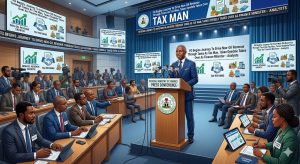
The resumption of Mr. Taiwo Oyedele popularly called the ‘Tax Man’ as the new Finance Minister and Coordinating Minisiter of the Economy, shows that, the federal.government is priortising Tax as the next major non-oil revenue earner in years to come, says analysts.
To them, Nigeria’s fiscal policy direction is facing renewed scrutiny following the reported removal of Wale Edun and the emergence of Oyedele, a leading figure in tax policy reform, in a key economic management role may now signal a stronger pivot toward tax-driven revenue.
The development is being interpreted by economists as a shift in emphasis from oil-dependent earnings to domestic revenue mobilisation, at a time when government finances remain under pressure.
Nigeria’s public debt has climbed above N120trillion in recent years, while debt servicing has consistently consumed a large share of federally collected revenue, in some periods exceeding 70 to 90 per cent.
With the country’s tax-to-GDP ratio still hovering around 10 per cent, well below the African average—analysts say the appointment of a tax specialist reflects a deliberate strategy to expand the government’s revenue base. Oyedele, who previously led fiscal reform efforts, has advocated raising the ratio to about 18 per cent within a few years through improved compliance, simplification of tax processes, and expansion of the tax net.
The chief executive of the Center for the Promotion of Private Enterprise (CPPE), Dr. Muda Yusuf said, the move points to a recognition that oil revenues can no longer sustain government spending needs.
“The volatility in oil prices and production challenges have made it clear that Nigeria must rely more on stable, predictable sources of revenue,” he said.
Nigeria’s oil earnings, which historically accounted for a significant portion of government revenue, have been weakened by fluctuating global prices, production shortfalls, and pipeline vandalism.
Although recent reforms have improved foreign exchange inflows and fiscal transparency, analysts say oil income alone is insufficient to fund an expanding national budget.
Financial analyst, Dr. Seun Olaleye, said the shift toward taxation is both necessary and inevitable. “You cannot run a modern economy on oil revenue alone. The real issue is how to build a sustainable revenue framework, and that means improving tax collection,” he said.

However, the implications for ordinary Nigerians could be significant. With inflation having peaked near 35 per cent in 2024 and still elevated despite moderation, households are already grappling with declining purchasing power. Analysts warned that, more aggressive tax enforcement, if not carefully managed, could further strain consumers and small businesses.
“There is a risk of tightening the noose on a struggling population. If incomes are not rising, and you are expanding the tax net, people will feel the pressure immediately,” noted a Lagos-based tax consultant, Bayo Johnson.
The informal sector, which accounts for a large share of Nigeria’s economy, is expected to be a key target of reforms. While formalising this segment could improve access to credit and broaden economic inclusion, experts said, it must be approached cautiously to avoid stifling micro-enterprises.
For businesses, the policy direction presents a mixed outlook. On one hand, improved tax administration and reduced multiplicity of taxes could enhance the ease of doing business. On the other, stricter compliance requirements and potential increases in effective tax rates could raise operating costs, particularly for small and medium-sized enterprises.
Analysts also noted that the success of any tax-focused strategy will depend heavily on public trust. Nigeria has long struggled with low compliance partly due to perceptions of poor service delivery and weak accountability in the use of public funds.
“People are more willing to pay taxes when they see value. If citizens do not see improvements in infrastructure, healthcare, and education, resistance to taxation will remain high,” said a financial economist at Auchi Polytechnic, Zakari Mohammed.
The broader implication is a potential restructuring of Nigeria’s revenue profile, with non-oil sources such as value-added tax, company income tax, and personal income tax playing a more dominant role. While oil will remain important, experts say its share in government revenue is likely to decline over time as reforms take hold.
At the same time, execution risks remain significant. Nigeria’s tax system is often described as fragmented, with overlapping authorities at federal, state, and local levels. Efforts to streamline administration and improve efficiency have faced institutional and political challenges in the past.
Mohammed said the policy signal is clear, but implementation will determine outcomes.
“The direction is right, but execution is everything. Without coordination, transparency, and efficiency, the expected gains may not materialise,” he said.
As the government seeks to stabilise public finances and fund ambitious spending plans, the shift toward tax revenue could mark a turning point in Nigeria’s economic management. But for citizens and businesses, the immediate concern will be whether the new approach delivers tangible benefits or simply adds to existing financial pressures.





