
Nigerians Switch To Charcoal, Firewood As Cooking Gas Hits N1,500 Per KG
BY CEES HARMON and GBENGA ELIJAH, Abuja
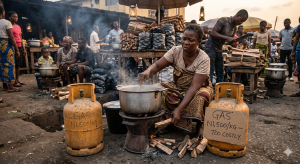
The rising price of cooking gas in which a Kilogramme (Kg) now goes for between N1, 300 and N1,500, has triggered most Nigerians to now switch to charcoal and firewood for cooking, BUSINESSDIARY can now reveal.
BUSINESSDIARY Correspndents who went round some gas stations in Lagos, Ogun, Ekiti and Abuja metropolis and suburbs at the weekend noticed that the price of cooking gas jumped last week from N1, 000 to about N1, 500 per kg at the weekend.
While our Abuja correspondent learnt that gas stations now sell at N1,300 with retailers selling higher within the Federal Capital Territory (FCT) after it moved from N1, 000 in the last two weeks, Lagos and Ogun States’ gas stations were selling between N1, 300 and N1, 500 depending on the areas with retailers selling as high as N1,700 in suburb.
There are indications that the situation might worsen this week as scarcity hit the local market, arising from ongoing crisis in Middle-East.
To this end, some Nigerinas have now returned to charcoal and firewood for cooking, atleast for now, until the situation improves.
In a one-room apartment tucked inside a crowded suburb of Lagos, 34-year-old mother of three, Ngozi Uwem, watches her cooking gas cylinder like a rationed lifeline. Just three months ago, she refilled it for N1,100. Today, the price has climbed to N1,500.
She told this medium, “I used to cook with gas every day. Now, I save it for when I’m in a hurry. The rest of the time, it’s charcoal. It’s cheaper, but it’s stressful,” as she crouched beside a smoking charcoal stove outside her doorway.
Across low-income communities in Nigeria, the sharp rise in the price of liquefied petroleum gas (LPG) is quietly forcing a reversal of years of progress toward cleaner cooking fuels. For millions of households already grappling with rising food prices and transport costs, the additional N400 per refill is enough to tip the balance.
In the densely populated area of Ajegunle, single father, Raphael John said, the increase has changed not just how he cooks, but how his children eat.
“Before, I could quickly make rice or beans in the morning before work. Now, I tell my children to manage bread or leftovers because I don’t want to waste gas. Sometimes we skip hot meals entirely,” he said.
For small business owners, the impact is even more immediate. At a roadside buka in Agege, food vendor, Musa Abdullahi said, his daily operations have been disrupted.
“Gas is faster and cleaner, but now it’s too expensive. I had to switch. But firewood brings smoke, and customers complain. If I increase prices, they won’t come. So I’m stuck,” he said, stirring a pot over firewood.

A similar dilemma confronts Esther Ogunleye, who fries akara near a busy bus stop in Iyana Iba. She said, the price hike has cut into her already thin margins, saying, “I used to refill twice a week. Now I stretch it to once. When the gas finishes, I use charcoal. But charcoal takes longer, and customers don’t like waiting.”
Beyond the economic strain, health concerns are beginning to surface. In a small clinic in an Alimosho, community in Lagos, health worker, Amina Bello said, she has noticed a rise in respiratory complaints.
“More women are coming in with coughs and eye irritation,” she says. “When people switch back to firewood and (charcoal), the smoke affects them, especially in poorly ventilated spaces.”
For families like that of 62-year-old widow Mama Sade in Oju Ore, Ogun State, the shift feels like a step backward in time.
“We were happy when gas became common. It made life easier. Now we are going back to firewood like before. It is not good for old people like me, but what choice do we have?” she recalled.
Energy analysts said, the increase in LPG prices is tied to a combination of foreign exchange challenges, supply bottlenecks, and global market pressures. Despite being rich in natural gas, Nigeria still relies heavily on market dynamics that make domestic prices volatile.
But for ordinary Nigerians, these macroeconomic explanations offer little comfort.
In a student hostel in Surulere, 21-year-old undergraduate, Tunde Balogun said, he and his roommates have adopted a strict cooking schedule to manage costs.
“Now we contribute money and cook once a day. If the gas finishes before the week ends, we switch to noodles with electric kettles or just buy cheap food outside,” he said.
Even in peri-urban areas, where firewood is more accessible, the cost of alternatives is rising. In Magboro, Ogun State, trader Funke Adeyemi said, charcoal prices have also increased due to higher demand. “Everybody is running away from gas now. So, charcoal sellers are also increasing their prices. There is no escape,” she said.
In Ekiti State, Seun Owoeye fans her charcoal stove as thick smoke curls into the air. Her youngest child coughs lightly in the background.
“Gas is better. It’s clean, it’s fast, and it’s safe. But now, it feels like something only rich people can afford,” she said quietly.
As Nigeria navigates its broader economic challenges, the rising cost of cooking gas is doing more than straining household budgets, it is reshaping daily routines, altering diets, and pushing vulnerable families toward choices that carry long-term health and environmental risks.
For many, the kitchen has become yet another frontline in the struggle to survive.
The current week, according to experts, may see further price resurgence as the government battle to salvage the situation and circulate the product widely in its local market.





