
FG, States Mum As Traders Turn Rail Tracks Into Markets
BY CEES HARMON
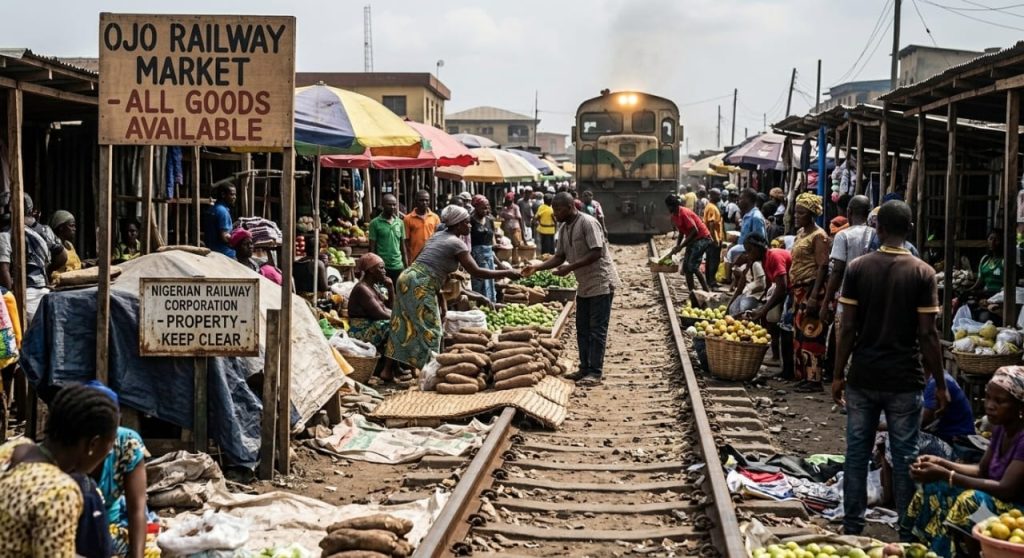
Despite repeated warnings about the dangers posed to rail transportation and public safety, traders and roadside vendors across several Nigerian cities have continued to encroach on railway corridors, converting sections of rail tracks into makeshift markets, while federal and state authorities appear to be taking little action to stem the trend.
Findings by BUSINESSDIARY show that, railway corridors in Lagos, Kano, Ibadan, Aba, Port Harcourt, Kaduna and other urban centres are increasingly being occupied by traders who display wares ranging from food items and clothing to household goods directly on or beside rail lines.
The development has raised concerns among transportation experts, safety advocates and railway authorities, who warned that, the practice threatens lives, disrupts rail operations and undermines ongoing efforts to revitalise Nigeria’s rail transport system.
Officials of the Nigerian Railway Corporation (NRC) said, the challenge has persisted for decades but has worsened in recent years due to rapid urbanisation, population growth, inadequate market infrastructure and weak enforcement of regulations governing railway right-of-way.
Speaking on the issue, a senior official of the NRC, who prefered anonymity described the situation as “a serious safety hazard.”
“Railway corridors are not markets. They are designated transportation infrastructure. Whenever traders occupy these areas, they expose themselves, their customers and rail passengers to significant risks,” the official said.
The NRC has repeatedly cautioned against unauthorised activities within railway corridors, stressing that, trains require considerable distances to stop once in motion and that any obstruction along the tracks could result in fatalities or accidents.
Industry analysts noted that, Nigeria has invested hundreds of billions of naira in rail infrastructure over the past decade, including the Lagos-Ibadan, Abuja-Kaduna and Warri-Itakpe standard-gauge rail lines, as part of efforts to reduce pressure on roads and improve transportation efficiency.
According to transportation economist, Dr. Segun Ahmed, the encroachment on railway property reflects broader governance and urban planning challenges.
“Many cities have experienced significant population growth without corresponding expansion in formal market facilities. As a result, informal traders occupy every available space, including rail corridors. Unfortunately, enforcement has been inconsistent,” he said.

The situation is particularly pronounced in densely populated urban centres where traders said, they have few alternatives.
At a railway corridor market in Lagos, a trader, Amina Sule said, economic hardship had pushed many vendors onto the tracks.
“People are struggling to survive. Market stalls are expensive and many of us cannot afford them. We know it is not ideal, but we need somewhere to sell,” she said.
Another trader, Chinedu Okafor, argued that, authorities should provide alternative locations before enforcing eviction orders.
“If government wants us to leave, they should first provide affordable market spaces. Simply chasing people away will not solve the problem,” he said.
However, railway safety experts insisted that, economic considerations cannot justify the risks.
Data from transportation authorities indicate that rail-related accidents involving trespassers remain a recurring challenge in many countries. Experts warned that, increased rail traffic under Nigeria’s railway modernisation programme could heighten the danger if encroachment continues unchecked.
President of the Chartered Institute of Transport Administration of Nigeria, Dr. Segun Obayendo said, railway corridors should be treated as critical national infrastructure.
“Encroachment on rail lines undermines safety, operational efficiency and infrastructure protection. It requires coordinated action from federal, state and local authorities,” he said.
Stakeholders have also questioned the apparent silence of many state governments despite the growing problem.
Urban development experts argued that, state governments have primary responsibility for market development, environmental sanitation and land-use enforcement within their jurisdictions.
“The failure to address informal trading along rail tracks points to a governance gap. State governments cannot leave the burden entirely to the railway corporation,” said urban planner, Mrs. Adebimpe Fashola.
The NRC said it continues to engage communities and conduct public awareness campaigns to discourage illegal occupation of railway property. However, officials acknowledged that sustained enforcement and intergovernmental cooperation would be necessary to achieve lasting results.
As Nigeria seeks to expand rail transportation as part of its economic diversification and infrastructure development agenda, observers say protecting railway corridors from encroachment will be critical to ensuring the safety, efficiency and sustainability of the country’s growing rail network.
For now, however, many sections of railway tracks across the country continue to serve a dual purpose as transport corridors for trains and as informal marketplaces for traders seeking livelihoods amid difficult economic conditions.





