
Incessant Transport Fare Hike Raises Prices Of Goods, Foodstuffs
BY CEES HARMON
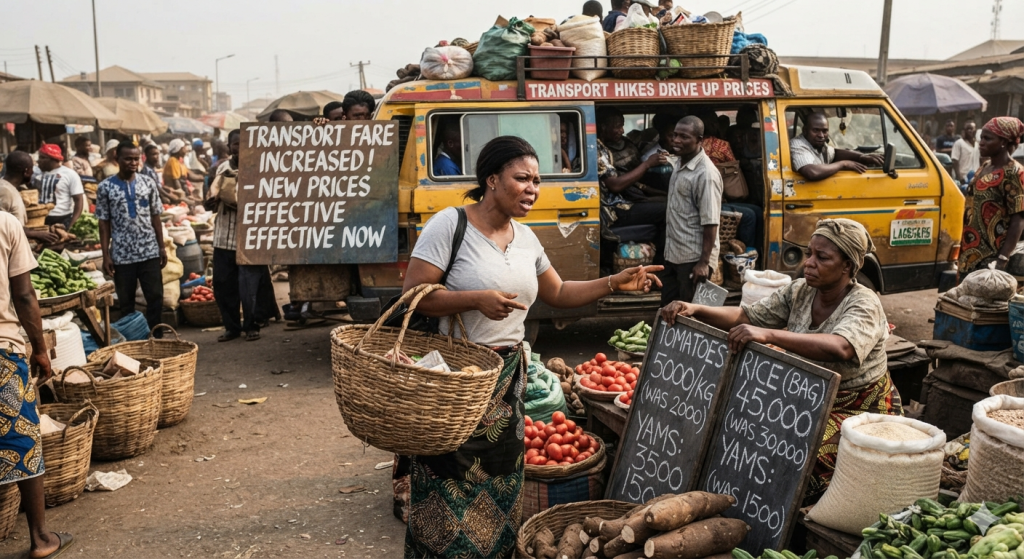
The high cost of transporting goods across Nigeria is increasingly emerging as a major drag on economic competitiveness, with businesses and economists warning that, poor infrastructure, insecurity and an overdependence on road transport are driving up the prices of food, manufactured products and other essential commodities.
Stakeholders said, the country’s logistics inefficiencies are eroding profit margins for businesses, worsening inflation and undermining Nigeria’s ability to compete with regional peers.
According to the National Bureau of Statistics (NBS), the transportation and storage sector contributed about 1.3 per cent to Nigeria’s Gross Domestic Product (GDP) in recent years despite the sector’s strategic importance to economic growth.
Industry experts argue that, the figure reflects structural inefficiencies in a country where more than 90 per cent of freight movement depends on roads.
The Manufacturers Association of Nigeria (MAN) has repeatedly warned that poor logistics infrastructure remains one of the biggest challenges confronting manufacturers.
President of MAN, Francis Meshioye said, manufacturers continue to grapple with rising haulage costs arising from poor road conditions, insecurity and multiple checkpoints along major transport corridors.
“Logistics costs have become a significant component of production costs. These challenges ultimately make Nigerian products more expensive and less competitive,” he said.
Stakeholders said, the Lagos-Ibadan Expressway, Apapa port corridor, Abuja-Kaduna highway, East-West Road and several agricultural routes linking northern food-producing states to southern markets have become expensive trade corridors due to delays and infrastructure bottlenecks.
According to the Centre for the Promotion of Private Enterprise (CPPE), logistics costs in Nigeria account for between 30 and 40 per cent of product costs in some sectors, compared to considerably lower levels in more efficient economies.
The chief executive officer of CPPE, Dr. Muda Yusuf said, Nigeria’s excessive dependence on road transportation has become an economic burden.

“You cannot build a globally competitive economy when virtually every item, from cement to food and industrial inputs, is transported by road. Efficient economies rely on integrated transport systems comprising rail, ports, roads and inland waterways,” Yusuf said.
The problem is particularly severe in agriculture. Farm produce transported from states such as Kano, Kaduna, Benue, Plateau and Taraba often arrives at urban centres with significantly higher prices because transport costs are embedded in the final selling price.
Insecurity has compounded the challenge.
Freight operators say they now spend more on private security arrangements, insurance and contingency planning to navigate routes vulnerable to banditry, kidnappings and cargo theft.
Meanwhile, the national president of the Association of Maritime Truck Owners, Remi Ogungbemi said, operators also contend with prolonged delays at ports and highways.
“The amount of time trucks spend on some routes has economic consequences. Delays increase fuel consumption, operating costs and delivery times,” he said.
The country’s decades-long underinvestment in rail infrastructure has further limited alternatives for cargo movement.
Although rail projects such as the Lagos-Ibadan and Warri-Itakpe corridors are operational, analysts say freight movement by rail remains too limited to substantially reduce pressure on roads.
A development economist, Professor Tayo Bello said, transportation inefficiency has become a hidden tax on the economy.
“Transportation is the bloodstream of economic activity. Every inefficiency eventually translates into higher inflation and lower productivity,” he said.
The World Bank has also repeatedly emphasised that, improving transport infrastructure could significantly lower the cost of doing business and strengthen Nigeria’s competitiveness under the African Continental Free Trade Area (AfCFTA).
Economists said, Nigeria’s aspiration to become a regional manufacturing hub will remain difficult to achieve unless the country reduces the cost of moving goods.
Financial economist at Auchi Polytechnic, Zakari Mohammed, called for accelerated investments in rail freight systems, inland waterways, modern ports and strategic economic corridors.
Analysts warned that, until such reforms are implemented, Nigerian consumers will continue to bear the cost of inefficiencies through higher prices for food, manufactured products and everyday goods.






Adult can be accessed through secure and reputable websites.
Explore trusted platforms for quality content.
my web site buy xanax without prescrition