
Lawal Commissions ZAM Lithium Processing Plant, Targets 2,000 Jobs In Zamfara
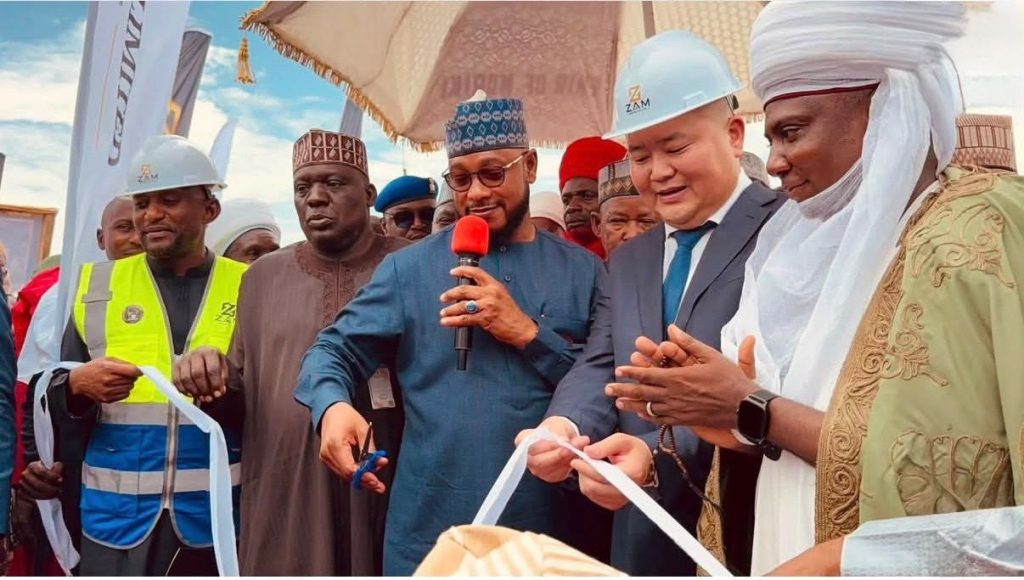
Zamfara State governor, Dr Dauda Lawal has officially commissioned a multi-billion-naira lithium mining and processing plant located in Boko village, within the Moriki Emirate of Kaura Namonda Local Government Area.
The state-of-the-art facility, which represents an investment of over 200 million US dollars, marks a historic turning point in the state’s quest to move beyond raw mineral exportation and embrace full-scale local processing, value addition and industrial development.
The commissioning ceremony drew a large gathering of traditional rulers, government officials, investors, community leaders and mining industry stakeholders who came to witness what the governor described as the dawn of a new era for Zamfara’s solid minerals sector.
The lithium processing plant is a flagship initiative under Governor Lawal’s broader economic diversification agenda, designed to ensure that Zamfara’s abundant natural resources are not only extracted but also processed and utilised in a manner that generates substantial revenue for the state, creates employment opportunities and stimulates homegrown industrial growth.
By establishing local processing capacity, the plant will significantly reduce the export of raw lithium and other minerals, thereby retaining more value within the state and the nation at large.
This strategic shift is expected to improve local utilisation of lithium and its entire value chain, positioning Zamfara as a key player in the global renewable energy and technology-driven economy, where lithium is increasingly in high demand for electric vehicle batteries, modern electronics and industrial applications.
The ZAM Processing Plant is a joint venture involving Zam Mining Coal Limited in collaboration with the Zamfara State Government, Bima Mines and Jinlide Mining Co. Ltd. This partnership has further demonstrated Governor Lawas unwavering commitment to restoring investor confidence and signalling that Zamfara State is fully open for business and ready to collaborate with credible investors in developing critical aspects of its economic infrastructure.

The plant will explore, mine, process and utilise the state’s rich mineral endowments, which include not only lithium but also gold, copper, and iron ore, thereby creating a comprehensive mining value chain that spans extraction, processing and industrial application.
The facility is equipped with the best advanced technological processing machines available globally, enabling it to scale up production to an impressive 6,000 tons of raw materials daily and over 2,000,000 tons annually.
In terms of employment, the project is set to generate approximately 2,000 direct and indirect jobs, with priority given to qualified workers and residents from the host communities in Zamfara State.
In his remarks at the commissioning ceremony, Governor Lawal delivered an impassioned address in which he described the event as a symbol of a new beginning and a testament to the potential of responsible investment in the solid minerals sector.
He emphasised that, Zamfara is a haven of vast mineral deposits and that the state government has a moral and economic obligation to harness these God-given resources in a manner that improves the lives of its people.
The Governor further noted that, the global economy is changing rapidly, driven by the future of renewable energy, electric vehicles, modern technology and industrial transformation and that Zamfara must position itself to become an active participant in this global shift.
With its vast deposits of raw materials and minerals, the state must not only extract but also explore the entire value chain, from mining to processing and manufacturing. He stressed that the establishment of the ZAM Processing Plant is entirely consistent with this vision of moving towards local processing, value addition, skill development and industrial growth.
He also commended the company for its meaningful corporate social responsibility commitments, which ensure that host communities remain partners in progress and beneficiaries of the development of resources found in their environment.





