
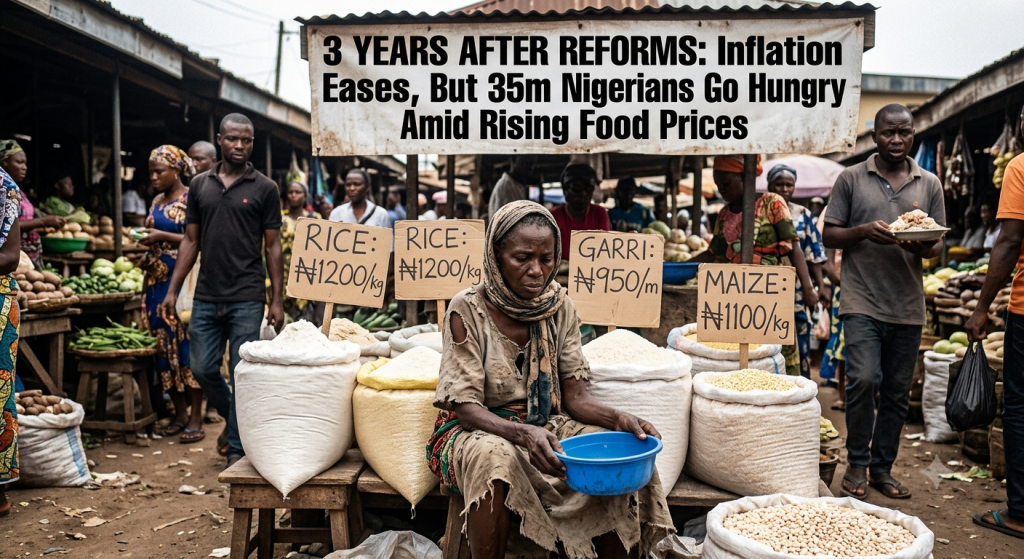
3 YEARS AFTER REFORMS: Inflation Eases, But 35m Nigerians Go Hungry Amid Rising Food Prices
BY CEES HARMON, SAMUEL OPEYEMI, Lagos And GBENGA ELIJAH, Abuja.
Three years after President Bola Tinubu embarked on one of Nigeria’s most ambitious economic reform programmes in decades, the country’s macroeconomic indicators are beginning to show signs of stabilisation.
However, the latest inflation figures suggest that the benefits of the reforms are yet to be fully felt by millions of Nigerians, as food prices continue to starve an estimated 35million Nigerians at the grassroots level.
A United Nations (UN) reports in January 2026 estimated 34.7 million Nigerians face acute food insecurity, arising from food inflation, insecurity, low disposable income, among others.
The June 2026 Consumer Price Index (CPI) released by the National Bureau of Statistics (NBS) presents a mixed picture of an economy gradually finding its footing while still grappling with deep-rooted structural challenges.
Headline inflation moderated marginally to 15.91 per cent in June from 15.93 per cent in May, while month-on-month inflation slowed from 1.75 per cent to 1.66 per cent. More encouragingly, core inflation, which excludes volatile agricultural produce and energy prices, continued its downward trend, suggesting that pressures from imported inflation and exchange-rate volatility are easing.
These developments point to growing macroeconomic stability following reforms that included the removal of petrol subsidies, liberalisation of the foreign exchange market, fiscal adjustments and efforts to restore investor confidence.
Yet beneath the improving headline figures lies a more troubling reality.
Food inflation, the most important measure affecting ordinary Nigerians, reversed its earlier moderation. Year-on-year food inflation increased to 17.52 per cent in June from 17.43 per cent in May, while month-on-month food inflation accelerated sharply from 2.98 per cent to 3.75 per cent, the highest monthly increase recorded in several months.
For many households, this means the cost of basic staples continues to rise despite improvements in macroeconomic indicators.
Economic analysts said, some of the administration’s reforms are beginning to produce measurable outcomes.
The liberalisation of the foreign exchange market has improved dollar liquidity compared with the severe shortages experienced in 2022 and 2023.
Manufacturers and import-dependent businesses have reported relatively easier access to foreign exchange, while exchange-rate volatility has moderated significantly.
Government fiscal reforms have also reduced distortions associated with fuel subsidies and widened the fiscal space for public investment.
The chief executive officer(CEO) of the Centre for the Promotion of Private Enterprise (CPPE), Dr. Muda Yusuf said, the moderation in headline inflation demonstrates that macroeconomic stability is gradually taking root.
“The continued easing of core inflation is encouraging. It reflects the positive impact of exchange-rate stability and improved macroeconomic conditions in moderating imported inflation and broader non-food price pressures,” he said.
According to Yusuf, the latest figures indicate that headline inflation has largely plateaued, suggesting that the economy may be entering a more stable phase after several years of severe macroeconomic turbulence.
CPPE said, renewed acceleration in food inflation has important economic and social consequences.
One of the most significant conclusions from the CPPE analysis, is that, Nigeria’s inflation problem is increasingly structural rather than monetary. The think tank estimates that food, transportation, housing, utilities and energy account for approximately 72 per cent of current inflationary pressures.
This suggests that further increases in interest rates alone may have limited impact on inflation unless accompanied by reforms that address supply-side bottlenecks.
Meanwhile, across markets, transport parks and business districts, many citizens say the cost of living continues to outpace their incomes despite the moderation in headline inflation.
Financial economist at Nnamdi Azikiwe University, Dr. FeLix Echekoba has similarly argued that the reforms were inevitable after years of economic distortions, noting that their success should be assessed over the medium to long term rather than by immediate outcomes.
According to Echekoba, the current phase represents an adjustment period during which macroeconomic fundamentals are improving, but the benefits have yet to fully filter through to households and businesses.
Despite these gains, economists say the reforms have not yet translated into meaningful relief for many Nigerians because food remains the single largest component of household expenditure.
Nigerians Groan
Meanwhile, Nigerians who spoke to *BUSINESSDIARY* at the weekend lamented a serious rise in cost of living, especially, food, transport and housing, denying the impact of reforms progress government declared.
A food trader at Wuse Market in Abuja, Aisha Ibrahim said, the prices of staples such as rice, beans and tomatoes remain beyond the reach of many customers.
“Customers come to price food and leave without buying. Even when prices stop rising as fast as before, they are still too high for most families. People are buying smaller quantities because their salaries have not increased, ” she said.
Speaking to *BUSINESSDIARY* , Mr. Abraham, a resident of Kurudu, Abuja, described the past seven months as extremely challenging for ordinary Nigerians. According to him, the continuous increase in transportation fares, largely driven by the high cost of fuel, has triggered a sharp rise in the prices of goods and services.

“Transportation has become very expensive, and this has affected almost everything. The government should urgently address the high cost of fuel and improve transportation services to reduce the burden on citizens,” he said.
Similarly, Mrs. Hannah, who resides in Zuba, Abuja said, the economic situation has worsened since the beginning of the year. She noted that, many families now struggle to afford two meals a day because of the persistent increase in food prices and other essential commodities.
She also expressed concern over unemployment and the prevalence of low-paying jobs, urging the government to introduce policies that will improve job opportunities and reduce the cost of living.
Another respondent, Mr. Olumide, a contractor based in Kuje, Abuja, lamented the slowdown in business activities. He disclosed that he has been unable to secure any contract for several months, blaming the situation on reduced government projects and the increasing focus on political activities ahead of elections.
According to him, many businesses are finding it difficult to survive under the current economic realities, with contractors and small business owners among the hardest hit.
However, not all respondents expressed negative views. Mrs. Hassana, a resident of Gwagwa, Abuja, commended the Federal Government and the FCT Administration for ongoing road infrastructure development across the capital city.
She said, the improved road network has reduced traffic congestion, shortened travel time, and made the movement of goods and services easier. She added that, the improved infrastructure has enhanced economic activities in some parts of Abuja and deserves recognition.
In Lagos, commercial bus driver Kehinde Adeyemi said, transport fares remain elevated despite improvements in fuel supply.
“Fuel is more available now than before, and that is good, but spare parts, engine oil and vehicle maintenance have all become more expensive. We still have to charge passengers more just to survive, ” he said.
For Blessing Adeyemi, a mother of three in Lagos, feeding her family has become increasingly difficult.
According to her, the prices of staple foods have risen sharply while her income has remained unchanged.
“Back in January, I could still manage to stock up the house with food items for the family. Now, prices have doubled. My salary hasn’t changed, so we eat less and manage what we have at home, ” she said.
Another food trader Ibrahim Adisa said, soaring prices have weakened consumers’ purchasing power, forcing many customers to buy only what they can afford.
“Customers complain every day. Spaghetti and tomatoes are far more expensive than they were at the start of the year. People buy in smaller quantities, and business is slower,” Musa said.
Similarly, Adisa Nojeem, a civil servant said rising transport and food costs have significantly eroded his disposable income.
“Transport costs have gone up since fuel prices rose. By the time I pay for commuting and food, there’s nothing left. Disposable income is worse now than in January,” she said.
For Grace Okonkwo, a civil servant in Enugu, feeding her family has become her greatest financial challenge.
“My salary is the same, but almost everything I buy has become more expensive over the past three years. School fees, transport, electricity and food now take almost all my income. You hear that inflation is coming down, but it doesn’t feel that way at home,” said Okonkwo.
Small business owner, Suleiman Abdullahi, who operates a furniture workshop in Lagos, acknowledged that access to foreign exchange has improved but said, production costs remain prohibitively high.
“Some imported materials are easier to source now, but electricity, diesel and transportation are still very expensive. Those costs are transferred to customers, and many people can no longer afford locally made furniture, ”
In Port Harcourt, accountant Chinyere Eze said, she believes the reforms may eventually succeed but urged government to provide stronger support for households during the transition.
“If the reforms are necessary, then government should also help ordinary people cope with the hardship. People need to see improvements in their daily lives, not just hear about better economic indicators,” stated Eze.
Similarly, university graduate Emmanuel Yusuf, who is seeking employment in Kaduna, said the greatest expectation from the reforms is job creation.
“The economy may be improving on paper, but many young people are still looking for jobs. The real success of these reforms will be measured by whether companies begin to employ more people,” he said.
For Ngozi Nwafor, who runs a neighbourhood grocery shop in Ota, Ogun State consumer spending has weakened considerably.
“People now buy one loaf of bread instead of two, half paint of rice instead of a full measure. Business is slower because household incomes have not caught up with rising prices.”
These sentiments underscore a recurring theme among economists: while macroeconomic indicators are beginning to improve, public confidence in the reform programme will ultimately depend on whether the gains translate into lower food prices, stronger purchasing power, increased employment and higher living standards for ordinary Nigerians.
Although government data points to improvements in macroeconomic indicators such as GDP growth, foreign exchange stability and external reserves, many Nigerians say those gains have yet to translate into lower prices or improved living standards.
For many households, the consensus is that while the economy may appear more stable on paper, the realities of higher food prices, transport costs and stagnant incomes continue to make daily life more difficult than it was at the beginning of the year.





