
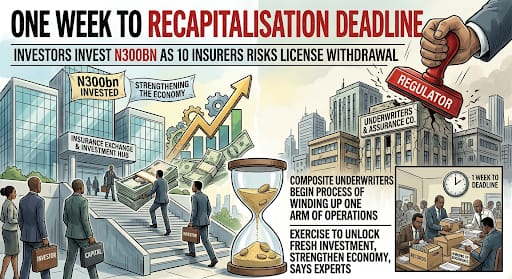
ONE WEEK TO RECAPITALISATION DEADLINE: Investors Invest N300bn As 10 Insurers Risks License Withdrawal
…. Composite Underwriters Begin Process of Winding Up One Arm Of Operations
.…… Exercise To Unlock Fresh Investment, Strengthen Economy, Says Experts
BY ZAKA KHALIQ and CEES HARMON
With one week to deadline given to insurance companies to recapitalise to a new capital threshold, the industry has attracted about N300billion fresh capital, BUSINESSDIARY learnt.
Similarly, investigation revealed that over 40 insurance companies have had their capital verified by the National Insurance Commission (NAICOM) while the last batch of the capital verification exercise is taking place between today and tomorrow.
However, BUSINESSDIARY learnt that about 10 underwriters are still yet to make 10 per cent statutory deposits with the Central Bank of Nigeria(CBN) which is a key requirement in the ongoing exercise. The affected underwriters are still far away in their journey to recapitalise, casting doubt on their ability to meet July 31st, 2026 deadline which is just a week away from now.
Some of the companies at risk of losing their licenses are those struggling in the market prior to the exercise as they have backlog of financial statements that are yet to be submitted to regulators, mounting unpaid claims, struggling to honour financial obligations and even payment of salaries as and when due.
Although, BUSINESSDIARY have the list of these companies, we could not mention their names for fear customers could besiege them and eventually lead to their collapse.
While the insurance industry regulator have suggested marriage among these companies to scale through this hurdle, they are not open to this, believing they can still convince investors to invest in them prior to deadline.
Meanwhile, some of the 29 insurance companies with composite license are relinquishing one arm of the business in a move to scale through the ongoing exercise as the Nigerian Insurance Industry Reform Act(NIIRA) 2025 didn’t recognise composite license. So, composite insurers were treated as having two companies under the exercise and must recapitalise them individually.
Moreover, NIIRA has given these companies five years to wind up one of the two businesses they operate.
Recall that NAICOM had earlier increased the minimum capital thresholds across the industry. Life companies had their capital increased from N2billion to N10 billion; Non-life underwriters from N3billion to N15billion; Composite insurers from N5billion to N25 billion and Reinsurers from N10billion to N35 billion, this, translating to about 400 per cent capital increase with a deadline of July 30, 2026.
Some of the companies that have met the regulatory expectations by rasing the required funding in this exercise include; Sovereign Trust Insurance (STI) Plc, Lasaco Assurance Plc, Great Nigeria Insurance (GNI), NEM Insurance Plc, Mutual Benefits Assurance, Cornerstone Insurance, Leadway Assurance, AIICO Insurance, Heir Insurance Group, eMPLE, Consolidated Hallmark Insurance, NSIA Insurance, Rex Insurance, SanlamAllianz, Universal Insurance, Unitrust Insurance, Sunu Assurances, among others.
Investigations revealed that, about 21 underwriting firms listed on the Nigerian Stock Exchange (NGX) have approached their shareholders and investors and have raised over N170billion cumulatively while about 30 of the 40 unlisted underwriting firms seem to have raised approximately over N130billion cumulatively, bringing the expected investments in the sector to over N300billion.
While Lasaco Assurance raised about N25billion, Sovereign Trust Insurance(STI) Plc got shareholders’ nod to raise N20 billion even as SUNU Assurances raised N9 billion to meet the new minimum capital requirement for non-life insurers.
Similarly, Linkage Assurance raised an additional N16 billion; Guinea Insurance, on the other hand, raise N15 billion in additional capital while Veritas Kapital Assurance raised N15 billion in fresh capital through a private placement.
Regency Alliance, however, mobilised N15billion and International Energy Insurance(IEI)Plc raised N17.5billion in additional funds in a move to meet the recapitalisation deadline.
Others too numerous to mention have also embarked on this fund-raising exercise.
The commissioner for Insurance/chief executive officer of NAICOM, Olusegun Omosehin said, the commission’s focus is to build a stronger, more credible insurance market that can protect policyholders and attract long-term investment.
“The recapitalisation and market conduct reforms are designed to ensure that insurance companies are financially sound, well governed and capable of meeting their obligations to policyholders. This will ultimately strengthen confidence in the industry,” Omosehin said.
The new president of the Chartered Insurance Institute of Nigeria(CIIN), Mr. Akinjide Orimolade, at a press briefing, said, quite a huge number of underwriters had investors who invested in them, believing most of the underwriters will scale through.
Orimolade, who is also the managing director/CEO of Stanbic IBTC, said, the exercise will make Nigeria’s insurance companies globally competitive, retains heavy and lucrative risks in the local market and enhance innovation in product and service delivery.

The immediate past chairman of Nigeria Insurers Association (NIA), Mr. Kunle Ahmed, assiured that, most of his members will scale this hurdle as there were local and foreign interests in the industry.
Ahmed, who is also the MD/CEO of AXA Mansard Insurance Plc, noted that, operators are not afraid to recapitalise because, in the end, the industry will become bigger and better for it.
Meanwhile, experts said, Nigeria’s ongoing insurance recapitalisation exercise is expected to trigger a new wave of investment into the financial services sector, improve insurers’ capacity to underwrite large-ticket risks and strengthen confidence in an industry that has long struggled with weak capitalisation and low insurance penetration.
Industry analysts believe the insurance sector could now witness increased equity investments, strategic mergers and acquisitions, foreign capital inflows and stronger institutional participation as operators race to meet the new capital thresholds.
Managing director of Arthur Stevens Asset Management Limited, Okechukwu Okeahialam said, recapitalisation represents more than a regulatory compliance exercise, describing it as a structural reset for Nigeria’s insurance industry.
He said, stronger capital bases would enable insurers to underwrite larger risks locally, improve corporate governance, enhance risk management practices and increase the industry’s relevance to the broader economy.
“By the end of 2026, recapitalisation is likely to reshape the competitive landscape. The industry may emerge leaner but considerably stronger, with operators possessing greater financial capacity to absorb shocks and support high-value sectors of the economy,” he said.
The Chairman of the Progressive Shareholders Association of Nigeria)(PSAN) , Boniface Okezie, told this medium that the exercise is a laudable one, citing that, the insurance industry has been lagging behind other financial sub-industries in Nigeria.
He said, NAICOM and the federal government have not been doing a good job at creating awareness of the industry, and have not been giving it their unflinching support, hence many local and foreign investors have lost interest in the Nigerian insurance industry.
Okezie said, he doubts the industry would be able to raise sufficient capital in view f he July 31 deadline. He said he expects the regulator to extend the recapitalization date as most insurance companies are yet to meet up.
Other analysts expect the recapitalisation to stimulate fresh investment from institutional investors seeking long-term opportunities within Nigeria’s financial services industry.
Investment banking experts note that stronger capital positions could improve insurers’ creditworthiness, attract strategic foreign partners and increase confidence among international reinsurers.
The exercise is also expected to trigger mergers, acquisitions and strategic alliances as smaller firms unable to independently meet the new capital requirements seek consolidation opportunities.
Industry observers say such consolidation could produce fewer but financially stronger insurance companies capable of competing more effectively across Africa.
However, analysts warnes that smaller operators could face considerable pressure.
Okeahialam noted that while higher capital requirements may initially prove challenging for some insurers, the long-term benefits would outweigh the short-term disruptions.
He argued that stronger capital requirements would eliminate structurally weak institutions, improve operational efficiency and strengthen policyholder protection across the industry.
The chief executive officer of the Centre for the Promotion of Private Enterprise (CPPE), Dr. Muda Yusuf, said stronger insurance companies would play a critical role in supporting economic growth by mobilising long-term investment capital and underwriting strategic sectors such as infrastructure, manufacturing, aviation, marine, agriculture and oil and gas.
According to him, capital adequacy is fundamental to restoring public confidence in insurance and increasing the industry’s contribution to national development.
“Insurance companies require strong balance sheets to retain larger risks within the domestic economy instead of depending excessively on foreign reinsurance. Better-capitalised insurers also inspire greater confidence among policyholders and investors,” Yusuf said.
Financial economist at Ebonyi State University, Dr. Nelson Nkwo, said recapitalisation could broaden investment opportunities within Nigeria’s capital market as insurance companies seek equity financing to strengthen their capital bases.
He added that successful recapitalisation would likely increase institutional investment in government securities, corporate bonds, infrastructure financing and equities because insurance companies are among the country’s largest long-term investors.
As the compliance deadline approaches, industry stakeholders said, the true success of the recapitalisation programme will not merely be measured by the amount of capital raised but by whether it produces stronger insurers capable of attracting investment, financing economic development, protecting policyholders and positioning Nigeria’s insurance industry as a major contributor to the country’s quest for a $1 trillion economy.





