
Despite N2trn FG Intervention, Rising Energy Costs Threathen Businesses, Households’ Survival
BY CEES HARMON
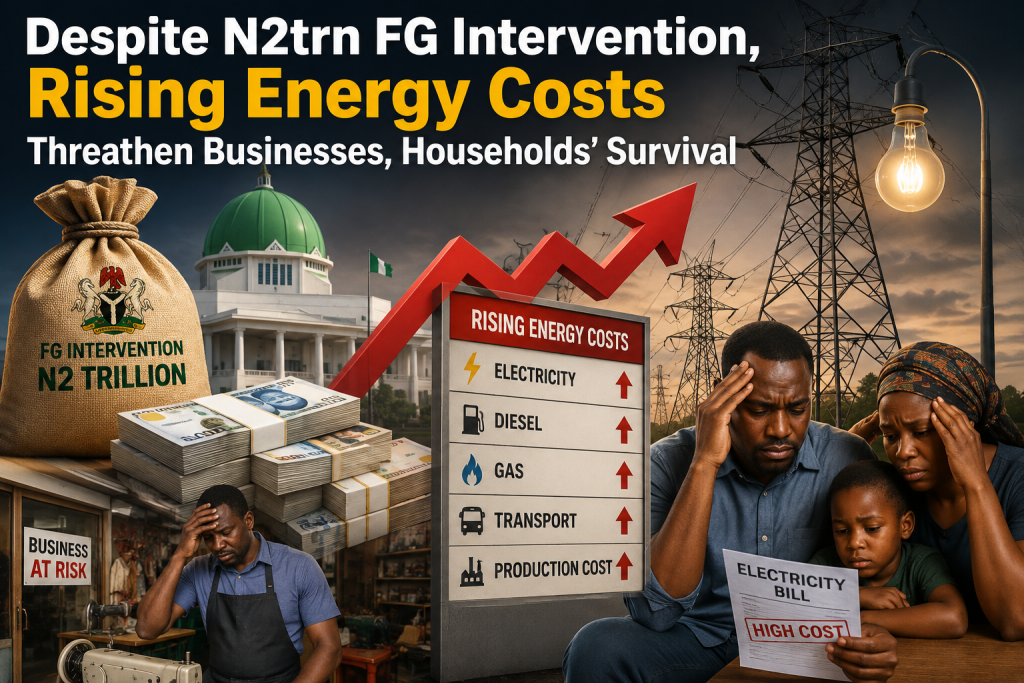
Despite several interventions of the federal government in electricity sector,, running into about N2trillion, the epileptic power situation continues forcing businesses and households to seek high alternative energy costs, BUSINESSDIARY learnt.
Since the coming of President Bola Tinubu’s administration, there have been series of interventions to improve the nation’s electricity supply.
The interventions focus on resolving severe liquidity crises, clearing legacy debts to Generation Companies (GenCos), decentralising market structures and upgrading grid and rural infrastructure to achieve commercial viability and stable power supply. In financial terms, these interventions were running into about N2trillions of naira , including a N1.23 trillion power sector bond issuance to clear legacy debts owed to power generation companies and gas suppliers.
Despite these, Nigeria’s persistent electricity supply crisis is increasingly undermining economic activity, with businesses spending hundreds of billions of naira on alternative power while households continue to contend with unreliable supply despite rising electricity costs.
The latest figures from the Nigerian Electricity Regulatory Commission (NERC) show the depth of the supply problem. In April 2026, grid-connected power plants had an installed capacity of 13,625 megawatts (MW), but only an average of 4,286MW was available for dispatch, representing a plant availability factor of just 31 per cent.
The gap between installed capacity and actual available generation highlights one of the fundamental weaknesses of Nigeria’s electricity system: having generating capacity on paper does not translate into adequate electricity reaching consumers.
The situation has direct consequences for economic growth. A recent African Development Bank (AfDB) report estimated that power outages cost Nigerian businesses about three per cent of their annual sales. The unreliable supply also forces companies to invest heavily in generators and other alternative sources of electricity, increasing operating costs and weakening competitiveness.
Data from the financial statements of companies listed on the Nigerian Exchange provide another indication of the burden. An analysis by one expert, Tajudeen Aduloju, showed that 24 listed companies spent N400.83 billion on diesel, gas and other alternative energy sources in the first quarter of 2026, up 3.66 per cent from N386.67 billion in the corresponding period of 2025.
For manufacturers, the burden is even more pronounced. The Manufacturers Association of Nigeria (MAN) said, manufacturers spent about N1.35 trillion on alternative power in 2025, representing a 21.6 per cent increase from N1.11 trillion in 2024.
Some entrepreneurs and households who spoke to *BUSINESSDIARY* at the weekend, pointed out that, they hardly enjoy six to 8hour uninterrupted electricity supply on a daily basis, saying, some of them on postpaid Billings were the suffering it the most.
Mr. Musibau Ayinla who own a salon in Abule-Egba axis of Lagos State said, most times when his customers come for haircut, there is always no light, forcing him to spend approximately N5, 000 daily on fueling his small generator.
He added that, even when electricity is supplied, under three to four hours, its off again, adding that, he really rely on electricity for his business.
“Although, there are exceptional cases, where the light will stay for several hours, most times, its always epileptic. Yet, they charge us higher because my shop is on postpaid. Monthly, my shop alone pay over N10, 009 for light we rarely use, ” he stated.
Similarly, Mr. Peter Moses who runs a laundering business on Lagos Island said, though, the light is stable at his own end and his office is on prepaid meter, the charges are extremely high since they are on Band A.
” For me, the equipments I use for my business means I consumes more and because of that, my landlord will alwaybask me to pay more than the rest tenants since we are only using one prepaid meter. But it is better than not having the light because I will have spend more on alternative energy, ” he said.
In Atan-Ota area of Ogun State, Mr. Kunle Adewale, who owns a welding shop lamented that, he rarely uses government-generated electricity for his business as he had to purchase a big generator that he fuels everyday for his businness, an expense that hits into his income.
He urged government to address the gaps in electricity sector, such that supply is stable and affordable.
Other Nigerians, mostly households who spoke to this medium said, the haven’t seen any major improvement in supply except for those areas on Band A whose light is mostly constant.
They want government to be genuine, transparent and sincere to address the anomaly in the electricity sector so that, Nigerinas can begin to enjoy constant electricity that is critical to businesses and economic growth.
An industry watcher, Francis Bajo, said the manufacturing sector could not thrive on unreliable electricity because companies were forced to provide their own power.
The implication, he said, is that Nigerian manufacturers effectively operate with a double energy bill: they pay for electricity from the grid and then spend additional money generating power when public supply fails.
Saying this raises production costs and ultimately feeds into the prices consumers pay for manufactured goods as power crisis threatens industrial competitiveness, he added that, “for an economy seeking to expand manufacturing, attract investment and create jobs, unreliable electricity represents a major structural disadvantage.”
A World Bank assessment of Nigeria’s power sector found that reliable electricity has significant implications for firms’ productivity. The bank has also identified the dependence on expensive backup generators as a major consequence of unreliable electricity supply.

The problem is not limited to generation. Nigeria’s electricity value chain faces interconnected weaknesses involving gas supply, generation, transmission, distribution, liquidity and infrastructure.
In February 2026, gas-fired power plants were receiving only about 692 million standard cubic feet per day (mmscfd), against requirements of approximately 1,630mmscfd, according to the Nigerian Independent System Operator. The resulting fuel shortage helped push national generation to around 4,300MW.
The liquidity crisis in the sector has compounded the problem. The electricity market’s accumulated debts have been estimated at about N6 trillion, constraining the ability of operators to pay suppliers and invest adequately in infrastructure.
Government has taken steps to address some of these problems, including measures to settle outstanding obligations to gas suppliers. In December 2025, the government approved N185 billion to address debts owed to gas producers supplying power plants.
But the persistence of supply constraints suggests that deeper reforms are still required.
The consequences extend beyond factories and corporate balance sheets. For households, unreliable electricity means additional expenditure on alternative sources of power, disruption to businesses operated from homes and neighbourhoods, and difficulty maintaining basic appliances and services.
Nigeria also continues to have one of the world’s largest populations without access to electricity. A World Bank 2025 assessment put the number of Nigerians without access at approximately 86.8 million.
Industry expert said, for those who are connected to the grid, access does not necessarily mean reliable supply.
“This distinction is crucial. A household may technically have an electricity connection while receiving electricity for only limited periods, making it necessary to depend on alternative sources, ” a market observer disclosed.
The World Bank’s Distributed Access through Renewable Energy Scale-Up (DARES) programme is designed to help more than 17 million Nigerians gain access to electricity through distributed renewable energy solutions, while replacing more than 250,000 polluting and expensive diesel generators.
Such decentralised solutions could become increasingly important as Nigeria attempts to close the gap between electricity demand and what the national grid can reliably provide.
The economic cost of the electricity crisis extends beyond what businesses spend on diesel and gas. Every hour a factory remains idle represents lost output. Every small business that closes because there is no power loses revenue. Every manufacturer that raises prices to recover higher energy costs passes part of the burden to consumers.
The cumulative effect is lower productivity, weaker competitiveness, reduced investment and slower job creation.
It also undermines efforts to diversify the economy. Manufacturing, agro-processing, telecommunications, retail, hospitality, healthcare and digital businesses all require dependable electricity. An economy cannot sustainably transition from dependence on primary commodities to higher-value production when one of its most basic productive inputs remains unreliable.
Saying that, electricity crisis therefore requires more than periodic interventions whenever the national grid collapses or generation falls, industry observers said, Nigeria needs a financially sustainable electricity market in which operators can recover legitimate costs, invest in infrastructure and provide consumers with measurable service improvements.
The government, they stated, must also accelerate investment in transmission and distribution infrastructure, address gas supply constraints, improve market liquidity and strengthen regulatory enforcement.
At the same time, they pointed out that, decentralised electricity solutions should be expanded, particularly for industrial clusters, rural communities and underserved urban areas. “Mini-grids, solar systems, battery storage and other distributed-energy technologies can complement rather than necessarily replace the national grid, ” another said.
The World Bank has increasingly supported such an approach, noting that, distributed renewable energy can reduce dependence on expensive and polluting backup generators while improving resilience.
Meanwhile, analysts suggested that Nigeria’s ambition to achieve faster economic growth ultimately depends on its ability to lower the cost of doing business, saying, electricity is central to that objective.
The latest generation figures show that the country still has a large gap between installed capacity and electricity actually available for dispatch. Businesses are spending hundreds of billions of naira on alternative energy, while manufacturers alone spent more than N1 trillion on self-generation in 2025.
These resources could otherwise be deployed to expand factories, hire workers, develop new products and invest in technology.
The electricity crisis is therefore not merely an energy-sector problem. It is an economy-wide productivity problem.
“Unless Nigeria can transform electricity from an unreliable and expensive input into a dependable foundation for production, the country’s ambitions for industrialisation, investment and sustained economic growth will remain constrained,” said Financial economist at Auchi Polytechnic, Zakari Mohammed.
The challenge for policymakers is no longer simply to increase generation capacity on paper. It is to ensure that affordable, reliable electricity actually reaches the businesses and households that need it.
Meanwhile, IKEDC official who was not authorised to speak to the media, noted that, Nigerian consumers, especially, those on postpaid billings, were not helping matters as they owe DisCos several billions of naira that is now affecting their capacities to distribute what is being generated by GenCos.
He said, government is addressing this by ensuring every household is on prepaid meter so that Nigerians pay for what they consumed, which will benefit all the parties involved.
Free distribution of prepaid meters are ongoing is some areas, while government has made it easier to purchase prepaid meters in areas where the free ones are not available, he stressed.





