
WHAT YOU SHOULD DO AS POLICYHOLDERS OF 8 DEFUNCT INSURANCE COMPANIES IN NIGERIA
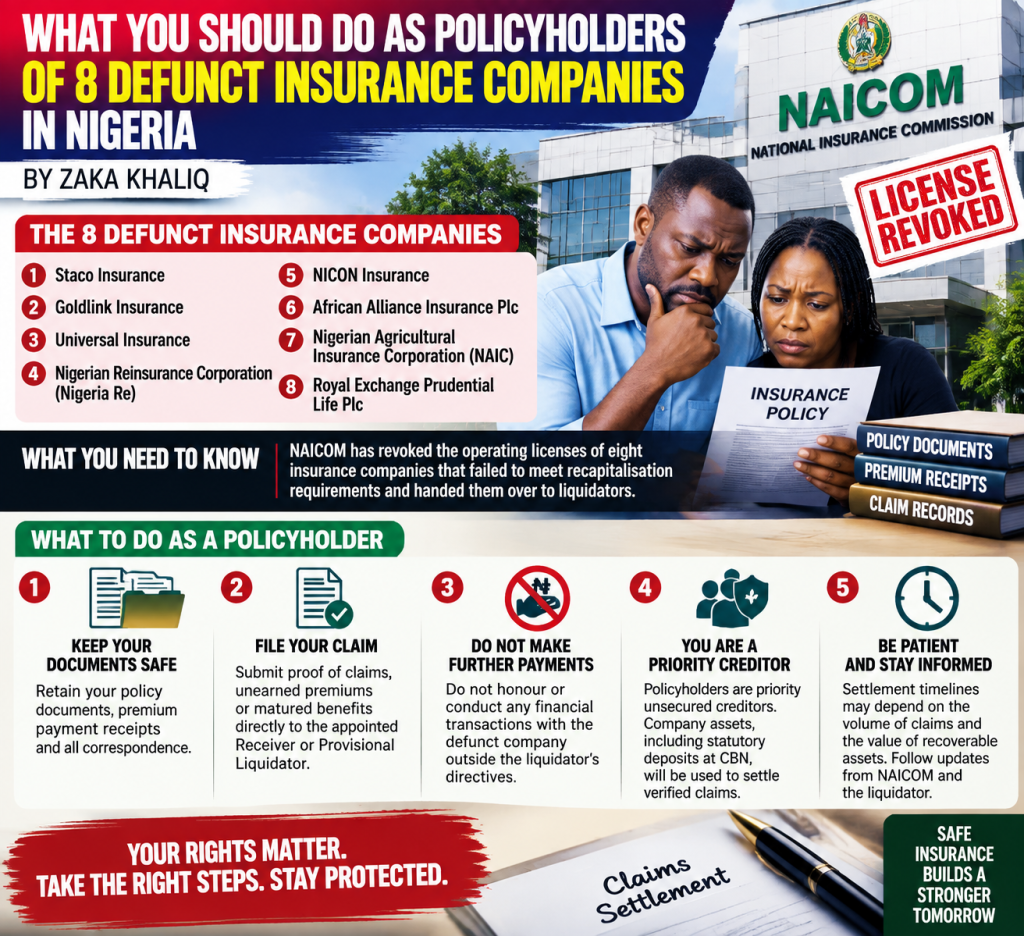
BY ZAKA KHALIQ
Last week, the National Insurance Commission (NAICOM) which is the regulatory body for insurance industry in Nigeria, announced that 50 out of the 58 companies in the sector scaled through the recapitalisation hurdle.
This development outrightlly left eight operators out in the cold as the regulator revoked their operating licenses and handled them over to liquidators who are to take possession of its assets and liabilities and take care of affected policyholders.
Hence, Staco Insurance, Goldlink Insurance, Universal Insurance, Nigerian Reinsurance Corporation (Nigeria Re), NICON Insurance, African Alliance Insurance Plc, Nigerian Agricultural Insurance Corporation (NAIC) and Royal Exchange Prudential Life Plc,
have now forfeited their licenses, according to BUSINESSDIARY findings.
Recall too that, A & G Insurance who operated a composite business prior to recapitalisation exercise, has forfeited its life arm and retains its general business, a development that may trigger retrenchment in the firm.
When an insurance company died, it creates a serious panic in the entire insurance system. The workers were left stranded as they becomes jobless all of a sudden.
The policyholders are lost as to the fate of their policies, especially, those with life savings schemes.
For brokers who serve as intermediaries between the insured public and the insurers, their phones will never stopped ringing as policyholders call ceaselessly to know what fate awaits them.
However, as a policyholder, there are several safeguard mechanism to protect you. The first priority after an insurance firm closed shop is always the policyholder.
When the National Insurance Commission (NAICOM) withdraws an insurance company’s operating license in Nigeria, policyholders become priority unsecured creditors. Their active contracts cease for new business and a court-approved receiver or provisional liquidator is appointed to sell company assets and settle outstanding valid claims or matured financial liabilities.
Impact on Policy Types
-
- General/Non-Life Business: Policies naturally expire or lapse at the end of their current contract term. Active liability is restricted to valid claims and risks that matured prior to or during the active contract year before cancellation.
- Life Business: Liquidators use realized asset sales to pay out policyholders who hold matured risks or surrender values calculated up to the exact date of the license revocation.
Policyholder Rights and Actions
-
- Filing Claims: Policyholders must submit proof of claims, unearned premiums, or matured benefits directly to the assigned Receiver or Provisional Liquidator (such as the recent actions managed under the Nigerian Insurance Industry Reforms Act(NIIRA) 2025 framework.
- Asset Distribution: Statutory deposits held by the Central Bank of Nigeria (CBN) on behalf of the insurer and corporate assets are liquidated to offset verified policyholder liabilities before any shareholder payout occurs.
- Restriction on Instructions: Policyholders are publicly instructed by regulators not to honoir or conduct any ongoing financial transactions or premium payments with the defunct company outside of the liquidator’s explicit directives.
Conclusion
So, where liquidation becomes unavoidable, outstanding claims are treated as liabilities of the failed insurer. These claims are settled from the company’s available assets, in line with legal and regulatory procedures.

Policyholders with valid claims are prioritised during the liquidation process, though settlement timelines may depend on the volume of claims and the value of recoverable assets.
Policyholders are also encouraged to keep their policy documents and premium payment records properly documented.





