
Low-Cost Housing No Longer Affordable As Housing Deficit Crosses 15m Units
…..Rents Soar As Inflation, Costly Building Materials, Expensive Mortgages Squeeze Low-income Earners 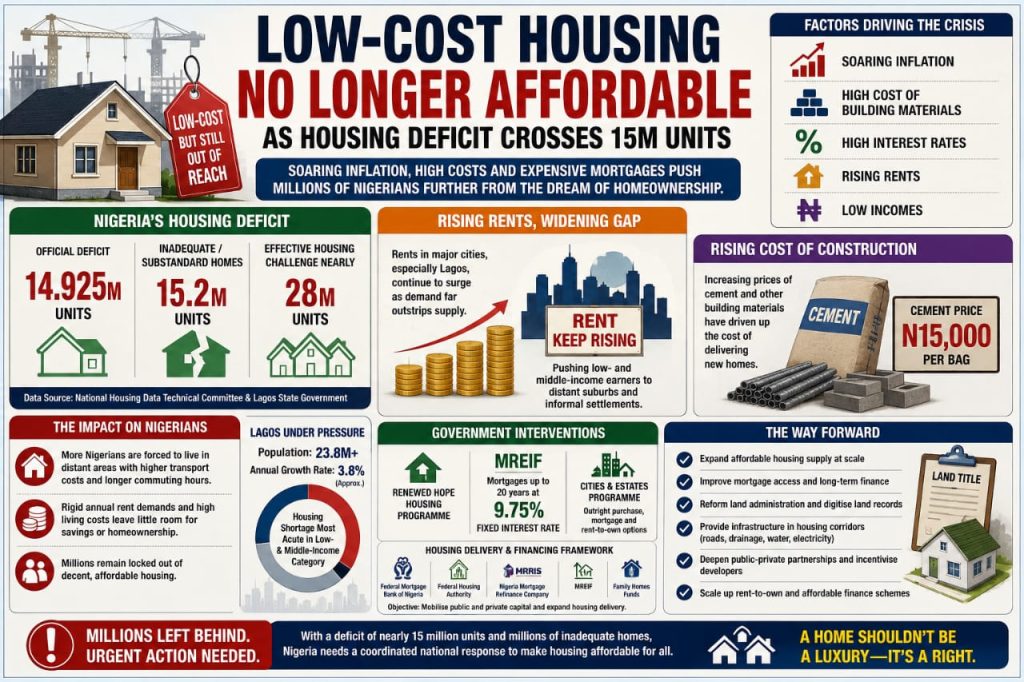
BY CEES HARMON
Nigeria’s housing crisis is deepening, with millions of workers struggling to afford even homes described as “low-cost” as soaring inflation, naira depreciation, high construction costs and expensive mortgages widen the gap between housing supply and household incomes.
BUSINESSDIARY learnt that Nigeria’s official housing deficit has now reached 14.925 million units, while a further 15.2 million existing homes are classified as structurally inadequate or substandard, putting the country’s broader housing challenge at close to 28 million units.
For ordinary Nigerians, however, the crisis is no longer just about the number of houses missing from the market. It is increasingly about whether they can afford the houses that are being built.
Low-cost housing, once regarded as one of the most practical solutions to Nigeria’s housing shortage, is becoming increasingly out of reach for the very households it is designed to serve.
Across major cities, particularly Lagos, rising rents are forcing low- and middle-income earners to move farther away from their workplaces, often into distant suburbs where cheaper accommodation comes with longer journeys, higher transportation costs and reduced quality of life.
The situation has been worsened by the sharp increase in the prices of cement, steel, roofing materials, fittings and other construction inputs, while high interest rates have made mortgage financing inaccessible to a large proportion of prospective homeowners.
Housing experts said the combination of rapid population growth, urbanisation, inflation, weak purchasing power, high land costs and limited long-term finance had created a widening affordability gap.
Affordable’ Housing, Unaffordable Nigerians
The paradox confronting the housing market is that even as governments and private developers increase efforts to deliver low-cost homes, the cost of building and financing those homes continues to rise.
Developers are facing higher input and infrastructure costs, while households are struggling with stagnant incomes and rising living expenses.
This has created a market where a house may technically qualify as affordable by development standards but remain beyond the financial capacity of the average Nigerian worker.
The Lagos State Government has warned that the housing shortage could worsen unless the gap between demand and delivery is urgently addressed.
Lagos, with an estimated population of more than 23.8 million and an annual growth rate of nearly 3.8 per cent, is under particularly intense pressure.
The state’s Commissioner for Housing, Moruf Akinderu-Fatai, said the shortage was most acute in the low- and middle-income segments, where affordability remains a major obstacle.
Rents Push Workers to the Outskirts
The growing housing shortage is already being reflected in the rental market, with tenants confronting increasingly steep rents and rigid annual payment requirements.
For many workers, the choice is becoming increasingly difficult: pay a large portion of their income to remain close to work or relocate to the outskirts and spend more time and money commuting.
The pressure is particularly severe in fast-growing urban centres where housing demand continues to outstrip supply.
Analysts said, the trend could worsen as Nigeria’s urban population expands unless large-scale housing construction begins to outpace population growth.
Government Interventions

The Federal Government has introduced several initiatives aimed at expanding housing supply and improving access to finance, including the Renewed Hope Housing Programme and the Ministry of Finance Incorporated Real Estate Investment Fund (MREIF).
MREIF provides mortgages of up to 20 years at a fixed interest rate of 9.75 per cent, while its Cities and Estates Programme is designed to support low- and medium-income Nigerians through outright purchase, mortgage and rent-to-own arrangements.
The Federal Ministry of Housing and Urban Development has also outlined a housing delivery and financing framework involving institutions including the Federal Mortgage Bank of Nigeria, Federal Housing Authority, Nigeria Mortgage Refinance Company, MREIF and Family Homes Funds.
The strategy is intended to mobilise public and private capital and increase housing delivery.
But experts insist that the scale of the crisis requires interventions far beyond government-funded housing projects.
Land, Infrastructure, Finance: The Big Obstacles
Housing stakeholders have identified difficult access to land, delays in obtaining property titles, inadequate infrastructure and limited long-term financing as some of the biggest barriers to large-scale housing development.
They called for accelerated land reforms and the digitisation of land administration to reduce the cost and time required to acquire land and secure titles.
They also urged governments to provide basic infrastructure — including roads, drainage, water and electricity — along designated housing corridors.
Such investments, they said, would reduce the burden on developers who currently have to provide much of the infrastructure needed to make housing estates habitable.
A lecturer of Urban and Regional Planning at Adeleke University, Dr. Kunle Adegoke, advocated deeper private-sector participation through public-private partnerships and incentives for developers targeting low- and middle-income households.
He said the focus should shift from isolated housing projects to mass housing schemes capable of delivering homes at the scale required to make a meaningful dent in the deficit.
Mortgage Access Critical
Adegoke also called for deeper development of Nigeria’s mortgage market and wider adoption of rent-to-own schemes and other alternative housing finance models.
He noted that many workers and self-employed Nigerians could not meet the requirements of conventional commercial mortgages.
While MREIF’s fixed-rate mortgage and rent-to-own models represent attempts to close the financing gap, experts said such schemes must reach millions of Nigerians if they are to significantly alter the housing landscape.
Lagos’ 10,623 Homes
The Lagos State Government said it had delivered 10,623 housing units through direct funding and public-private partnerships over the past seven years and expects the figure to exceed 14,000 units before the end of 2026.
The state has also supported more than 20,000 residents through mortgage and rent-to-own programmes over the past 12 years.
But housing stakeholders said the figures also underscore the magnitude of the national challenge.
With almost 15 million units officially missing and millions of existing homes considered inadequate, they argued that Nigeria needs a coordinated national response involving federal and state governments, private developers, mortgage institutions, pension funds and other long-term investment providers.
For millions of Nigerians, the housing crisis is no longer a distant policy statistic. It is reflected in the rent they struggle to pay, the long distances they travel to work and the growing difficulty of owning a home.
Unless housing supply begins to grow substantially faster than demand, experts warned that population growth, rapid urbanisation and rising construction costs could push decent accommodation even further beyond the reach of ordinary Nigerians..





