
EDITORIAL: Fake Agencies Expose Rot Nigeria Must Root Out
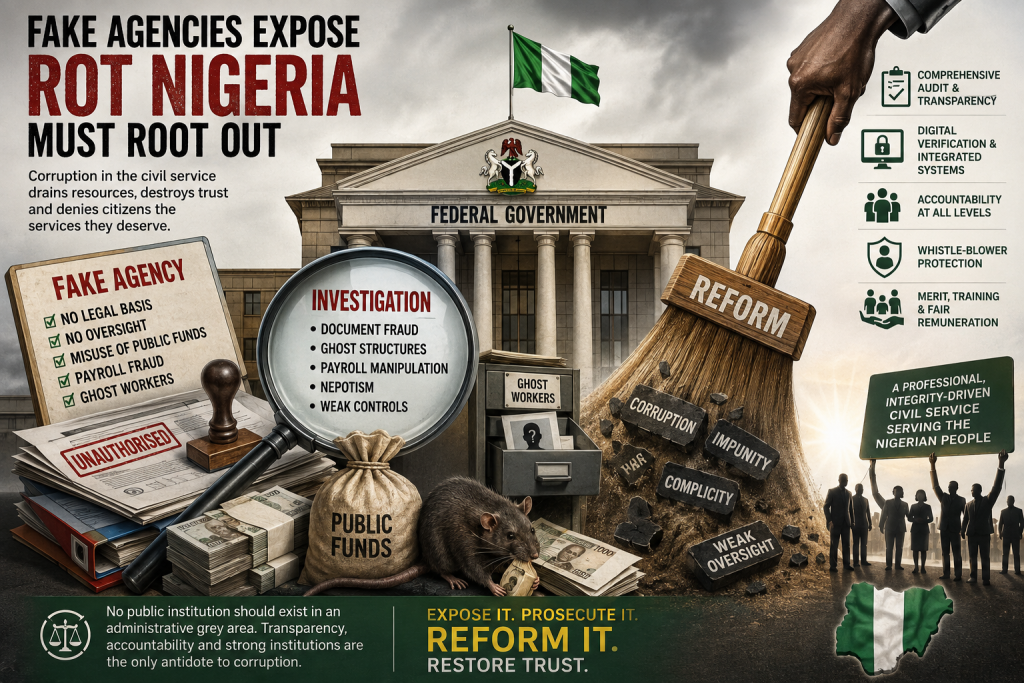
The reported uncovering of fake or unauthorised government agencies by the ICPC is more than another corruption story.
It raises troubling questions about oversight, accountability and the integrity of Nigeria’s public administration.
How can entities without legitimate legal foundations operate within or around the machinery of government? How could they possibly obtain recognition, access public resources, recruit personnel or transact official business without failures somewhere along the chain of supervision?
These are questions that must be answered fully.
Nigeria’s civil service is supposed to provide continuity, professionalism and institutional memory regardless of changes in political leadership.
Ministers and political appointees may come and go, but the civil service remains the engine that translates government policies into action.
When that engine becomes weakened by corruption, ghost structures, payroll manipulation, nepotism, document fraud and weak internal controls, the consequences extend far beyond government offices.
Corruption in the civil service means fewer resources for roads, schools, hospitals and other public services. It means genuine businesses may face unnecessary bureaucratic hurdles while those with connections exploit loopholes. It means citizens pay taxes into a system without receiving commensurate value.
Most dangerously, it erodes trust in government itself. The revelation concerning fake agencies should therefore not be treated as an isolated scandal that can be resolved simply by arresting a few individuals. Nigeria must investigate the entire ecosystem that allowed such structures to emerge and, potentially, survive.
Every fake agency must have a history. There must be documents, approvals or representations made in its name. There may have been bank accounts, personnel records, payments, official correspondence or relationships with public officials.
Those responsible for creating such structures, and those who knowingly enabled or protected them, must be identified.
The fight against corruption must follow the evidence wherever it leads. This is where the ICPC’s investigation becomes particularly important.
Nigerians deserve to know the scale of the problem, the institutions affected, the amount of public resources involved and the officials responsible for any wrongdoing.
Transparency should be central to the process. However, uncovering the problem is only the first step. The more important task is preventing a recurrence.
Nigeria needs a comprehensive audit of government agencies, departments and public bodies. There should be a single, regularly updated and publicly verifiable register showing the legal basis, functions, supervising ministry and leadership structure of every Federal Government agency.
No public institution should exist in an administrative grey area. The country must also strengthen digital verification across the public service. Payroll systems, personnel records, budget releases and government accounts should be integrated with robust identity and institutional verification mechanisms.

An agency that does not legally exist should not be able to employ staff, receive budget allocations or conduct transactions in the name of the government.
Internal auditors, accountants, directors of administration and permanent secretaries must also be held to higher standards of accountability.
Too often, corruption investigations focus on junior officials while those responsible for supervision escape scrutiny.
That approach must change. A culture of impunity flourishes when public officers believe that the worst consequence of misconduct is a transfer, suspension or quiet retirement.
Where public funds have been stolen or institutions deliberately manipulated, those responsible should face due process and, where found guilty, appropriate sanctions.
Public assets and funds obtained illegally should also be recovered.
Yet Nigeria must recognise that corruption is not sustained by punishment alone. Prevention is equally important.
Civil servants should be properly trained, fairly remunerated and promoted on merit. Recruitment and advancement must be transparent. Political interference in routine administration should be reduced, while professional standards should be strengthened.
The civil service cannot effectively fight corruption if honest officers are marginalised while compromised officials are rewarded.
Whistle-blowers must also be protected.
Many cases of corruption remain hidden because those who discover wrongdoing fear victimisation, loss of employment or other consequences. A public servant who reports fraud through legitimate channels should be protected, not punished.
The ICPC’s discovery should therefore become a turning point. Nigeria is undertaking difficult economic reforms and asking citizens to endure significant sacrifices in the hope of building a more efficient and prosperous economy.
Government cannot credibly demand sacrifice from citizens while corruption and institutional waste continue unchecked within the public sector.
Every naira diverted through fraud is a naira unavailable for public services. Every fake institution that finds its way into the government system represents not only a failure of oversight but also an assault on public trust.
Nigeria’s civil service remains indispensable to national development. But it must be cleaned up, modernised and protected from the networks of corruption that have undermined its effectiveness.
The ICPC has opened a window into what may be a deeper problem. The appropriate response is not a temporary outrage followed by silence. It must be a thorough investigation, institutional reform, transparent prosecution where wrongdoing is established and a lasting overhaul of public-sector controls.
Nigeria does not merely need to expose fake agencies. It must ensure that the corruption, complicity and institutional weaknesses that make such absurdities possible are rooted out completely.
Only then can the civil service begin to reclaim its proper role: not as a hiding place for fraud and patronage, but as a professional institution dedicated to serving the Nigerian people.





