
Fuel Subsidy Return Impossible, Politicians Selling Empty Promises — Sanwo-Olu
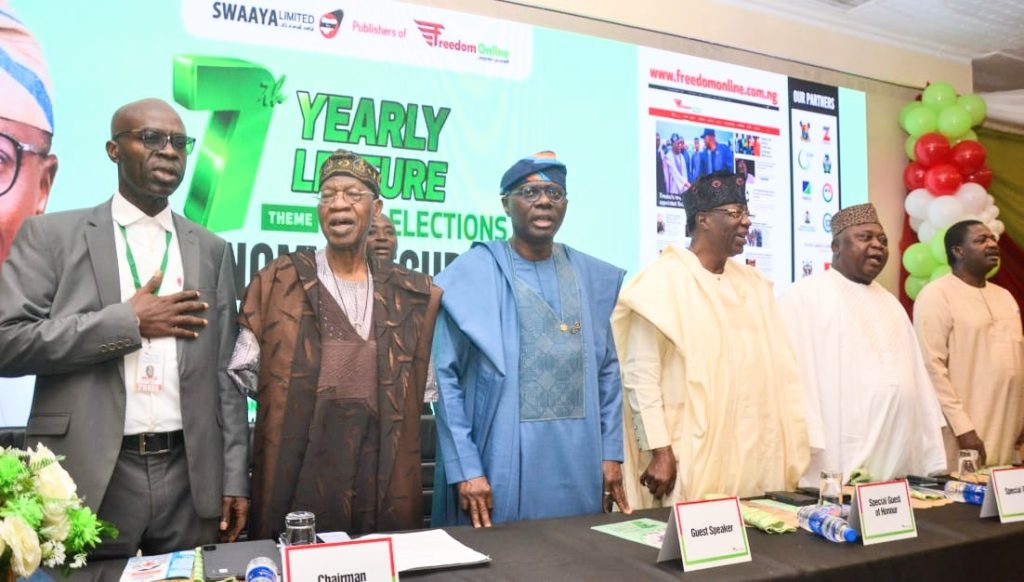
Lagos State governor, Babajide Sanwo-Olu, has dismissed campaign promises by opposition politicians to restore petrol subsidy, describing them as ’empty promises’ that are neither fiscally realistic nor sustainable.
Sanwo-Olu warned that, Nigerians should be wary of politicians seeking votes ahead of the 2027 elections by promising a return to the subsidy regime, arguing that, no government could realistically sustain the huge financial burden associated with the policy.
The governor spoke on Thursday while delivering the 7th Freedom Online Newspaper Lecture, themed ‘2027 Elections, Economy, Security and Nigeria’s Future,’ in Ikeja, Lagos.
The lecture was chaired by former minister of Information and Culture, Alhaji Lai Mohammed, while former Ogun State governor and Senator representing Ogun East, Gbenga Daniel, was the Special Guest of Honour.
Sanwo-Olu said, the petrol subsidy had become a major drain on government finances, diverting resources that could have been deployed to critical infrastructure and social services.
According to him, the subsidy was originally introduced to cushion the effect of inefficiencies in domestic petroleum supply but eventually became an avenue through which public funds were wasted without delivering commensurate benefits to ordinary Nigerians.
He said, president Bola Ahmed Tinubu demonstrated political courage by removing the subsidy on his first day in office, despite the potential political consequences.
“The oil subsidy was not removed because anybody enjoyed removing it. It was removed because it had become a hole in the national purse through which the money for roads, schools and hospitals was draining away,” Sanwo-Olu said.
He acknowledged that, the policy had imposed significant hardship on Nigerians, particularly through higher transportation and food costs, but argued that the economic benefits were beginning to emerge.
“I will not stand here and tell you that oil subsidy removal has been painless. It has not. Lagosians particularly have felt it at the pump, at the market, and in the price of a bag of rice.
“Any governor who tells you otherwise has not been listening to his own people. But the measure of a reform is not whether it hurts. It is whether it heals. And the evidence that this one is healing is now arriving, quarter by quarter,” he said.
The Lagos governor warned that the subsidy would increasingly become a major campaign issue as the 2027 presidential election approaches.
He said, opposition politicians were already exploiting public frustration over the rising cost of living by promising to restore the subsidy.
“Barely two weeks into the season of presidential election campaign, opposition politicians have reached for the fuel subsidy as their instrument of choice. We will see more of this. We will see promises that no treasury on earth could honour,” he said.
Sanwo-Olu further argued that, the removal of the subsidy had significantly improved revenue available to the three tiers of government.
He said, monthly allocations to states and local governments had more than doubled in naira terms since the subsidy was removed, stressing that the additional resources had given sub-national governments greater capacity to fund development.
The governor also defended the economic reforms of the Tinubu administration, saying available economic indicators suggested that the measures were beginning to produce results despite the pains associated with their implementation.
He cited the 4.43 per cent real GDP growth recorded in the second quarter of 2026, compared with 3.89 per cent in the first quarter and 4.23 per cent in the corresponding quarter of 2025.

According to him, agriculture expanded by 4.39 per cent, compared with 2.82 per cent a year earlier, while the services sector recorded 4.6 per cent growth.
Sanwo-Olu also added that, Nigeria’s nominal GDP was more than 18 per cent larger than it was a year earlier, while foreign exchange reserves had risen to about $53 billion.
He noted that, Nigeria was running a trade surplus and that Fitch and Moody’s had upgraded the country’s credit rating.
He further pointed to the decline in inflation from its peak of almost 35 per cent at the end of 2024 to 15.9 per cent in June 2026.
The governor also highlighted the increase in diaspora remittances, saying Nigerians abroad sent $947 million through formal channels in July alone, the highest monthly figure recorded in the country.
“These statistics are not my numbers; they belong to the National Bureau of Statistics and the Central Bank of Nigeria, and every journalist seeking facts can check them,” he said.
On the 2027 elections, Sanwo-Olu said, Nigeria’s democratic and electoral systems had made significant progress since the return to civilian rule in 1999.
He contrasted Nigeria’s democratic experience with the political instability witnessed in some West African countries, including Mali, Guinea, Burkina Faso, Niger and Guinea-Bissau, where military interventions have disrupted democratic governance.
The governor said, electoral reforms, including technological innovations in voter verification and results transmission, had strengthened Nigeria’s electoral process.
‘Our elections have improved. Anyone who covered the elections of the 2000s knows how far we have come,’ he said.
Sanwo-Olu, however, charged the Independent National Electoral Commission (INEC) to ensure that it was fully prepared for the 2027 elections.
He said the electoral umpire must be ready to conduct credible elections across all polling units on January 16 and February 6, 2027.
On security, Sanwo-Olu said, poverty remained one of the major drivers of insecurity, arguing that economic empowerment and job creation must therefore remain central to Nigeria’s security strategy.
He highlighted the expansion of the Nigerian Army from eight to 12 divisions, the deployment of additional personnel and the establishment of new divisional headquarters.
He also cited the creation of a Special Operations Command by the Nigerian Navy, decentralisation of police training, and the deployment of Forest Guards and Mining Marshals.
According to him, the Federal Government’s youth-focused interventions, including NELFUND, the Consumer Credit Corporation, the 3 Million Technical Talent programme, the Student Venture Capital Grant and other empowerment initiatives, are designed to tackle the economic conditions that fuel insecurity.
“The President believes the most effective security policy is job creation, and the surest guarantee of a job is a country safe enough to invest in,” Sanwo-Olu said.
In his remarks, former Information and Culture Minister, Lai Mohammed, said political stability could not be separated from economic inclusion.
Mohammed warned that businesses could not thrive in an atmosphere of insecurity and uncertainty, stressing that economic growth and national security were mutually dependent.
“When young people are gainfully employed and see a clear path to self-actualisation, the political space becomes far less susceptible to manipulation and electoral violence,” he said.
He urged political actors to view the 2027 election not merely as a contest for power but as an opportunity to strengthen institutions, build investor confidence and promote national stability.
Mohammed acknowledged the difficult challenges confronting the Federal Government in the areas of economic reform and security, but said the problems could not be resolved overnight.
According to him, Nigeria requires consistency, patience, stronger institutions and national cooperation to overcome the challenges.
The Convener and Editor-in-Chief of Freedom Online, Gabriel Akinadewo said, the lecture was organised against the backdrop of renewed political activities and the need for political actors to place national development above partisan interests.
Akinadewo also called for the modernisation of Nigeria’s laws to reflect contemporary realities, advocating the repeal of outdated legislation and the creation of a legal framework capable of protecting citizens’ freedoms and supporting the country’s development.





