
Long Queues Persist At CNG Stations As Conversion Rises
BY CEES HARMON and SAMUEL OPEYEMI
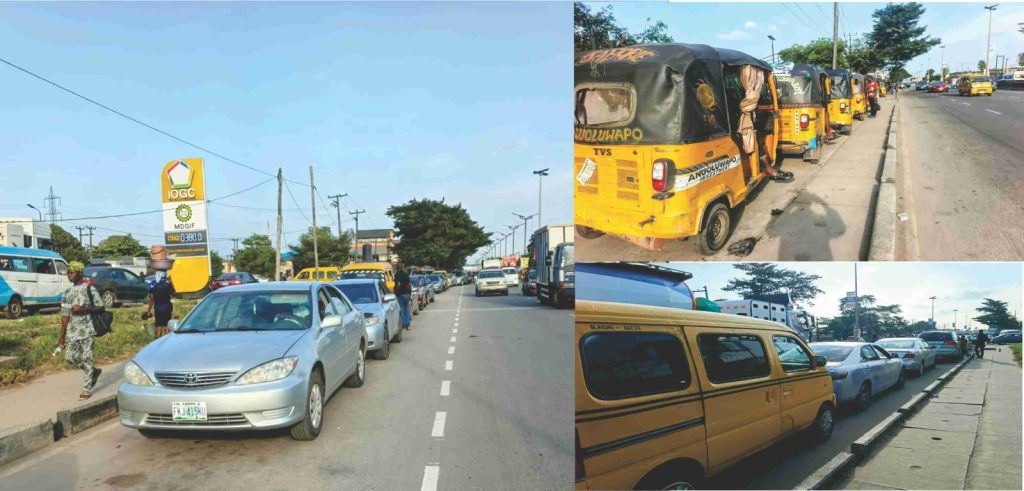
The federal government’s push to drive down transportation costs through Compressed Natural Gas (CNG) is gaining traction among motorists, but long queues, inadequate refuelling infrastructure and limited operating hours at CNG stations are threatening to slow the wider impact of the initiative.
While more commercial drivers and private vehicle owners are converting to CNG because of its significantly lower running cost compared with petrol, motorists say, the scarcity of refuelling stations is forcing them to spend hours in queues to access the cheaper fuel.
At the NNPCL Ashade Junction in Agege, Lagos, tricycle operator, Boluwatife Ojo, described CNG as a ‘lifeline’ for commercial drivers, saying, iit has dramatically reduced his daily operating costs.
According to him, CNG sells for about N380 per standard cubic metre, compared with petrol at between N1,250 and N1,310 per litre.
“I fill my Keke NAPEP in the morning with N1,700, while someone using petrol will spend N7,000, and that won’t even be the end,” Ojo said, adding that, he earns between N25,000 and N30,000 daily using CNG.
But he lamented the queues and limited number of stations offering the product.
“We get gas at Ojota, Agidingbi, Agege, Mangoro, Toll Gate or Mushin. So you can see the few stations offering the service compared to the population size,” he said.
Another CNG user, Taiwo Enitan said, the economics of CNG were compelling but warned that availability remained the biggest obstacle.
“As big as Agege is, you can only get two gas stations — one at Pen Cinema under the bridge and the other at Ashade Junction, serving numerous cars,” he said.
Queues Stretch To Three Hours
For e-hailing driver, Michael Oyowe, the fuel savings have been substantial since he converted his vehicle, but the time lost at CNG stations is eroding some of the benefits.
Oyowe said, he spent about N800,000 to retrofit his vehicle and has since enjoyed lower operating costs.
However, he said, queues could last between two and three hours, while most CNG stations close around 7pm.
“We waste precious time queuing just to get gas. Sometimes it takes two hours, and at other times three hours. Getting gas on Sundays is like a living nightmare,” he said.
He urged government and investors to accelerate investment in CNG infrastructure, describing the fuel as cheaper, cleaner and beneficial to vehicle engines.
Conversion Rising, Infrastructure Lags
The growing interest in conversion comes as the federal government intensifies its campaign to move motorists away from petrol.
President Bola Tinubu had set October 1 as the target for Nigerians to begin seeing measurable reductions in transportation costs as the government, transport operators and state authorities deepen the adoption of CNG and electric mobility.

But automobile engineer and chairman of the Board of Directors of Driving Schools in Nigeria, Engr. Saliyu Aliu, said the target would have limited impact without a nationwide CNG infrastructure network.
There will be no significant impact for now,” Aliu said, warning that, CNG infrastructure had not covered most states.
He said, the situation was particularly challenging in Northern Nigeria, where a large proportion of motorists are commercial drivers.
“If the government wants the directive to have an impact, it should establish more CNG refuelling stations across the states,” he said.
According to him, wider CNG adoption could eventually reduce petrol demand and force filling stations to lower prices as competition increases.
Government Plans 1,000 More Stations
The Presidential Initiative on CNG and Electric Vehicles (Pi-CNG & EV) has acknowledged that infrastructure remains critical to achieving the government’s transport-cost reduction target.
Technical operations and executive coordinator of the initiative, Joseph Uche Igama said, building a CNG refuelling station could take between six months and one year, depending on its size, because of licensing, construction and safety requirements.
“Until we can ensure availability of gas nationwide, that’s when we’ll see a real drop in transport prices,” Igama said.
The federal government had earlier announced plans to expand the national CNG refuelling network, with the first batch of 500 additional stations expected by the end of October and another 500 stations ordered, bringing the planned total to 1,000 stations.
The government has also directed the release of 100,000 CNG conversion kits to accelerate vehicle conversion.
Igama said, although the government’s free conversion-kit programme was currently paused, conversion costs had fallen and financing options were available through partnerships with financial institutions and the federal government-backed CREDICORP consumer-credit scheme.
N150 University Bus Fare Plan
As part of efforts to spread the benefits of cheaper gas-powered transport, the federal government is also planning subsidised CNG conversions for university lecturers and workers and the deployment of CNG-powered buses to selected tertiary institutions.
Under Project SPROUT’s Campus Transport Scheme, the first phase will cover 20 public universities, with 100 CNG buses expected to be deployed and fares capped at N150 per trip.
The initiative is aimed at reducing transportation costs for students, lecturers and other university workers.
However, industry stakeholders insist that the success of the broader CNG programme will ultimately depend on whether government can match rising conversion rates with a sufficiently large and reliable refuelling network.
For motorists already on CNG, the verdict is clear: the fuel saves money, but the queues cost time.
And until more stations are built, operate longer hours and are spread across the country, the federal government’s promise of cheaper transportation may remain a benefit enjoyed by converted motorists rather than a reality for millions of Nigerian commuters.





