
FUEL CRISIS: Transporters Turn To Bottle Purchases, Trip-by-Trip Refuelling To Survive
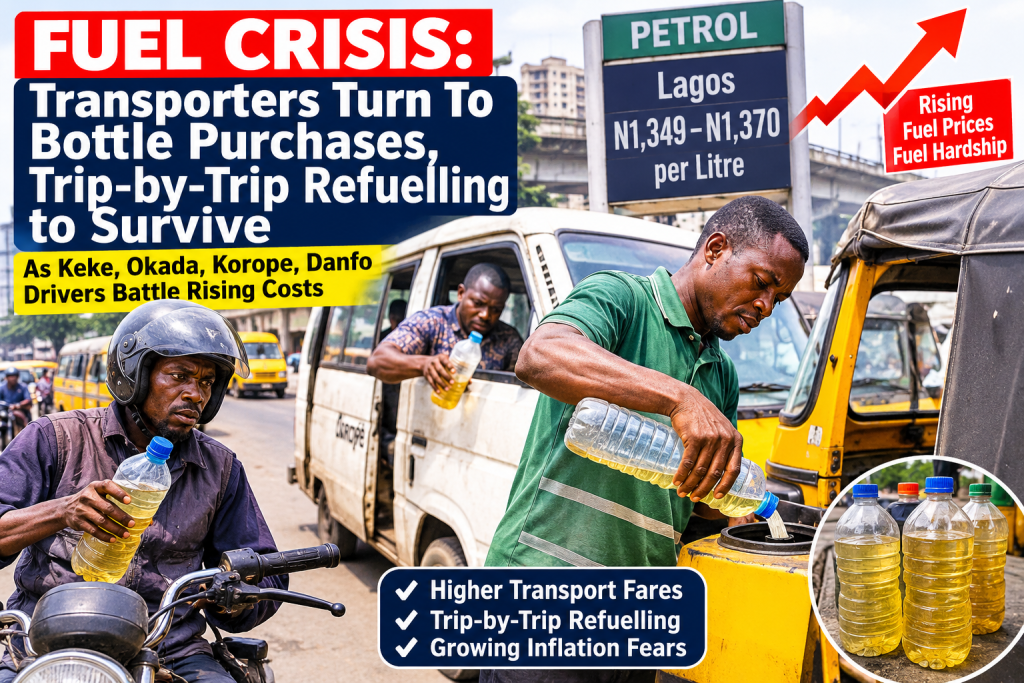
As Keke, Okada Operators, Korope, Danfo Drivers Battle Rising Costs
BY ZAKA KHALIQ and CEES HARMON
Nigeria’s rising petrol prices are forcing commercial transport operators to adopt increasingly difficult survival strategies, including buying fuel in bottles and refuelling their vehicles one trip at a time, BUSINESSDIARY learnt.
This is even as economists warned that, the latest increase could trigger fresh inflationary pressure across the economy.
A survey of commercial transport activities in parts of Lagos and Ogun States show that, operators of tricycles, motorcycles, minibuses and commercial buses are struggling to keep their businesses running as petrol prices climb, with many unable to afford the quantities they previously purchased to begin their daily operations.
Some Keke Marwa and Okada operators now buy petrol in small quantities using bottles and other containers, depending on the money available to them, rather than purchasing several litres at once.
For operators of Korope minibuses and Danfo buses, the adjustment is increasingly taking the form of trip-by-trip refuelling, with drivers buying only enough petrol to undertake journeys they believe they can afford.
For Mr Tunji Alani, a Tricycle operator who operates between Agree and Alakuko area of Lagos, ‘ the current economic conditions
don’t allow us to full our tank these days. What would have take N20, 000 to buy a fulll tank now cost over N40, 000 to do same. Amd how much are we making per day to go and full my tank.
” Using empty water bottle to store fuel was to avoid disappointment should in case, petrol finished midway, so that passengers are not disappointed. It also gives us an idea of what we make per trip with the little fuel we buy. ”
A minibus operation, Mr. Latiif Isa, also corroborated Alani, urging Migerins to understad their current predicament.
The development reflects the growing financial pressure on small-scale transport businesses, where the cost of keeping vehicles on the road is competing with the need to generate enough revenue to maintain vehicles, support families and meet other daily obligations.
The pressure has intensified following another round of increases in petrol prices across the country.
In Lagos, petrol prices rose to between N1,349 and N1,370 per litre as of November 4, following adjustments in depot prices. MRS and NNPC filling stations sold at about N1,360 per litre, while Mobil sold at N1,349. Independent marketers charged as much as N1,370.
At the depot level, A.A. Rano raised its petrol price by N75 to N1,295 per litre, while African Terminal, Aiteo and Integrated adjusted their prices to about N1,300. NIPCO increased its price by N55 to N1,305, while Dangote Petroleum Refinery’s price rose marginally by N3 to N1,303. MRS retained its depot price at N1,310.
For transport operators whose businesses depend heavily on petrol, the increases mean higher daily operating expenses and difficult choices between raising fares, reducing the number of trips, buying fuel in smaller quantities or accepting lower earnings.
However, passing the additional costs to passengers has become increasingly difficult because commuters are also struggling with the rising cost of living.
Workers, traders, artisans, students and other low-income earners who depend on commercial transportation are already spending a substantial part of their incomes on daily mobility. Higher fares could therefore further reduce the money available for food, education, healthcare and other essential needs.
The pressure is reflected in official transport fare statistics. National Bureau of Statistics data showed that the average motorcycle transport fare increased from N464.55 in May 2023 to N1,072.51 in May 2026, representing a 130.87 per cent rise.
Similarly, average intra-city bus fares increased from N649.59 to N1,431.25 over the same period, a 120.33 per cent increase.
The latest petrol price increase has also raised concerns among economic and energy experts about another round of cost pressures, particularly in transportation, food distribution, manufacturing and small businesses that depend on petrol-powered generators.
Daniel Okorie, managing Partner of Energy Ethics, attributed the latest increase partly to higher freight charges, insurance premiums and the widening difference between dated Brent crude prices and futures contracts.
Okorie, who had projected that petrol could reach N1,411 per litre in Lagos in November if prevailing cost pressures persisted, said physical petroleum cargoes had become about $30 more expensive than futures contracts.

He explained that Lagos, the additional costs associated with transporting petroleum products, insurance and other import-related expenses were increasingly being reflected in domestic pump prices.
According to him, Dangote Petroleum Refinery’s pricing is also influenced by import parity because about 40 per cent of its feedstock is sourced internationally.
He added that even domestically sourced crude oil attracts freight charges and other commercial premiums, which increase the cost of producing and supplying refined petroleum products.
However, petroleum marketers expressed reservations about projections of further increases.
Chinedu Ukadike, National Publicity Secretary of the Independent Petroleum Marketers Association of Nigeria, described expectations of another price increase as speculative, saying marketers were monitoring developments in the market before taking pricing decisions.
Similarly, Joseph Obele, National Publicity Secretary of the Petroleum Products Retail Outlets Owners Association of Nigeria, expressed doubts about another increase, citing indications that tensions in the Middle East were easing and international crude oil prices were declining.
A financial economist at Nnamdi Azikiwe University, Dr. Felix Echekoba, however, said petrol prices could exceed N1,400 per litre, depending on developments in the international market.
He identified exchange rate movements, international crude oil prices, refined petroleum product prices, import financing costs, freight and insurance premiums as major determinants of domestic petrol prices.
Echekoba explained that in a deregulated market, operators may be compelled to adjust pump prices when their replacement costs rise, to avoid selling products below the cost of replenishing their stocks.
The inflationary implications extend beyond transportation. Higher fuel costs increase the expenses incurred by farmers, aggregators, wholesalers and retailers in moving agricultural produce from farms to markets and distributing finished products to consumers.
Manufacturers and small businesses also face additional costs from operating petrol-powered generators, particularly where unreliable electricity supply makes alternative power sources necessary.
Zakari Mohammed, a financial economist at Auchi Polytechnic, warned that businesses unable to transfer additional operating expenses to consumers could experience shrinking profit margins, while those that increase prices could contribute to another round of consumer price increases.
He said,.the development was particularly concerning because the economy was still grappling with the effects of previous increases in energy and transportation costs.
Although, an increase in petrol prices does not automatically translate into an equivalent rise in the inflation rate, Mohammed noted that, its widespread use across economic activities makes it an important cost driver.
For small-scale transport operators, the consequences are already being felt in their daily business decisions. Rather than focusing on expanding their operations or maximising earnings, some are now concerned primarily with raising enough money to purchase fuel for their next journeys.
The situation also threatens informal-sector businesses whose activities depend on affordable transportation. Traders and artisans may face higher costs of moving goods and reaching customers, while commuters could be forced to reduce their journeys or spend less on other household needs.
The latest increase has also renewed questions about the extent to which domestic refining can shield Nigerian consumers from international petroleum market volatility.
Although the commencement of large-scale operations at Dangote Petroleum Refinery has expanded domestic supply options and reduced some dependence on imported refined products, petrol prices remain exposed to international crude oil benchmarks, exchange rate movements, feedstock arrangements and other commercial costs.
Meanwhile, the Federal Government has announced measures intended to cushion the impact of rising petrol prices, including NNPC Retail’s decision to temporarily forgo its profit margin on petrol sales. However, the extent to which such interventions will provide meaningful relief to transport operators and commuters remains uncertain.
Ultimately, the resort to bottle purchases and trip-by-trip refuelling illustrates how rising energy costs are reshaping livelihoods in Nigeria. What may appear to be a change in fuel-buying habits is, in reality, a sign of the growing pressure on household incomes and small businesses.
“Without greater efficiency in domestic refining, improved crude oil supply arrangements, a more stable foreign exchange market and lower distribution costs, petrol price volatility could continue to undermine household purchasing power, raise business expenses and complicate the country’s efforts to achieve price stability,” said Dayo Johnson, a petroleum economist in Lagos.





