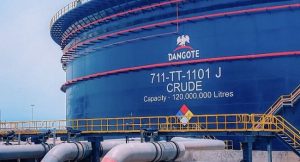
More Organised Private Sector(OPS) groups frowned at the steps taken by the Petroleum and Natural Gas Senior Staff Association of Nigeria (PENGASSAN) to cut off supply to Dangote refinery. in a protest against the retrenchment of 800 staff by the refinery.
Stakeholders, therefore, warned that the country faces renewed foreign exchange (FX) pressures, as PENGASSAN directs its members nationwide to withdraw their services following the alleged mass dismissal of more than 800 Nigerian workers by Dangote Refinery.
This is as the National Industrial Court sitting in Abuja on Monday issued an interim order stopping PENGASSAN from continuing with its nationwide industrial action against the Dangote Petroleum Refinery and Petrochemicals.
Therefore, some members of the organised labour sector have called for the reinstatement of the 800 sacked workers, accusing Dangote of displacing qualified Nigerian professionals and replacing them with foreign labour. However, some OPS groups felt PENGASSAN is biting more than it can chew by allowing the whole country to pay for a sin of one company.
Stakeholders from private sector wondered what made PENGASSAN to take such extreme step as it amounts to an economic sabotage, thus, calling on both parties to return to the negotiating table to trash out their differences.
On its part, the Nigerian Association of Chambers of Commerce, Industry, Mines and Agriculture (NACCIMA) lamented that, the chamber is deeply concerned about the damage the strike would bring on individuals and the economy at large.
According to its national president, (Dr) Jani Ibrahim, this conflict could wreck havoc on the economy and weaken public services across the country, thereby, calling on both parties to return to negotiation table,adding that, “A nationwide shutdown in the energy sector at this time would be a crippling blow to Nigeria’s stabilising economy. The business community is alarmed at the possible consequences for jobs, inflation, and investor confidence. Dialogue is not optional; it is urgent and necessary.”
“
On his part, a lawyer, activist and expert on labour matters, Barrister
Nnanna E. Ogbo, ustified the action of PENGASSAN saying, ‘I support the workers’ right to challenge Dangote if their mass sackings breached labour laws or union rights.’
To him, “But the implications are weighty: legally, the strike could be declared unlawful if due process was not followed; economically, it risks fuel scarcity, higher pump prices, inflation, and loss of government revenue; socially, it could trigger public anger and pressure on government.”
Similarly, a Lagosian, Mr. Kunle Lekan described the action by PENGASSAN as ‘an overzealous act. it is totally wrong for labour to punish the whole country for the supposedly offence of one person or organisation.’
Another Nigerian, Mr Chris Uche said, “due to the sensitivity of the sector, labour unions in oil and gas have been holding the country to ransom. In a free economy, you can’t force a private company to accept unionism. This decision is at the prerogative of the company to join union or not. However, if it’s a government-owned entity, they have every right to protest any act of anti-unionism. They should stop taking the country for a ride.”
Some market observers said, this development may discourage private investors from investing in the oil and gas sector as they are not assured that there won’t be labour interference that may sabotage their investments and could push the Nigerian economy’s daily revenue loss into about $110.8 million from crude oil export and trigger shutdown of gas power plants – a situation which may ground the already distressed economy.
Already, gas providers reported yesterday that gas facilities supplying Escravos Lagos Pipeline System had been shut down, resulting in the disruption of gas supply to the distribution network. Operators and customers were informed that gas would be suspended temporarily till the crisis is addressed.
In the same vein, the National Industrial Court sitting in Abuja has, on Monday, issued an interim order stopping the group from continuing with its nationwide industrial action against the Dangote Refinery.
Justice Emmanuel Sublim, presiding over the matter, granted the order, saying, the strike meant to disrupt the operations of the Refinery by cutting crude and gas supplies to it, was capable of causing serious damage to the nation’s economy and that the Association should stop forthwith.
The decision of the court was consequent upon an ex-parte application filed by the Refinery’s counsel, Mr. George Ibrahim, SAN.
Moreover, the court equally restrained key regulatory bodies, the Nigerian National Petroleum Company Limited (NNPCL), the Nigerian Midstream and Downstream Petroleum Regulatory Authority (NMDPRA), and the Nigerian Upstream Petroleum Regulatory Commission (NUPRC) from enforcing any directive by PENGASSAN to halt crude oil and gas supply to the refinery.
In his ruling, Justice Sublim said, the court agreed with the Refinery’s submission that the strike could cause irreparable damage if not promptly addressed . He emphasised the need to maintain the status quo pending the determination of the substantive motion.
The court further directed that the restraining order and suit be served on all defendants without delay. The matter has been adjourned till October 13 for hearing of the motion on notice.
in the same vein,, the leadership of Association of Senior Civil Servants of Nigeria (ASCSN) has thrown its weight behind PENGASSAN.
In its statement, on Monday, the president, Comrade Shehu Mohammed, expressed total solidarity with the Trade Union Congress of Nigeria (TUC) and PENGASSAN in condemning the unjust and anti-labour practices recently carried out by the management of Dangote Petroleum Refinery.
In the statement, Mohammed said, “the arbitrary dismissal of workers for exercising their constitutional right to freely associate and belong to a trade union is a gross violation of Section 40 of the Nigerian Constitution and a direct breach of Nigeria’s obligations under International Labour Organization (ILO) conventions.
“Such acts are unacceptable and cannot be tolerated in a democracy. We,
therefore, stand shoulder-to-shoulder with TUC and PENGASSAN in demanding
the immediate reinstatement of all affected workers just as we support the call for an independent investigation into the refinery’s anti-worker practices.”
Furthermore, Mohammed warned “that if this matter is not resolved within a reasonable time frame, the ASCSN may be compelled to join the national action in full force, in defence of workers’ rights and to ensure justice is done.”
However and in solidarity, Trade Union Congress (TUC) has thrown its weight behind the strike and demanded Dangote Refinery to follow labour law.
The secretary general of TUC, Comrade Nuhu Toro called on Dangote Refinery to reinstate the 800 staff that were sacked for allegedly belonging to trade union in line with International Labour Organisation (ILO).
In a swift reaction, Dangote accused PENGASSAN of deploying terrorist tactics to frustrate investors. Dangote, however, warned that, cutting crude oil and gas supplies to the refinery could plunge Nigerians into fresh rounds of fuel scarcity while inflicting huge revenue losses on the government.
In a statement, the refinery described the directive as “criminal, reckless and an act of economic sabotage” that, if enforced, would disrupt the production and nationwide supply of critical petroleum products, including petrol, diesel, aviation fuel, kerosene and cooking gas.