
Bank Deposits At CBN Window Drops To N1.76trn
…….As Banks Adjust To New Regulations
BY ZAKA KHALIQ
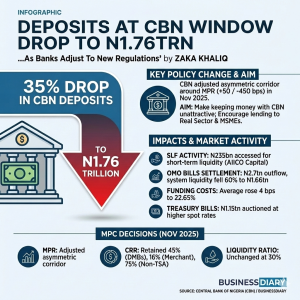
The adjustment of asymmetric corridor to +50 and -450 basis points around the Monetary Policy Rate(MPR) at the last MPC meeting in November 2025 is taking a toll on the banks as deposits at the Central Bank of Nigeria(CBN) window fell by 35 per cent to N1.76trillion.
The apex bank had, at the latest MPC meeting, adjusted the asymmetric corridors to make it unattractive for banks to keep money with CBN.
The aim of the move, *BUSINESSDIARY* learnt, is to ensure banks increase lending to the real sector and Micro, Small and Medium Enterprises (MSMEs), thereby, leading to economic growth.
This development, it was learnt, however, triggered banks to reduce their deposits in the apex bank and increase lending to critical sectors of the nation’s economy.
According to experts at TrustBanc Financial Group Limited, deposits at the CBN window fell by 35 per cent to N1.76 trillion, as banks adjusted to the apex bank’s primary market actions.
Similarly, activity picked up at the Standing Lending Facility (SLF), with some market participants accessing about N235billion to meet short-term liquidity needs, according to AIICO Capital Limited.
In the Treasury bills market, the CBN conducted an auction offering N1.15 trillion across the 91-day, 182-day and 364-day tenors, even as the apex bank allotted the full amount at higher spot rates, reinforcing the upward pressure on short-term yields.

Consequently, average funding costs in the money market rose by four basis points to 22.65 per cent. The Open Repo Rate (OPR) remained unchanged at 22.50 per cent, while the Overnight Rate (OVN) climbed by eight basis points to close at 22.79 per cent.
Despite the net Nigerian Treasury Bills settlement due last week, analysts expect system liquidity to remain relatively firm, with funding rates likely to trade around current levels in the neacondition.
Meanwhile, money market rates closed on a mixed note as liquidity in the financial system fell sharply by about 60 per cent, following a major outflow triggered by the settlement of Open Market Operation (OMO) bills.
Market data showed that system liquidity declined after the settlement of about N2.7 trillion OMO bills allotted to foreign portfolio investors and local deposit money banks, tightening funding conditions across the interbank market.
The Central Bank of Nigeria’s aggressive open market operations at the start of the year drained liquidity from the system, as the apex bank sought to maintain a manageable funding profile.
As a result, money market liquidity opened the session at about N1.66 trillion, representing a 60 per cent drop from the previous day’s level.
Bank placements at the Standing Deposit Facility (SDF) also continued to decline, reflecting tighter liquidity conditions.
Earlier, .CBN governor, Olayemi Cardoso, speaking in Abuja at the end of the November MPC meeting said, the committee members also voted to adjust the asymmetric corridor to +50 and -450 basis points around the MPR.
The governor said, the committee also retained the cash reserve ratio (CRR) at 45 percent for deposit money banks (DMBs), merchant banks at 16 percent, and 75 percent for non-treasury single account (TSA) public sector deposits.
He added that the committee decided to keep the liquidity ratio unchanged at 30 percent.





