Valentine Beyond Boundaries For Prosperous Nigeria
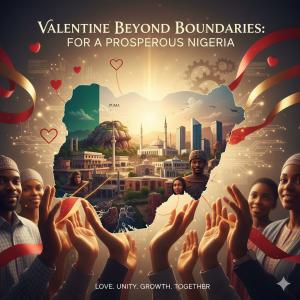
Every February 14, streets, restaurants and social media platforms across Nigeria glow in red and white as couples exchange gifts, flowers and heartfelt messages to mark Valentine’s Day.
Yet, in a country as diverse and complex as ours, the deeper essence of the day should stretch far beyond romance. It should serve as a national reminder that love, in its broadest and most powerful sense, remains Nigeria’s most urgent civic virtue.
Nigeria is home to more than 250 ethnic groups, divided across religious affiliations, political loyalties, generational identities and socio-economic realities. These differences are not weaknesses; they are sources of cultural richness and strength. However, when mistrust and suspicion take root along these lines, the consequences can be severe, from political tension and sectarian conflict to online hostility and social fragmentation.
Valentine’s Day offers a symbolic opportunity to push back against these divisions.
Love, in a national context, is not sentimental. It is practical. It is expressed in tolerance, fairness, inclusion and empathy. It is demonstrated when citizens defend the rights of those who worship differently, speak a different language or vote for another political party. It is affirmed when leaders prioritise justice over patronage, dialogue over hostility and national interest over sectional gain.
Across Nigeria’s history, moments of unity have proven transformative. From collective responses to public health crises to the resilience shown during economic hardship, Nigerians have repeatedly demonstrated that solidarity can overcome adversity.
These moments should not be reserved for emergencies alone. They should define our everyday civic culture.
In today’s digital age, where misinformation can inflame ethnic or religious tensions within minutes, demonstrating love also means choosing restraint and responsibility. It means rejecting narratives that dehumanise fellow citizens. It means remembering that behind every label, North or South, Christian or Muslim, majority or minority, is a human being deserving of dignity.

For young Nigerians in particular, Valentine’s Day can represent a shift in meaning. Beyond romantic gestures, it can inspire acts of kindness across community lines, visiting orphanages, supporting displaced persons, mentoring across social divides, or simply building friendships that transcend inherited prejudices.
The future of national cohesion depends largely on this generation’s willingness to see diversity not as a threat but as shared heritage.
Political leaders, too, must embrace the spirit of the season. Love of country is measured not by rhetoric but by policies that protect the vulnerable, reduce inequality and ensure justice. A Nigeria where opportunity is not determined by ethnicity or religion is one where unity will flourish naturally.
The economic dimension of unity cannot be ignored. A divided society struggles to build investor confidence, attract long-term capital or sustain development.
Trust is a cornerstone of growth. When citizens believe they are treated fairly regardless of identity, productivity and cooperation rise. In that sense, national love is also sound economic policy.
Valentine’s Day, stripped of commercial excess, reminds us that relationships, whether personal or national, survive on empathy, sacrifice and mutual respect. Nigeria’s diversity is permanent. The choice before us is whether we allow it to fracture us or enrich us.
If February 14 becomes more than a celebration of romantic affection, if it becomes a conscious reaffirmation of unity across ethnic, religious, political and demographic lines, then it will serve a higher purpose.
In a nation of immense promise and persistent challenges, perhaps the most radical and Transformatve act is simple: to choose love over division, and to practice it deliberately, every day of the year.