Leveraging Tourism As Nigeria’s Next Economic Frontier
At a time when Nigeria is searching for durable pathways to economic diversification, tourism remains one of the country’s most underutilised assets.
Beyond oil and gas, few sectors combine job creation, foreign exchange earnings, cultural diplomacy and small-business growth as powerfully as tourism. Yet, despite Nigeria’s vast natural beauty, rich history and vibrant creative culture, tourism continues to sit at the margins of national economic planning. This must change.
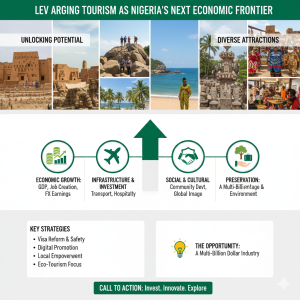
Nigeria has what many successful tourism economies spend decades trying to build: diversity. From the Obudu Mountain Resort to Yankari Game Reserve, from the ancient walls of Kano to the Osun-Osogbo Sacred Grove, and from the beaches of Lagos to the festivals of Calabar, Argungu and Ojude Oba, the country possesses attractions that can compete globally. Nollywood, Afrobeats and Nigerian cuisine have already sparked international curiosity.
What is missing is a coherent strategy to convert this cultural capital into sustained economic value.
Tourism is labour-intensive and inclusive. It creates jobs not only in hotels and airlines, but also for tour guides, artisans, transport operators, farmers, entertainers and tech startups. For a country battling youth unemployment, tourism offers opportunities that do not require heavy capital investment or advanced technical skills to get started. With the right policies, it can absorb thousands of young Nigerians into productive work, especially, in rural and semi-urban areas where government and private-sector jobs are scarce.
However, Nigeria cannot talk seriously about tourism growth without addressing the fundamentals. Security is paramount. No amount of marketing can override travellers’ concerns about safety. Improving security around major tourist corridors, cultural sites and national parks is not optional; it is foundational.
This requires coordination between federal, state and local authorities, as well as community involvement to protect and benefit from tourist assets.

Infrastructure is another critical bottleneck. Poor road networks, unreliable power supply, weak rail connectivity and congested airports raise the cost of travel and discourage both domestic and international tourists. Tourism thrives where movement is easy and experiences are seamless. Targeted infrastructure development around tourism clusters, rather than thinly spread capital projects, would deliver faster and more visible results.
Equally important is policy coherence. Nigeria’s tourism sector suffers from fragmented regulation, overlapping agencies and inconsistent incentives. A clear national tourism master plan, aligned with state-level strategies, would provide direction and confidence for investors. Incentives such as tax holidays, access to credit for hospitality businesses, and public-private partnerships for resort and heritage site development can catalyse private capital into the sector.
Domestic tourism also deserves greater attention. Millions of Nigerians travel within the country every year for work, family and religious reasons. With better promotion, pricing and safety, leisure tourism can be layered onto these movements. Encouraging Nigerians to “see Nigeria” is not just patriotic messaging; it is sound economics that keeps spending within the country and builds resilience against external shocks.
Marketing and branding remain weak links. Nigeria’s global image is often shaped by negative headlines, while its stories of beauty, creativity and hospitality go untold. Strategic international marketing, digital storytelling and partnerships with airlines, influencers and the diaspora can help reshape perceptions. Countries like Morocco, Rwanda and Ghana have shown how deliberate branding can reposition a nation as a must-visit destination within a decade.
Ultimately, tourism growth must be sustainable. Protecting cultural heritage, conserving wildlife and ensuring host communities benefit economically are essential to long-term success. Tourism that displaces communities or degrades the environment will ultimately fail. Inclusive planning, local ownership and environmental standards must be at the heart of expansion efforts.
Nigeria’s economic challenges are deep, but so are its opportunities. Tourism is not a silver bullet, but it is a powerful, proven tool that many comparable economies have used to drive growth, create jobs and earn foreign exchange. With political will, smart investment and coordinated action, tourism can move from the sidelines to become a central pillar of Nigeria’s economic future.