
Economic Hardship Deepens As Nigerians Battle Renewed Crisis In Cost, Standard of Living
BY CEES HARMON
Nigeria is witnessing a renewed surge in the cost of living, with rising prices of school fees, food, petrol, cooking gas, electricity tariffs, healthcare, and taxes placing unprecedented pressure on household incomes and worsening living standards across the country.
Recent data show that inflation, though moderating on paper, remains deeply entrenched in everyday life.
Headline inflation hovered around 15% in early 2026 after peaking near 35% in 2024, but experts say the easing has not translated into relief for ordinary Nigerians.
“The numbers suggest inflation is slowing, but the reality for households is very different. Prices are still high, and incomes have not caught up, so people continue to feel poorer,”
said the chief executive of the Center for the Promotion of Private Enterprise (CPPE), Dr. Muda Yusuf.
Evidence suggests that the crisis is largely driven by sustained increases in energy and food costs. Over the past five years, petrol prices have surged sharply, while cooking gas prices have also climbed significantly, raising transport and household energy costs.
Food prices have been particularly severe. According to recent estimates, the cost of preparing a basic pot of jollof rice has increased by more than 150% since 2023, with a single meal consuming a large share of the N70,000 minimum wage.
Data tracking grocery prices show a dramatic jump in the cost of essential food items, from about N25,225 in 2020 to over N147,000 in 2026, highlighting the scale of pressure on household budgets.
“Food inflation has been the most painful component for Nigerians because it directly affects survival. When food prices rise this fast, poverty deepens almost immediately,” said an economic analyst, Dr. Simeon Muokhudo.
The World Bank has also warned that rising food costs disproportionately affect low-income households, who spend the bulk of their earnings on basic consumption.
Despite nominal wage increases, economists say real incomes have collapsed. “Even where salaries have increased, they have not kept pace with inflation, In real terms, purchasing power has declined significantly,” Muokhudo added.
Recent policy reforms, while aimed at stabilising the economy, have contributed to rising costs. The removal of petrol subsidies, electricity tariff hikes, and proposed tax changes have increased the cost of essential services.

Electricity tariff adjustments alone have shifted more of the burden to consumers, while higher fuel prices have cascaded into transport fares, food logistics, and school operations.
A financial economist at Nnamdi Azikiwe University, Dr. Felix Echekoba, stated that, “Energy is at the centre of this crisis. Once you increase fuel and electricity prices, everything else, from transportation to production goes up.”
Healthcare costs have also climbed, as hospitals pass on higher energy and import costs for drugs and equipment to patients.
According to analysts, inflation pressures are now concentrated in services such as health, education, and transport, which continue to record double-digit increases despite moderation in food inflation.
Economists describe Nigeria’s situation as a classic cost-push inflation crisis, driven by structural factors such as currency depreciation, energy costs, insecurity in farming regions, and supply chain disruptions.
For millions of Nigerians, the impact is immediate and severe.
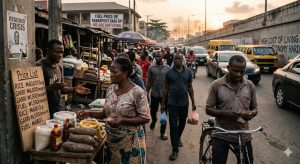
“I have stopped buying certain foods entirely,” said Chioma Eze, a Lagos-based trader. “We now cook smaller portions, and sometimes we skip meals just to cope.”
Another resident, Musa Abdullahi, a civil servant in Abuja, said rising school fees and transport costs have forced difficult choices. “I had to move my children to a cheaper school.
Even transportation to work now takes a big part of my salary,” he said.
Small business owners are also struggling. “The cost of running a small restaurant has doubled. Gas, food items, everything is more expensive, and customers are not spending like before,” said Adebayo Ogunleye a food vendor in Lagos.
Studies indicate that rising living costs are pushing more Nigerians into poverty, increasing debt levels, and reducing overall welfare.
A recent analysis summed up the situation: despite lower official inflation figures, Nigerians are “barely surviving” as prices remain high and incomes stagnant.
While Nigeria’s economy continues to record modest growth projections, experts warn that without targeted interventions such as food supply reforms, wage adjustments, and social protection, the benefits may not translate into improved living standards.
The resurgence in living costs continues to define daily life for millions, turning basic necessities into luxuries and reshaping consumption patterns across Africa’s largest economy.





