
Nigerians Buckle Under Soaring Rents As Housing Crisis Deepens
BY CEES HARMON
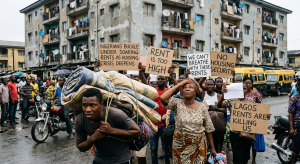
Millions of Nigerians are facing mounting pressure from surging house rents as inflation, rapid urbanisation, high construction costs and limited housing supply combine to deepen the country’s housing crisis.
From Lagos to Abuja and Port Harcourt, tenants said, accommodation costs have risen sharply over the past two years, forcing many households to relocate farther from city centres, share apartments or devote a disproportionate share of their incomes to rent.
The development comes amid Nigeria’s worsening cost-of-living crisis, where rising food prices, transportation costs, electricity tariffs, and school fees have already strained household finances.
“I renewed my two-bedroom apartment in Lagos last year for N1.2 million, but my landlord is now demanding N2 million. My salary has not increased, yet every expense keeps going up,” said Livinus Okafor, a civil servant living in the Ikotun area of Lagos.
Real estate analysts said, the housing challenge reflects broader macroeconomic pressures affecting both developers and tenants.
According to the National Bureau of Statistics(NBS), Nigeria’s inflationary environment has significantly increased the prices of cement, iron rods, tiles, paints, cables and other construction materials, making housing development more expensive.
The cost of cement alone has more than doubled in recent years, while the depreciation of the naira has pushed up the prices of imported building materials and equipment.
“The housing sector is heavily impacted by inflation and exchange rate volatility. Developers are facing higher financing costs, higher material costs, and infrastructure deficits. Inevitably, those costs are transferred to tenants,” noted the chief executive of the Center for the Promotion of Private Enterprise(COPE) , Dr. Muda Yusuf.
Nigeria currently faces an estimated housing deficit of more than 20 million units, according to industry estimates, with rapid population growth and urban migration worsening demand pressures.
Experts said, the shortage is particularly severe in major commercial cities where employment opportunities continue to attract migrants.
In Abuja, average rents in some districts have reportedly doubled within two years, driven by rising demand and limited supply.
“For many young workers, renting a decent apartment is becoming nearly impossible People now spend 40 to 60 percent of their incomes on rent, which is unhealthy for any economy.” said housing advocate, Funmilayo Adeoye.
Landlords, however, argued that, they are equally under pressure.

Property owner, Adewale Ogunleye said, rising maintenance expenses, taxes, security costs and inflation have forced many landlords to adjust rents upward.
Diesel prices, repairs, security, and service charges have all increased, he said. “People think landlords are simply exploiting tenants, but many property owners are also struggling to maintain their buildings, ” he noted.
Real estate developers also cited high borrowing costs as a major challenge.
Nigeria’s high interest rate environment has made mortgage financing and real estate development increasingly difficult, discouraging new housing projects.
A property developer, Chinedu Okeke, told BUSINESSDIARY that, “the cost of financing is a major obstacle. Developers borrow at very high rates, and when you add infrastructure costs like roads, power, and drainage, housing becomes extremely expensive.”
The problem has also exposed the weakness of Nigeria’s mortgage system. Compared to many countries, mortgage penetration in Nigeria remains very low, leaving most citizens dependent on outright rent payments or informal housing arrangements.
Analysts said, weak access to long-term affordable financing has limited home ownership and increased pressure on the rental market.
Beyond economics, urban planning experts argue that poor infrastructure concentration in a few cities has intensified housing demand in select urban centres.
‘Economic opportunities are too concentrated in Lagos and Abuja, said urban development consultant Ibrahim Yusuf, adding that, “if infrastructure and industries were better distributed across states, housing pressure would reduce significantly. ‘
Tenants’ associations are, meanwhile, calling for stronger government intervention, including rent regulation, affordable housing schemes, and incentives for mass housing development.
However, economists warn that excessive rent controls without corresponding increases in housing supply could discourage private investment in real estate.
“The long-term solution is not arbitrary rent caps. Nigeria needs large-scale housing construction, cheaper financing, improved infrastructure, and stable macroeconomic policies, ” he said.
The federal government has repeatedly pledged to expand affordable housing through public-private partnerships and housing programmes, but many Nigerians say the impact has yet to be widely felt.
For families already battling rising living costs, the housing crisis is becoming increasingly unbearable.
“After paying rent, transport, food, and electricity, there is almost nothing left. People are working harder but living worse, ”
an Abuja resident, Maryam Bello said.





