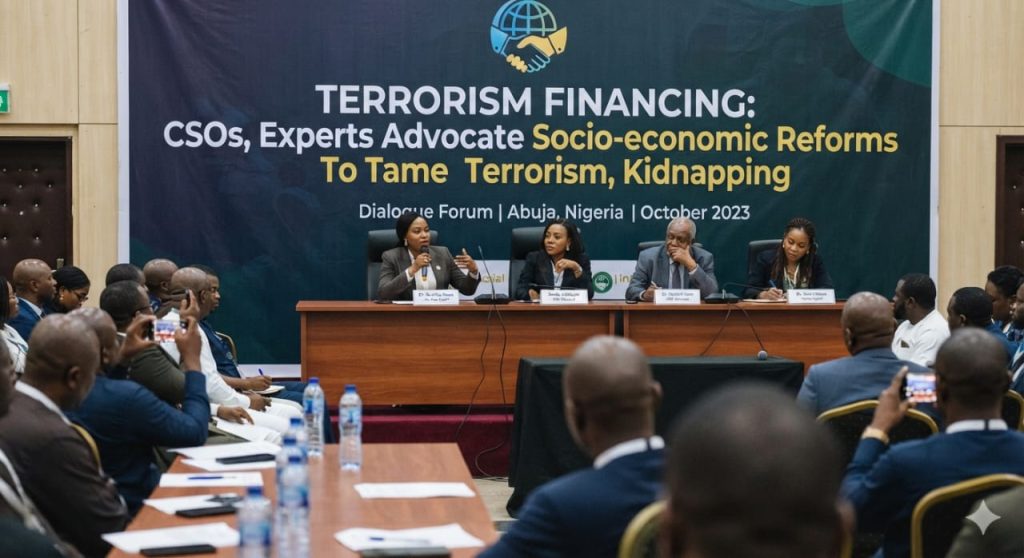
TERRORISM FINANCING: CSOs, Experts Advocate Socio-economic Reforms To Tame Terrorism, Kidnapping
BY CEES HARMON
Civil society organisations (CSOs) and security experts have called for a comprehensive strategy to combat terrorism financing, warning that, disrupting the financial lifeline of criminal groups alone will not end Nigeria’s worsening insecurity unless accompanied by broader institutional and socio-economic reforms.
Speaking against the backdrop of increasing terrorist attacks, kidnappings and violent crimes across the country, experts agreed that, choking the sources of funding for terrorist organisations would significantly weaken their operational capacity but stressed that, it must form part of a wider national security framework.
Recall that, the Central Bank of Nigeria (CBN) has ordered banks, payment service banks and other financial institutions to immediately freeze all accounts, assets, and transactions linked to six individuals and 4 Bureau De Change (BDC) operators over terrorism financing.
The directive, contained in a circular dated June 24, 2026 (Ref:CMD/FCS/PUB/CIR/002/011), stated that, the latest update to the Nigeria Sanctions List, effective June 18, 2026, is binding on all regulated institutions and requires immediate implementation.
The apex bank, in the circular, notified regulated entities of fresh sanctions issued by the Nigeria Sanctions Committee (NIGSAC) and the United States Department of the Treasury’s Office of Foreign Assets Control (OFAC) under Executive Order 13224, as amended.
Responding to the development, a security analyst, Dr. Musa Adamu said, financial intelligence remains one of the most potent weapons against terrorism, noting that, terrorist organisations depend on steady financial flows to procure arms, recruit fighters, gather intelligence and sustain logistics.
“Following the money trail will certainly reduce the operational capacity of terrorist groups. However, terrorism in Nigeria has evolved into a complex ecosystem involving ideological extremism, organised crime, illegal mining, cattle rustling and cross-border trafficking. Financial disruption alone cannot eliminate these threats,” he said.
According to the Global Terrorism Index 2025, Nigeria remains among the countries most affected by terrorism despite recording improvements from previous years, while the country continues to witness frequent incidents of kidnapping-for-ransom and attacks by armed criminal groups.
Security consultant, Col. Francis Attah (rtd.), argued that, addressing terrorism requires a whole-of-government approach that combines military operations with intelligence-led policing, judicial reforms and stronger border security.
“We must strengthen intelligence gathering, improve inter-agency collaboration, secure our porous borders, deploy modern surveillance technology and ensure swift prosecution of terror financiers. Without certainty of punishment, criminal networks will continue to thrive,” he said.

The experts also identified youth unemployment, poverty, weak governance and corruption as underlying drivers of violent crimes, urging government to invest heavily in education, skills acquisition and job creation.
Executive director of the Civil Society Legislative Advocacy Centre (CISLAC), Auwal Musa Rafsanjani said, fighting corruption should remain central to Nigeria’s security strategy because illicit financial flows and diversion of public resources often create opportunities for criminal enterprises.
“Security is not only about weapons. Good governance, transparency, accountability and inclusive economic development are equally critical in preventing violent extremism and organised crime,” he noted.
On the growing debate over state policing, the experts maintained that decentralising policing could improve response time and community intelligence if backed by constitutional safeguards.
They explained that, state police would differ from the current centralised policing architecture by allowing states to recruit personnel familiar with local languages, terrain and security dynamics. However, they cautioned that without adequate oversight, operational standards and legal safeguards, state police could be vulnerable to political interference and abuse by state governments.
A former Assistant Inspector-General of Police said, ‘State policing is not a magic solution. Success depends on professionalism, funding, accountability and coordination with federal security agencies.’
Meanwhile, with insecurity spreading beyond traditional flashpoints into parts of the South-West, a security professional, Moses Ajabe, urged business owners to adopt stronger preventive measures.
He advised companies to conduct regular security risk assessments, install surveillance cameras and access control systems, verify employees and contractors thoroughly, establish emergency response protocols and maintain close collaboration with security agencies and host communities.
Ajabe also encouraged business owners to embrace digital security by protecting sensitive data from cybercriminals, limiting public disclosure of executives’ movements and training staff to identify suspicious activities.
According to available crime statistics from the National Bureau of Statistics, thousands of Nigerians have fallen victim to kidnapping in recent years, with billions of naira reportedly paid as ransom, underscoring the economic and psychological impact of insecurity on businesses and households.
Ajabe concluded that defeating terrorism, kidnapping and other violent crimes requires sustained political commitment, improved intelligence, effective law enforcement, stronger institutions and greater public participation.
He stressed that, while disrupting terrorism financing is an important starting point, lasting national security will only be achieved through coordinated reforms that simultaneously address criminal funding, governance deficits and socio-economic inequalities.