
Nigeria Needs Improved Economic Complexion To Unlock Sustainable Growth
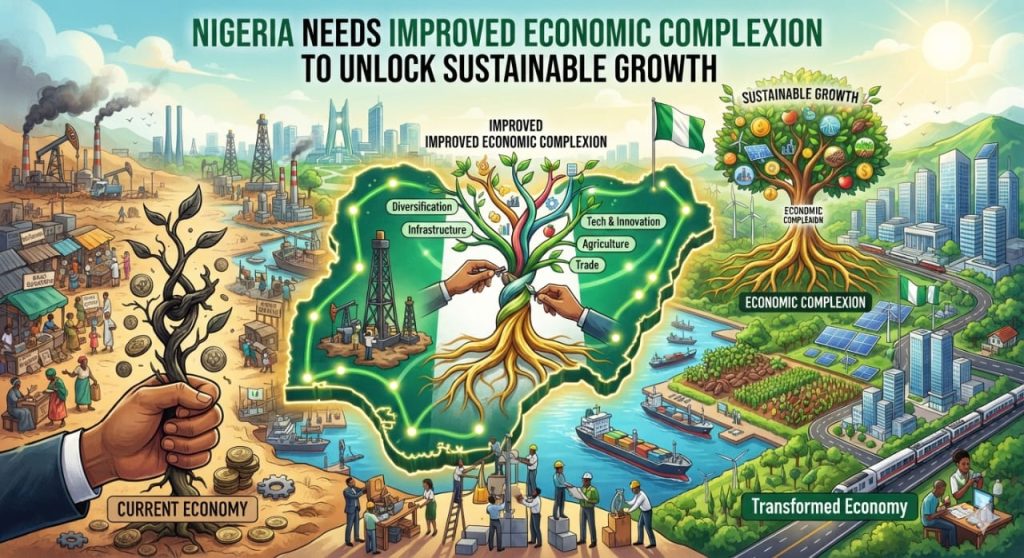
For decades, Nigeria has been described as the ‘Giant of Africa.’ It boasts the continent’s largest population, vast natural resources, an entrepreneurial citizenry and one of Africa’s biggest consumer markets. Yet, these advantages have not translated into the level of economic prosperity expected of a country with such enormous potential.
The challenge is not the absence of resources or opportunities. It is the complexion of the economy itself.
An economy’s complexion is defined by the quality, diversity and competitiveness of its productive sectors. Healthy economies are characterised by strong manufacturing, modern agriculture, efficient infrastructure, robust exports, technological innovation and a vibrant private sector.
By contrast, economies that depend excessively on raw commodity exports and imports of finished goods remain vulnerable to external shocks and struggle to generate broad-based prosperity.
Nigeria belongs to the latter category.
Although Nigeria has made progress in telecommunications, financial services, entertainment and the digital economy, its productive base remains relatively narrow. The manufacturing sector has contributed only about 9 to 10 per cent of Gross Domestic Product (GDP) for much of the past two decades, while crude oil still accounts for the overwhelming share of export earnings and a substantial portion of government revenue.
This economic structure has repeatedly exposed the country to fluctuations in global oil prices and exchange-rate instability.
The consequences are evident.
According to the National Bureau of Statistics (NBS), agriculture contributes roughly one-quarter of Nigeria’s GDP and employs a large share of the labour force, yet productivity remains low because of inadequate mechanisation, insecurity, poor rural infrastructure and limited irrigation.
Manufacturing has struggled to expand because of unreliable electricity, expensive financing, weak logistics and inconsistent industrial policies. The result is an economy that consumes more than it produces.
Nigeria imports refined petroleum products, industrial machinery, pharmaceuticals, processed foods and numerous consumer goods that could be produced locally with the right policies and investments. This import dependence places persistent pressure on foreign exchange demand and weakens the naira whenever export earnings decline.
Recent reforms introduced by the federal government, including the removal of petrol subsidies, exchange-rate liberalisation and fiscal adjustments, have sought to restore macroeconomic stability. Indeed, some encouraging signs are emerging. Foreign exchange liquidity has improved, headline inflation has shown signs of moderation compared with earlier peaks, and investor confidence is gradually recovering.
However, macroeconomic stability alone cannot deliver rapid economic growth.
The next phase of reform must focus on transforming the productive structure of the economy.
Industrialisation should become the centrepiece of Nigeria’s development strategy. Countries that achieved sustained economic transformation did so by producing more sophisticated goods, expanding manufacturing capacity and integrating into global value chains.
China transformed from a predominantly agrarian economy into the world’s manufacturing powerhouse through decades of industrial investment. Vietnam evolved into a major exporter of electronics, textiles and agricultural products.
Indonesia diversified beyond oil by strengthening manufacturing and agro-processing. Nigeria possesses similar opportunities.

With more than 220 million people, the country offers Africa’s largest domestic markets. The African Continental Free Trade Area (AfCFTA) provides Nigerian manufacturers access to a continental market of over 1.4 billion people. The country’s abundant agricultural resources can support agro-processing industries, while its mineral deposits present opportunities for domestic beneficiation rather than raw exports.
Yet these opportunities will remain unrealised unless long-standing structural constraints are addressed.
Electricity remains perhaps the greatest impediment to industrial competitiveness. Despite improvements in generation capacity over the years, power supply remains unreliable, forcing businesses to rely heavily on diesel and petrol generators. Energy costs now account for a significant share of manufacturing expenses, reducing profitability and discouraging investment.
Infrastructure deficits also continue to constrain economic growth.
Roads linking farms to markets require upgrading. Rail freight networks remain underdeveloped. Inland waterways are underutilised. Port congestion increases the cost of imports and exports, while inadequate storage facilities contribute to substantial post-harvest losses in agriculture.
Access to finance presents another obstacle. Commercial lending rates often exceed 25 per cent, making long-term industrial investment prohibitively expensive. Development finance institutions should therefore play a greater role in providing affordable financing for manufacturers, agro-processors and small businesses capable of generating employment.
The business environment also requires further improvement. Policy consistency is essential for investor confidence. Frequent changes in tariffs, taxation and regulatory requirements increase uncertainty and discourage long-term investments.
Governments at all levels must create a predictable regulatory environment that rewards production rather than speculation.
Equally important is human capital development. A modern economy requires skilled workers, engineers, technicians, researchers and innovators. Greater investment in education, vocational training, digital skills and scientific research will enhance productivity and strengthen Nigeria’s competitiveness in an increasingly technology-driven global economy.
Subnational governments also have a critical role to play. States that invest in industrial parks, improve infrastructure, strengthen security and simplify business regulations are increasingly attracting manufacturing investments. The emergence of industrial clusters in Lagos, Ogun, Kano, Kaduna, Abia and Anambra demonstrates that sound policies can stimulate local economic development even within a challenging national environment.
Nigeria must also accelerate value addition. Instead of exporting cocoa beans, cotton, hides, lithium and other raw materials, the country should process them into chocolate, textiles, leather products, batteries and other higher-value manufactured goods. Such an approach would create jobs, increase export earnings and reduce dependence on volatile commodity markets.
Nigeria has all the ingredients required for economic transformation: abundant natural resources, a large and youthful population, entrepreneurial talent and strategic access to regional markets. What remains is the determination to build an economy driven by production, innovation and competitiveness rather than consumption and imports.
Improving Nigeria’s economic complexion is therefore not an abstract aspiration. It is the pathway to higher productivity, stronger exports, greater investment, sustainable job creation and shared prosperity.
The country’s future will be determined not by the resources beneath its soil, but by the value it creates above it.





