
Nigerians, Telcos Trade Blame Over Data Depletion
.. As Telcos Links Data Drain To App Updates
….Consumers Advocate Values For Money, Better Services
BY CEES HARMON, Lagos and GBENGA ELIJAH, Abuja.
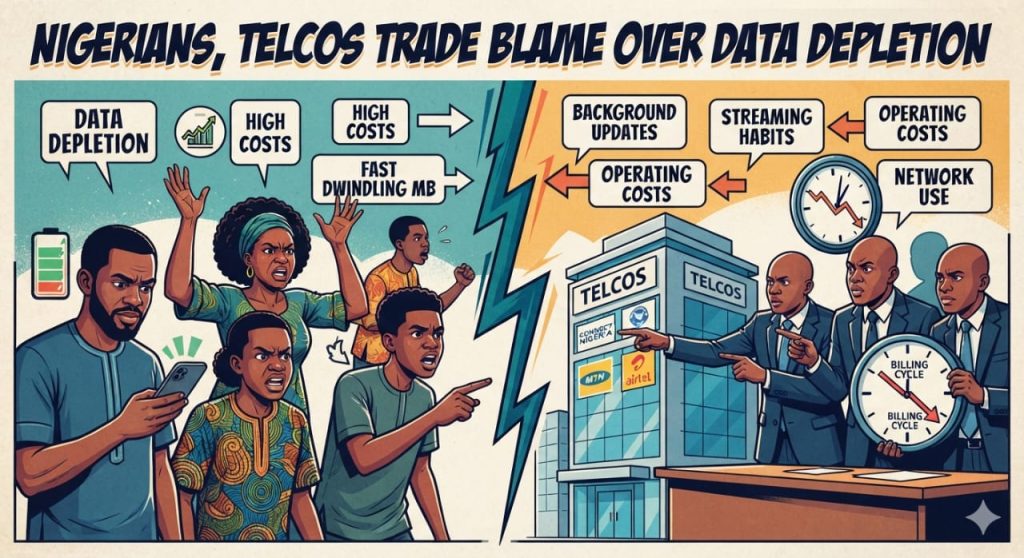
Nigeriia’s mobile phone users and their telecommunications service providers are trading blames over who is responsible for data depletion, BUSINESSDIARY learnt.
While Nigerians have always complained that they are not getting values for money, the three biggest telcos, which are MTN, Glo and Airtel linked data drain to automatic mobile application updates on the phones of their subscribers.
Nigerians who spoke to BUSINESSDIARY at the weekend, were groaning over the development, urging service providers to do better in service delivery, especially, on browsing and voice calls.
Consumers urged operators to improve transparency in data billing and service delivery as internet costs continue to rise.
The concerns come months after the Nigerian Communications Commission (NCC) approved a tariff adjustment that increased the prices of voice and data services, prompting many subscribers to question whether they are receiving value for money.
Interviews with subscribers, industry experts and consumer advocates reveal growing frustration over what many describe as data bundles being exhausted faster than expected, even as telecommunications operators insist their billing systems are accurate and comply with regulatory standards.
According to the NCC, Nigeria has over 170 million internet subscriptions, with mobile broadband serving as the primary means of internet access for millions of individuals, businesses, students and government agencies. As digital banking, e-commerce, online learning and remote work expand, internet connectivity has become indispensable to daily life.
Many subscribers, however, said, rising data costs have not been matched by improvements in service quality.
Nigerians Groan
A civil servant in Lagos, Chinwe Okafor said, she now spends considerably more on internet subscriptions than she did a year ago.
“I buy data more frequently now because it doesn’t seem to last as long. Before, I could use a bundle for several weeks, but now it finishes much faster. We need more transparency from the telecom companies,” she said.
Similarly, Oluwaseun Adeyemi, who runs a small business in Lagos,said, unreliable network connections often force users to repeat downloads and uploads, leading to additional data consumption.
“When the network is unstable, you have to restart downloads or reconnect several times. That consumes extra data, and the customer bears the cost,” she stated.
University student, Maryam Ibrahim at Lagos State University said, the rising cost of internet access has become a burden on students. She added that, “Most lectures, assignments and research are online. Affordable educational data plans would help students a lot.”
Also speaking, Ngozi Eze, an online fashion retailer in Ota, Ogun State said, internet access now accounts for a significant portion of her operating expenses. “Our businesses depend on social media and online communication. We simply want to know exactly where our data is going.”
Meanwhile, many subscribers in the Federal Capital Territory (FCT), Abuja, have called on telecommunications operators to improve service delivery and ensure consumers receive value for the money they spend on data subscriptions.
Speaking with BUSINESSDIARY, Mr. Sunday Pascal expressed frustration over what he described as poor network performance despite the huge amount he spends on data every month.
“I have spent a significant part of my income on data subscriptions because I rely on internet calls and online communication to stay connected with my clients. Unfortunately, there are times when the network completely fails at the most critical moments,” he said.
Pascal recalled an experience during a business trip from Abuja to Enugu, where both mobile networks he used lost service for several hours. “My family could not reach me, and even the client I was travelling to meet could not contact me. It was only by God’s grace that I was eventually able to complete the business meeting successfully. I almost lost the contract because of the prolonged network outage.”
He appealed to the federal government and regulatory authorities to ensure that telecommunications operators improve service quality and provide better value for subscribers.
Another subscriber, Mr. Akachukwu, expressed concern over data expiration policies, saying many customers lose unused data due to network challenges beyond their control. “There are times when I cannot use my subscribed data because of poor network service, yet the data expires. Consumers should not lose what they have paid for simply because the network is unavailable.”
He suggested that, unused data should automatically roll over whenever a subscriber renews a data plan.
“I currently have about 14GB of unused data that remains after expiration. Whenever I subscribe again, the new subscription is used first while the old balance remains untouched until it eventually expires. Telecommunications companies should review this policy so that customers can continue using previously unused data after renewing their subscriptions.”
For Miss Nkechi, a marketer in Abuja, the poor quality of telecommunications services has become a daily challenge.
“The telecommunications system is simply not encouraging. Everyone experiences it every day, so there is really not much more to say,” she remarked.
A student of the University of Abuja, David, also lamented the rising cost of data and its impact on students’ academic activities.
“As students, we depend heavily on the internet for research, assignments and online learning. The increasing cost of data has become a serious financial burden.”
He appealed to telecommunications operators to introduce affordable student data plans that would support learning and improve access to educational resources.
“I believe there should be special educational data packages for students. This will encourage more online learning and reduce the financial pressure on students.”
Industry stakeholders have consistently maintained that network expansion, infrastructure upgrades and increased investment remain critical to improving service delivery.

However, subscribers believe more needs to be done to address persistent complaints about data depletion, network reliability and customer satisfaction.
As demand for digital connectivity continues to grow across Nigeria, many consumers said, they expect telecommunications operators to deliver faster, more reliable services while ensuring subscribers receive fair value for every naira spent on data subscriptions.
Telcos Finger Apps Updates
Telecom operators have linked rapid date depletion to regular and automatic mobile phone application updates, a defense most subscribers didn’t agree with.
Similarly, the linked vandalism, theft and other vices on telecommunications base stations as responsible for poor service network, calling on Nigerians to work hand-in-hand with telcos to secure base stations across the country.
And because of the negative perceptions of Nigerians on data consumption, the ICT sector regulator, NCC, has been embarking on advocacy to enlighten mobile phone users on what they need to do to reduce and slow down data consumption.
Similarly, the telcos, of which MTN is the biggest spender, are now embarking on enlightenment campaign to show consumers on what drain their data and how it could be rectified.
To this end, MTN Nigeria has launched ‘Data On Trial’ initiative to allow its network users lodge complaints and possible resolution on alleged data depletion.
Speaking at the launch of the initiative at its head office in Ikoyi, Lagos, recently, the chief Technical officer, MTN, Yahaya Ibrahim said: “We spent over N900billion last year to upgrade network and we are spending over a N1trillion this year for network upgrade.”
The huge spending on to upgrade its network and system, he noted, shows importance MTN attached to giving premium services to its customers, in view of complaints on the quality of mobile networks in the country.
He stated that, the company listens and attends to customers’ painpoints, which warrants constant system upgrade to give customers a better experience.
On data depletion allegations leveled against telecommunication operators across the country by Nigerians, he said, MTN doesn’t need to deplete data of its customers, explaining that, most data depletion arises from the Application software upgrade and the quality and resolutions of contebts accessed by phone users.
Complaining that its base stations and facilities are, on a daily basis, under threat of vandalism, sabotage and fibre cut, which mostly affected the quality of mobile network, he disclosed that, its outfit records a minimum of 30 to 40 fibre cut complaints per day.
Earlier, the chief Corporate Services and Sustainability officer at MTN Nigeria, Tobe Okigbo, had said, the ‘Data On Trial Initiative’ gives opportunities to its network users to, on their own, find out how data is consumed and billed on its network while giving opportunities to customers to raise concerns directly with its technical teams.
The firm, he said, adopted a similar strategy years ago when subscribers raised concerns over unauthorised value added service subscriptions and deductions.
Okigbo said, MTN subsequently suspended affected services, subjected its systems to regulatory reviews and implemented measures that helped restore customer confidence.
“We want Nigerians to tell us what is wrong, ask questions and help us identify issues so that we can collectively find solutions,” he noted.
Meanwhile, reacting on behalf of telcos accros the country, executive secretary. Association of Telecommunications Companies of Nigeria (ATCON), Ajibola Olude said: “At several fora, we have consistently educated the general public that our members are not cheating them. Many people are unaware that virtually every app installed on their phones consumes data in the background, particularly for updates and other routine activities. ”
Experts’ Reactions
Responding to the concerns, a telecoms consultant in Lagos,Olaolu Banjoko said, many consumers underestimate the amount of data consumed by modern smartphones and applications.
According to him, automatic software updates, cloud backups, video streaming, location services and background application activities contribute significantly to data usage.
“Many users are unaware that several applications continue consuming data even when they are not actively using them. Better consumer education is necessary,” Banjoko said.
Another consultant, Seun Adebayo, maintained that, telecom operators use internationally accepted billing systems that are subject to regulatory oversight.
He said, operators have no incentive to manipulate subscribers’ data consumption because customer confidence remains critical to the industry’s sustainability.
“The increase in video streaming, cloud services and other data-intensive applications has naturally increased data consumption. Billing systems are regularly monitored and comply with regulatory standards,” Adebayo said.
The chief executive officer of the Centre for the Promotion of Private Enterprise (CPPE), Dr. Muda Yusuf said, improving transparency would help rebuild consumer confidence.
According to him, operators should provide subscribers with more detailed information showing which applications consume the highest volumes of data.
“Consumers deserve greater visibility into their data usage. Real-time usage analytics and clearer notifications would reduce disputes and improve trust,” Yusuf said.
Subscribers also called on NCC to strengthen oversight of the sector by conducting periodic independent audits of operators’ billing systems and ensuring greater transparency in data measurement.
Among the measures proposed by consumers are affordable data plans for students and small businesses, improved tools for monitoring data usage in real time, and regular publication of network performance indicators by telecom operators.
Industry analysts noted that, telecom companies are also contending with rising operating costs driven by unreliable electricity supply, higher diesel prices, foreign exchange volatility and the increasing cost of importing telecommunications equipment.
While acknowledging these challenges, they argued that consumers expect measurable improvements in service quality whenever tariffs increase.
As demand for digital services continues to grow, experts say restoring public confidence will require closer collaboration between operators, regulators and consumer groups to ensure subscribers receive fair value for the data services they purchase.





