
THE STREET MARKET: Why Your Insurance Company Must Recapitalise
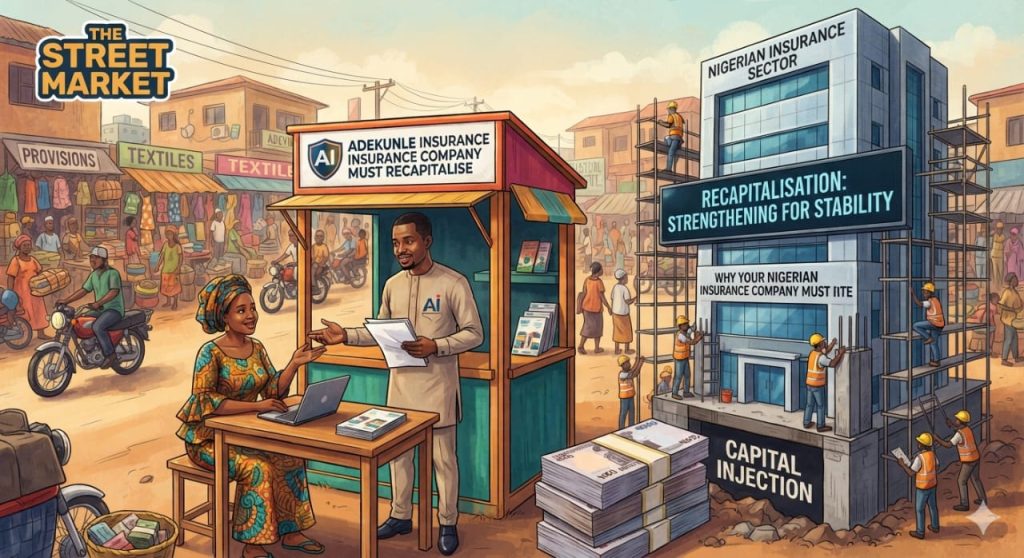
BY ZAKA KHALIQ
As insurance industry recapitlisation exercise rounds up today, Nigerinas must be interested in the insurance companies that recapotalised.
Already, BUSINESSDIARY investigation revealed that over 80 per cent of the exisitong underwriters scaled through the hurdle whose deadline is today, July 31st, 2026, as the National Insurance Commission (NAICOM) insist no shift in deadline.
Recall that NAICOM had earlier increased the minimum capital thresholds across the industry. Life companies had their capital increased from N2billion to N10 billion; Non-life underwriters from N3billion to N15billion; Composite insurers from N5billion to N25 billion and Reinsurers from N10billion to N35 billion, this, translating to about 400 per cent capital increase with a deadline of July 30, 2026.
As a motorist who has either comprehensive or third party motor insurance policy or a worker with group life insurance coverage or other life policies, it is critical to monitor the operations of your insurer.
This is critical to know how strong or weak your underwriter is to either ppay claims or not when risk crystalises.
Even for the uninsured, you need to know a cradle insurer to do your underwriting with. So, everyone should stay alert to know who is liquid enough to carry their risks.
No doubt, the exercise will primarily guarantee that policyholders receive prompt, full claims payments while building a more reliable and financially secure financial sector.
Ordinary citizens, local businesses and the broader economy stand to gain several major benefits from this financial shake-up.
Here are the snipet of the exercise:
Individual Policyholder
- Guaranteed Claims Settlement: The massive capital boost removes liquidity struggles, giving you the confidence that accidents, health issues, or property losses will be paid out without delays.
- Safety Nets for Insolvency: The new law introduces a dedicated Policyholder Protection Fund, meaning that even if an insurance company fails or merges, your active policies and claims remain legally protected.
- Zero-Tolerance for Delays: Regulatory enforcement eliminates the old practice of insurers dragging out claims approvals, ensuring immediate financial relief when disasters strike.
- Fair Pricing and Transparency: Stricter risk-based supervision means clear policy wording and fairer, highly transparent product pricing for the public.
- Digital Convenience: To attract a larger customer base, recapitalised firms are investing heavily in mobile apps, web interfaces, and USSD codes, making buying policies and tracking claims as fast as digital banking.
Businesses and Manufacturers
- Higher Local Underwriting Capacity: Nigerian insurers can now take on massive, complex industrial risks—such as aviation, marine cargo, and large factories—without being forced to outsource the coverage to foreign corporations.
- Cheaper Corporate Premiums: Keeping insurance risks within the country drastically cuts operational costs and eliminates foreign exchange complexities for local businesses.
- Easier Access to Project Loans: Since commercial banks mandate comprehensive insurance before releasing massive project financing, having stronger local insurers simplifies and accelerates business loan approvals.
For Investors and the Economy
- Robust Stock Performance: The consolidation of weaker players into fewer, financial powerhouses is projected to boost the profitability and dividend payouts of insurance stocks listed on the Nigerian Exchange Group (NGX).
- Cross-Border Protection: The reform aligns Nigeria with regional frameworks like the ECOWAS Brown Card Scheme, granting citizens and logistics companies smooth insurance coverage across West African borders.





