
EDITORIAL: Lagos Must End Waste Crisis Before It Overwhelms The City
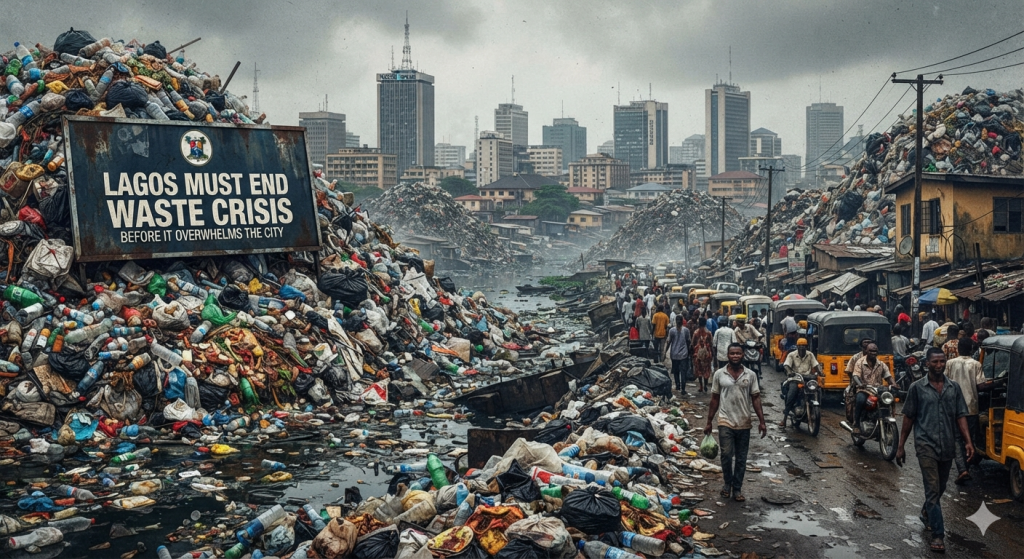
The foul odour that now hangs over many parts of Lagos is more than an environmental nuisance; it is an indictment of a waste management system that is increasingly unable to cope with the realities of Africa’s largest city.
From residential neighbourhoods and major highways to markets and commercial districts, mountains of uncollected refuse have become an unfortunate symbol of a city struggling to keep pace with its own growth.
For a state that prides itself as Nigeria’s economic nerve centre and one of Africa’s leading investment destinations, this is unacceptable.
The persistent stench emanating from refuse heaps is not simply the result of poor sanitation habits among residents. It is also a reflection of inadequate waste disposal infrastructure, particularly the shortage of accessible and well-managed dump sites where refuse collection operators can evacuate waste efficiently.
Without sufficient disposal facilities, even the most efficient waste collection system will eventually break down.
Lagos generates thousands of tonnes of solid waste every day, a figure that continues to rise as the population expands and economic activities increase.
Yet, the infrastructure required to receive, process and dispose of this waste has not grown at the same pace. Consequently, refuse accumulates on roadsides, drainage channels become clogged, illegal dumpsites proliferate, and the city is left battling an environmental crisis that poses serious risks to public health.
The implications are profound.
Decomposing refuse attracts flies, rodents and disease-causing organisms. It pollutes the air, contaminates water sources and contributes to the spread of communicable diseases such as cholera, typhoid and diarrhoea.
During the rainy season, blocked drains caused by indiscriminate waste disposal worsen flooding, destroying homes and businesses and disrupting economic activities.
The economic consequences are equally significant. Investors are naturally drawn to cities that are clean, orderly and efficiently managed. Tourism suffers when visitors are greeted by overflowing refuse dumps and offensive odours. Businesses incur higher costs in maintaining hygienic environments, while property values decline in neighbourhoods blighted by persistent waste accumulation.
A city aspiring to become a globally competitive megacity cannot afford such conditions.
While the Lagos State Government has introduced reforms in the waste management sector over the years and continues to work with private sector operators, the current situation suggests that these efforts require urgent reinforcement.
Waste generation is outpacing waste disposal capacity, and unless decisive action is taken, the problem will only worsen.

Government must therefore make the expansion of waste disposal infrastructure an immediate priority.
More engineered landfill sites, transfer stations and waste processing facilities should be established across the state to reduce the pressure on existing facilities and improve the efficiency of refuse evacuation.
At the same time, Lagos must move beyond the traditional model of collecting and dumping refuse. Modern cities increasingly view waste as an economic resource rather than a liability..
Waste-to-energy projects, recycling and composting facilities should be developed through well-structured public-private partnerships.
Such investments would reduce dependence on landfills while creating employment, generating electricity and supporting a circular economy.
The state should also strengthen waste sorting and recycling programmes. Households and businesses should be encouraged to separate recyclable materials from organic waste before collection. This would significantly reduce the volume of waste destined for landfills while creating new opportunities for recycling industries.
Enforcement must not be neglected. Illegal dumping, indiscriminate disposal of refuse and environmental violations should attract swift and meaningful sanctions.
At the same time, public enlightenment campaigns should be intensified to encourage responsible waste disposal and greater environmental consciousness among residents.
Technology should equally become part of the solution. Digital platforms that enable residents to report overflowing refuse bins, monitor collection schedules and track service delivery can improve accountability and responsiveness within the waste management system.
The responsibility, however, does not rest with government alone. Residents must also play their part by disposing of waste properly, patronising only authorised waste operators and resisting the temptation to dump refuse in drains, canals and open spaces.
The present situation demands urgency rather than excuses. Lagos cannot continue to celebrate its status as Africa’s commercial capital while basic environmental sanitation deteriorates. Cleanliness is not a luxury; it is a fundamental requirement for public health, economic competitiveness and sustainable urban development.
The lingering stench across parts of Lagos should serve as a wake-up call to policymakers. A city of more than 20 million people cannot depend on inadequate waste disposal facilities while expecting different outcomes. The answer lies in sustained investment, stronger regulation, improved infrastructure and a comprehensive waste management strategy that reflects the realities of a rapidly growing megacity.
Lagos has repeatedly demonstrated its capacity for bold reforms in transportation, taxation and urban renewal. It must now demonstrate the same commitment to solving its waste management crisis.
The city deserves to be known for its enterprise, innovation and resilience, not for the smell of rotting refuse.





