
EDITORIAL: Osun Election Must Strengthen, Not Weaken Nigeria’s Democracy
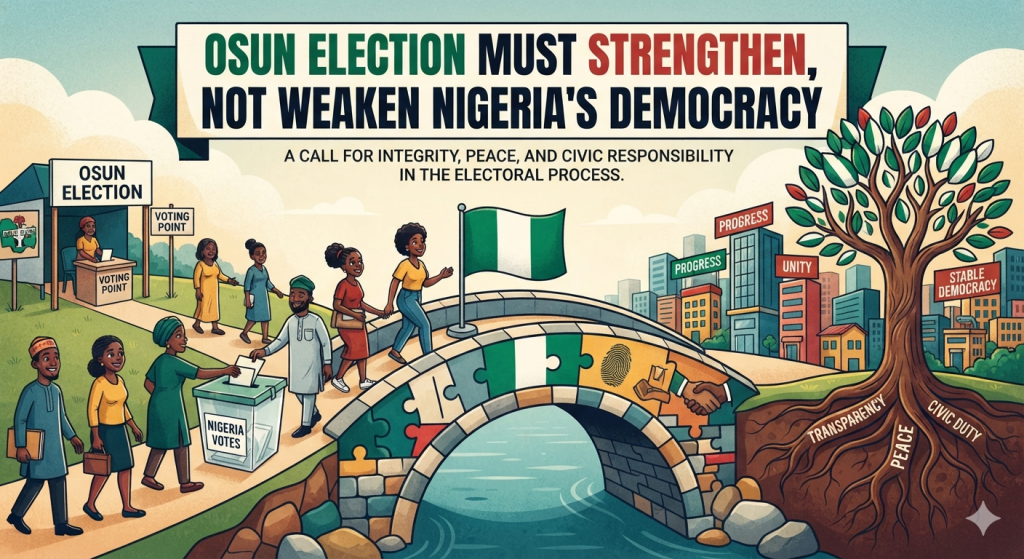
The forthcoming Osun State governorship election presents another important test of Nigeria’s democratic credentials.
Beyond determining who will occupy the Government House in Osogbo, the election will provide an opportunity for the Independent National Electoral Commission (INEC), political parties, candidates, security agencies and voters to demonstrate that Nigeria’s democracy is capable of producing credible leadership through a transparent and peaceful process.
The responsibility is enormous.
For INEC, there can be no room for complacency. The commission must get the Osun election right, not merely by conducting the poll on schedule, but by ensuring that every stage of the electoral process is transparent, impartial and credible.
INEC must demonstrate that no political party or candidate enjoys an unfair advantage.
Election officials must be properly trained and deployed, sensitive materials must be protected, accreditation and voting procedures must be strictly followed, and results must be transparently collated and declared.
The credibility of an election is determined not only by what happens at polling units but by the confidence voters have in the entire process.
INEC must therefore communicate clearly with voters, political parties and other stakeholders before, during and after the election. Any technical or logistical problems should be addressed promptly rather than allowed to create suspicion. Where complaints arise, the commission must respond with facts and transparency.
The security agencies also have a critical responsibility. Their presence should protect voters and electoral personnel, not intimidate them. Security personnel must remain professional, politically neutral and accountable. No Nigerian should be prevented from exercising the constitutional right to vote because of political violence or intimidation.
Political contestants, for their part, must understand that elections are contests for public service, not wars to be won at any cost.
Candidates and their supporters should campaign on issues rather than personalities. Osun needs serious discussions about education, healthcare, agriculture, infrastructure, employment, industrial development, internally generated revenue and the welfare of its people. It does not need inflammatory rhetoric, ethnic mobilisation, religious manipulation, violence or character assassination.
The contestants must also commit themselves to accepting the outcome of a credible election. Where a candidate believes that the process has been compromised, the appropriate response is to use established legal channels rather than mobilise supporters to cause disorder.
Nigeria has suffered enough from election-related violence. Political competition should never become a justification for destroying the peace and economic activities of the people whom politicians seek to govern.
Political parties equally have a responsibility to restrain their supporters. Party leadership should make it clear that thuggery, vote buying, intimidation and destruction of campaign materials are unacceptable. A candidate cannot credibly promise good governance while relying on undemocratic methods to obtain power.
Perhaps the greatest responsibility, however, rests with the electorate.
Osun voters must recognise that an election is not simply an opportunity to collect money from politicians. It is an opportunity to determine who will control public resources and make decisions affecting the lives of millions of people for the next four years.

The temptation to accept money or gifts in exchange for votes may be understandable in an environment where many households are struggling. But voters must consider the long-term cost.
A politician who distributes a few thousand naira during an election campaign can potentially control billions of naira in public resources after assuming office. The immediate cash may disappear within days, while the consequences of electing an incompetent or corrupt administration can persist for years.
The electorate should therefore ask fundamental questions: Which candidate has a credible plan for creating jobs? Who can improve schools and hospitals? Who understands agriculture and industrial development? Who can attract investment? Who has demonstrated competence and integrity? Which candidate has the capacity to manage public finances responsibly?
These are the questions that should determine votes.
The people of Osun should resist the politics of stomach infrastructure if it means sacrificing the future of the state.
Democracy is ultimately about converting political power into better roads, functioning schools, quality healthcare, economic opportunities, security and improved living standards.
Voters should also understand that accepting inducements does not oblige them to surrender their conscience. Their vote is secret, and the ultimate responsibility is to choose the candidate they believe can best serve the public interest.
At the same time, political parties must address the economic conditions that make vote buying attractive. Poverty creates vulnerability, and politicians exploit that vulnerability. Long-term electoral reform must therefore go hand in hand with economic policies that improve household incomes and reduce citizens’ dependence on political patronage.
The Osun election should also be an opportunity to strengthen Nigeria’s democratic institutions. Civil society organisations, the media, election observers and community leaders should monitor the process and promote peaceful participation
The media, in particular, must resist becoming an instrument of partisan propaganda. Voters deserve factual information that enables them to make informed decisions.
The outcome of the election will belong to Osun people, but its implications will extend beyond the state.
A peaceful, transparent and credible election will strengthen confidence in Nigeria’s democratic institutions. A disputed or violent election, on the other hand, could deepen public cynicism and reinforce the perception that political power is obtained through money, manipulation and force rather than the people’s mandate.
This is why INEC must get it right. This is why candidates must play fairly. And this is why voters must look beyond the money offered during campaigns.
Osun deserves leadership chosen on the basis of competence, character, ideas and demonstrated capacity to deliver. Political parties should present candidates capable of governing, not merely winning elections.
Candidates should seek the people’s mandate without heating up the polity. INEC should provide a level playing field. Security agencies should protect the process. And voters should protect their future by voting according to their conscience and assessment of the candidates.
The ultimate dividend of democracy is not the money shared during an election campaign. It is good governance after the election.
Osun voters have the power to determine which of these two they will receive.





