
THE STREET MARKET: What Nigerians Stand To Gain From CBN’s Regulatory Sandbox Initiative
BY ZAKA KHALIQ
Recall that fhe Central Bank of Nigeria(CBN), on Tuesday, announced the commencement of the second cohort of its Regulatory Sandbox Programme, with a new dual-track structure designed to support responsible innovation in virtual assets and data-enabled financial services.
The programme, which opens for applications on August 12, 2026 and closes on August 31, 2026, will run under two dedicated tracks: the Virtual Asset Service Provider (VASP) Track and the Data-Enabled Financial Services Track.
Here, BUSINESSDIARY takes a look at how Nigerians can benefit from this initiative in the short and long run.
In simple terms, ordinary Nigerians could benefit in several practical ways:
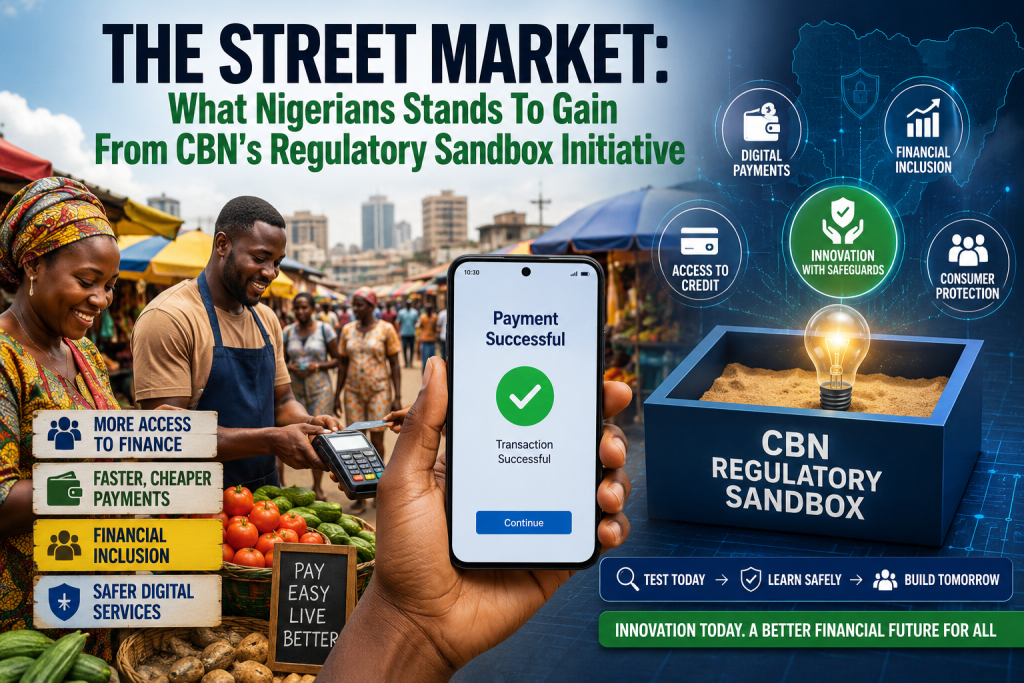
1. Better financial services: New digital services could make banking, payments, savings and credit faster and easier.
2. More access to credit:Data-enabled innovations may help banks assess customers better and provide loans to people who previously struggled to qualify.

3. Cheaper and faster payments: Innovations in payments, wallets and settlement could reduce transaction costs and improve speed.
4. More financial inclusion: People who are underserved by traditional banks could gain access to useful financial products.
5. Safer digital finance: The CBN will test new technologies under supervision, helping identify cybersecurity, fraud and consumer-protection risks before products reach the wider public.
6. More innovative products: Nigerians could eventually have more choices of financial services tailored to their needs.
6. Better consumer protection: Companies testing products must operate within agreed safeguards and report to the CBN.
THE BOTTOM LINE
The initiative is essentially about allowing new financial technologies to be tested safely before being introduced to the wider public.
If successful, Nigerians could enjoy better, cheaper, faster and more accessible financial services, while reducing the risks associated with new technologies.





