
EDITORIAL: Nigeria Needs Economic Reforms With Human Face
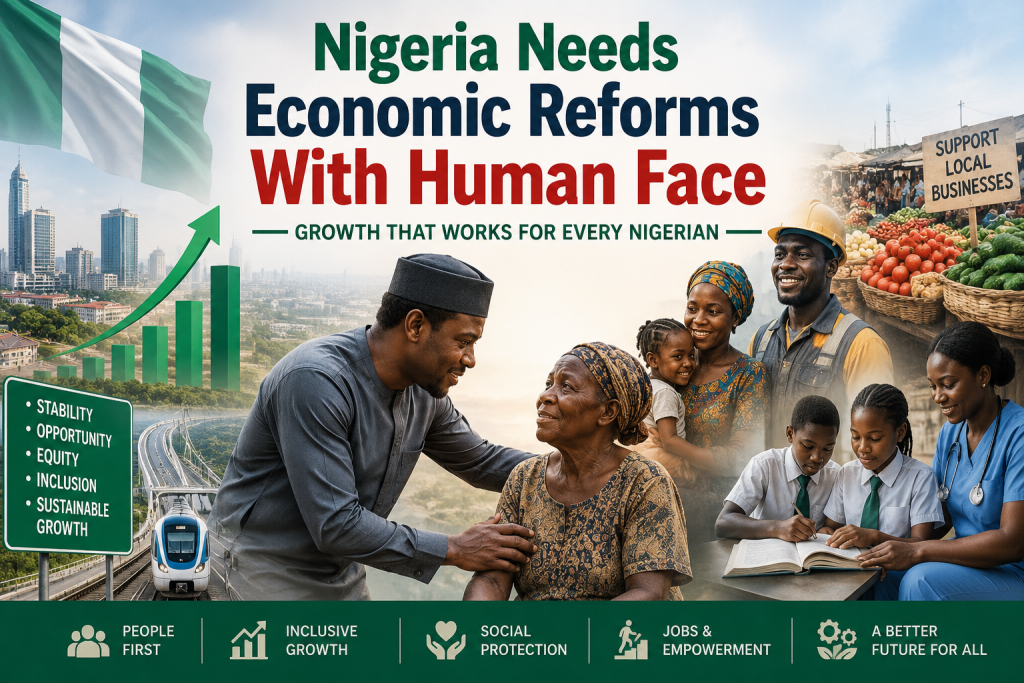
Nigeria needs economic reforms. There is little doubt about that.
For decades, the country has struggled with weak public finances, inadequate infrastructure, excessive dependence on oil, a distorted foreign-exchange market, low productivity and an electricity system incapable of supporting rapid industrialisation.
Correcting these weaknesses requires difficult decisions.
But reform should not become synonymous with hardship. The central question facing the Nigerian government is not whether reforms should continue, but how they can be implemented without leaving millions of Nigerians behind.
The reforms of the past three years, including fuel subsidy removal, foreign-exchange reforms and fiscal adjustments, have helped address longstanding distortions.
There are signs of improving macroeconomic stability, but many households and businesses continue to face severe cost pressures.
This contradiction should concern policymakers.
An economy cannot be described as successfully transformed when macroeconomic indicators improve while ordinary households struggle to afford food, transportation, housing, healthcare and education.
The ultimate purpose of economic reform is to improve people’s lives. Government must therefore build a bridge between economic stabilisation and household welfare.
That bridge must begin with food.
Poor households are particularly vulnerable to food inflation because they spend a large proportion of their income on feeding their families.
The World Bank has noted that poor Nigerian households can spend up to 70 per cent of their income on food. Government must therefore treat food production as an economic priority.
Security in farming communities must improve. Farmers need access to affordable inputs, finance, irrigation, storage, transportation and markets.
Agricultural productivity must increase, while bottlenecks that raise the cost of moving food from farms to consumers should be removed.
Government must also recognise that Nigerians cannot live on macroeconomic stability. They need jobs and incomes.
Millions of young Nigerians enter the labour market every year. Economic reforms must therefore be deliberately linked to productive job creation in manufacturing, agriculture, construction, technology and services.
This requires lowering the cost of doing business.
A manufacturer that spends excessively on electricity, transportation, logistics and finance will struggle to expand. Small businesses facing high energy and borrowing costs cannot easily create jobs.
Nigeria cannot achieve inclusive growth when productive enterprises are struggling merely to survive.

Government should therefore channel the additional fiscal resources generated by reforms into infrastructure and productivity-enhancing investments, particularly electricity, roads, railways, ports, healthcare and education. Social protection must also become a permanent component of economic policy.
Cash transfers and other interventions can provide temporary relief to vulnerable households, but social protection should go beyond emergency assistance. It should help people acquire skills, access healthcare and education, build productive livelihoods and withstand economic shocks.
The government must also ensure that public spending delivers visible value.
Nigerians are more likely to accept difficult reforms when they can see where the sacrifices are going. Government should therefore provide greater transparency about revenue gains, expenditure and the savings generated by reforms.
Citizens should be able to ask: What has the government gained from these reforms, and how is that gain being converted into better public services? The answer cannot simply be higher government revenue.
Revenue becomes meaningful when it produces electricity, roads, schools, hospitals, security and economic opportunities.
There is also a need for better communication. Economic reform should not be presented as a technical exercise understood only by economists and financial-market operators.
Government must explain the problems being addressed, the expected costs, the anticipated benefits and the measures being taken to protect vulnerable citizens.
Most importantly, reforms must be properly sequenced. Where a policy inevitably increases costs, complementary measures should be introduced to protect households and businesses from excessive hardship.
The experience of recent years demonstrates that macroeconomic correction without adequate cushioning can deepen poverty and weaken public support for reform.
Nigeria should stay the course on necessary reforms, but change the way their costs and benefits are distributed.
There is no contradiction between fiscal discipline and compassion. There is no contradiction between market-oriented reforms and social protection. There is no contradiction between encouraging investment and protecting vulnerable citizens.
The strongest economic reform programme is one that creates confidence among investors while creating hope among citizens.
The test of reform should therefore move beyond inflation, foreign-exchange reserves and fiscal balances. Those indicators matter, but they are means, not ends.
The ultimate measure must be whether Nigerians are living better.
The government should pursue economic reforms with a human face, firm enough to correct structural weaknesses, but compassionate enough to protect those least able to absorb the costs of adjustment.
That is how economic reform becomes not merely an exercise in stabilising numbers, but a pathway to shared prosperity.





