
High Treatment Costs In Private Facilities Trigger Mass Exodus To Govt Hospitals
….. As More Nigerians Seek Self-medication To Treat Ailments
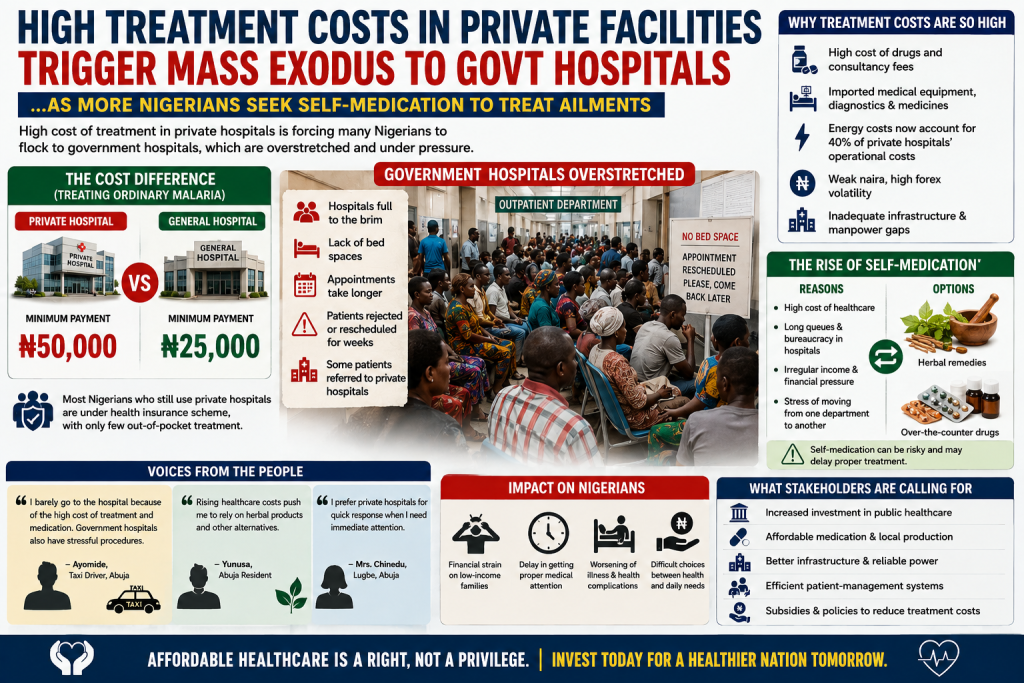
BY ZAKA KHALIQ and GBENGA ELIJAH, Abuja
High cost of treatments for ailments in private hospitals has triggered mass exodus of Nigerians, who needs healthcare, to government hospitals nationwide, BUSINESSDIARY can reveal.
This development is now overstressing government hospitals as people who needed to access these facilities are more than the infrastructure on ground.
This has triggered lack of bed spaces for patients, hence, making hospitals reject patients or reschedule their appointmetnt for a couple of weeks.
For some with chronic ailments, they are either refered to private hospitals for prompt attention, however, those who didn’t have much to pay the hospital bills at a private facility will rather endure the stress until it gets to their turn, it was learnt.
To treat ordinary malaria at a private hospital in Lagos and Abuja, it was learnt that the minimum payment is N50,000 whereas, it can be treated with N25, 000 at a general hospital, our findings show.
To this end, most of those who still use private hospitals are those under health insurance scheme, with only few Out-Of-Pocket treatment recorded.
Private hospitals have attributed the hike in treatment fees to increase in cost of drugs and consultancy fees as they try to strike a balance between affordable and quality service delivery.
Most of the general hospitals visited by our correspondents in Lagos and Ogun States, including the Federal Capital Territory (FCT), Abuja were full to the brim, with appointment taking longer than it was, years back.
With low disposable income of ordinary Nigerians which do not afford them the luxury of using private hospitals, they have to endure the stress to seek healthcare at government hospitals.
However, a survey by BUSINESSDIARY shows that, the growing financial burden associated with healthcare is influencing the decisions of many Nigerians, with some turning to self-medication and herbal remedies as alternatives to conventional medical treatment.
Speaking with this medium in Abuja at the weekend, Mr. Ayomide, a taxi driver, said the high cost of medication and treatment has made it difficult for him to regularly visit hospitals.
According to him, the situation is not limited to private hospitals, as government-owned hospitals also present significant challenges for patients.
I barely go to the hospital because of the high cost of medication and treatment, Ayomide said, adding that, the procedures involved in some government hospitals could be frustrating and, in some cases, dangerous for patients who require urgent attention.
He particularly recounted his experience at a specialist hospital where he took his daughter for treatment. He described the process of moving from one ward or department to another to obtain approvals and access medication as stressful and time-consuming.
Ayomide said, the distance between different departments becomes particularly challenging when patients are required to undergo laboratory tests to determine the cause of an illness.
He appealed to the government to increase its intervention in the healthcare sector by subsidising treatment costs and improving the coordination of services within government hospitals.
He also called for a review of the hospital’s operational procedures, suggesting that, essential services and equipment should be made available closer to patients instead of requiring them to move repeatedly from one department to another.
“Government should find a way to reduce the stress patients go through. If every ward or department can have the necessary facilities in place, patients will not have to move from one place to another before receiving treatment,” he said.
Another Abuja resident, Mr. Yunusa, told BUSINESSDIARY that, the increasing cost of healthcare has also contributed to the growing practice of self-medication.
Yunusa said, he does not regularly visit hospitals, explaining that, he sometimes resorts to alternative remedies, including herbal products, which he believes are widely accepted in African communities.
Rising healthcare costs, he stressed, had encouraged him to rely on alternative remedies, including herbal products, instead of visiting hospitals regularly.
His experience reflects a broader concern among healthcare observers that financial difficulties may encourage some Nigerians to delay seeking professional medical attention or rely on treatments without proper medical guidance.
Mrs. Chinedu, a resident of Lugbe, Abuja, said, her choice between conventional and alternative treatment largely depends on the nature of the health challenge and her financial situation.
She explained that, she uses both conventional medicine and other forms of treatment depending on what she can afford and what she believes will address the particular health problem.

When asked by our correspondentt, which type of hospital is more expensive between private and government facilities, she said the cost is not her only consideration.
According to her, she prefers private hospitals because of their relatively quicker response to patients, particularly ,when immediate attention is required.
“For me, it depends on the situation and the money available. What matters most is getting treatment that works and getting attention on time,” she said.
Further interactions with taxi drivers in Abuja revealed that, many of them are increasingly inclined towards self-medication because of the expenses associated with visiting both private and government hospitals.
Some of the drivers said, their irregular income makes it difficult to cope with consultation fees, laboratory tests, transportation, medication and other hospital-related expenses.
The development highlights the difficult choices facing low-income Nigerians who must balance healthcare needs with daily living expenses.
While private hospitals are often perceived as providing faster services, their treatment costs remain a major concern for many patients.
Government hospitals, on the other hand, are generally considered more affordable but are frequently criticised by patients for long queues, bureaucratic procedures, delays and the movement required between different departments.
The situation has renewed calls for greater government investment in public healthcare, affordable medication, improved hospital infrastructure and more efficient patient-management systems.
However, the chairman, HMA Medicals Limited, Lanre Shittu, also highlighted the sector’s high operating costs and inadequate infrastructure, which, he said, were adding to the financial burden on healthcare providers.
Similarly, CEO of Brighter Life Hospital, Abuja, Finhas Odey, said the rising cost of imported medical equipment, diagnostics and medicines was making healthcare delivery increasingly expensive.
He noted that, the naira’s exchange rate had significantly increased the cost of importing medical equipment compared with five years ago.
Nigeria’s heavy dependence on imported pharmaceuticals is further exposing healthcare providers and patients to foreign exchange volatility.
The Association of General and Private Medical Practitioners of Nigeria estimates that energy expenses alone now account for about 40 percent of operational costs in the private healthcare sector.
According to figures from the Federal Ministry of Health, some public healthcare institutions spend between N20 million and N180 million monthly on power, with energy accounting for as much as 50 percent of operating expenses.
With hospitals spending heavily on electricity, diesel, imported equipment, medicines, personnel and infrastructure, providers have little room to absorb additional costs without adjusting prices.
Meanwhile, the general manager, DCL Laboratory Products, Abuja, Andrew Chimezie said, the persistence of medical inflation reflects a combination of structural supply shocks and defensive pricing behaviour across the healthcare value chain.
He identified the exit of major pharmaceutical companies from Nigeria as one of the factors reshaping the market, noting that, their departure has left many products largely import-driven and priced at the end-consumer level.
According to him, the situation has become more challenging because Nigeria has yet to significantly ramp up local production of essential medicines.
He explained that, the departure of major drug manufacturers had altered distribution models and shifted more products towards import-dependent channels.
Chimezie said, the exits were also perceived as risk signals by manufacturers and distributors, prompting businesses to shorten payback periods and seek faster returns on their investments.
Beyond pharmaceuticals, healthcare providers are being squeezed by soaring energy costs and the persistent loss of skilled medical personnel.
Chimezie said, the exodus of health workers had created serious manpower gaps in hospitals, forcing healthcare facilities to offer higher remuneration and other incentives to retain available talent.
“Many health workers have left in droves, leaving gaps. Hospitals are paying premiums to retain talent and close those gaps, which pushes up the cost of healthcare,” he said.
He added that, unreliable power supply remained another major driver of operating costs.
“Power supply is another major factor. Energy is a constant headache,” Chimezie said.
The pressure is particularly severe for hospitals, laboratories and other healthcare facilities that require uninterrupted electricity to operate critical equipment.
For many Nigerians, the choice between private hospitals, government facilities and alternative remedies is increasingly determined not only by medical needs, but also by what they can afford.
Stakeholders are calling for increased investment in public healthcare, affordable medication, better infrastructure and more efficient hospital services to reduce treatment delays and discourage dangerous self-medication.





