
PETROL SUBSIDY REMOVAL: 3 Years After, Government Counts Gains As Nigerians Endure Hardships
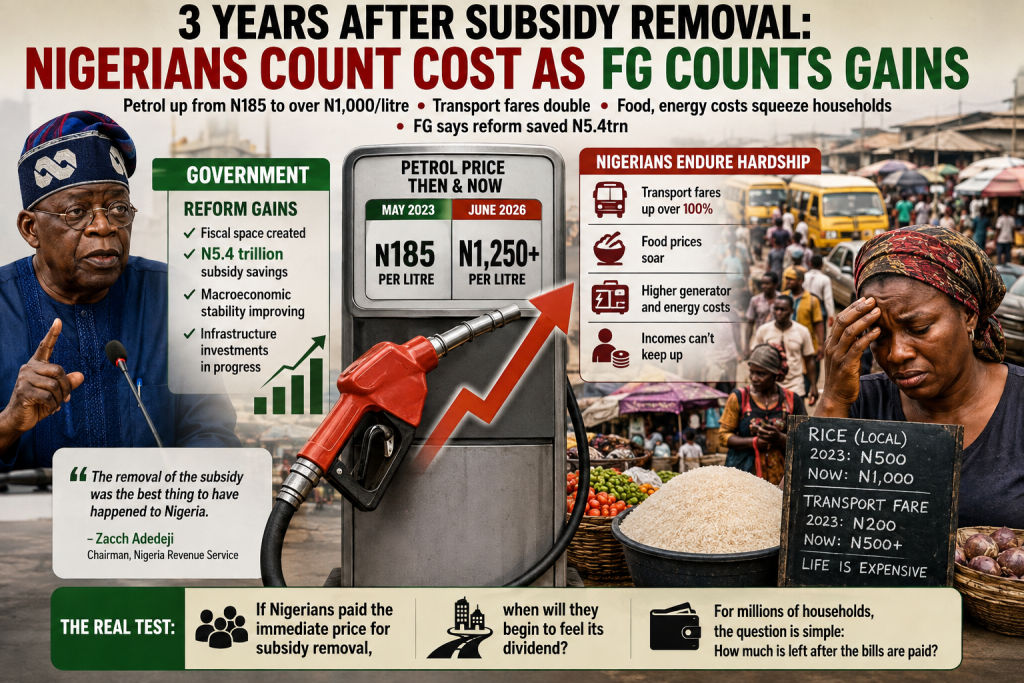
*Petrol Up From N185 To Over N1,200/litre
*Transport Fares Double, Food, Energy Costs Squeeze Households
*As FG Says Reform Saved N5.4trn
BY CEES HARMON and ADEYEMI OBADIMU
More than three years after President Bola Ahmed Tinubu removed petrol subsidy, the Federal Government is counting billions of naira in savings and greater fiscal space.
Millions of Nigerians, however, are counting something else: higher transport fares, costlier food, expensive electricity and shrinking purchasing power.
The sharp contrast has turned subsidy removal into one of Nigeria’s most consequential and divisive economic reforms, with the government defending its long-term gains while households struggle to cope with the immediate cost.
When the subsidy was removed in May 2023, petrol rose from about N185 to N500–N600 per litre in many parts of the country.
Today, petrol sells for roughly N1,250–N1,400 per litre, according to figures cited by former Finance Minister, Wale Edun, while National Bureau of Statistics data put the average retail price at N1,051.47 per litre in February 2026.
The consequences have spread far beyond filling stations.
Transport costs have more than doubled in many areas, while petrol-dependent households and businesses face higher generator costs. Farmers, traders and manufacturers have also had to absorb rising logistics and operating expenses, with much of the cost eventually passed to consumers.
For workers who commute daily, the impact is particularly brutal.
A Lagos teacher, Riyah James, told BUSINESSDIARY that, rising transport fares now consume a large chunk of her income.
‘There’s hardly anything left of my salary,’ she said, adding that, food prices have also made household budgeting increasingly difficult.
Her experience is supported by recent research. A 2026 study covering 1,200 households across Nigeria’s six geopolitical zones found that a 1 per cent increase in fuel prices was associated with a 1.34 per cent increase in household transportation expenditure and a 0.78 per cent decline in household welfare.
The World Bank has similarly warned that subsidy removal would increase transport and electricity costs and reduce household purchasing power.
INCOME UP, PURCHASING POWER DOWN For many Nigerians, even wage increases have failed to keep pace with the cost of living.
Chichi Okafor, a sales attendant at Aspanda Market, Lagos, said her monthly salary rose from N45,000 in 2023 to N60,000, but the increase has not translated into a better standard of living.
Her regular Mile 2–Trade Fair transport fare, she said, has climbed from about N200 to N400–N500, sometimes reaching N700 during peak periods.
A plate of rice that once cost around N500, she added, now costs about N1,000.
Her story captures the dilemma facing millions of wage earners: nominal income may be rising, but real purchasing power is falling.
FG: SUBSIDY REMOVAL SAVED N5.4TRN The Federal Government insists the reform was unavoidable.
Nigeria Revenue Service chairman, Zacch Adedeji recently described subsidy removal as the “best thing” to happen to Nigeria, arguing that the old system was fiscally unsustainable.
The government’s reform scorecard says the reforms generated N20.4 trillion in incremental resources, including N5.4 trillion in subsidy savings accruing to the Federal Government under the FAAC allocation formula.
But government expenditure also surged.
Between June 2023 and December 2025, the government reported N30.64 trillion in incremental expenditure, including N9.39 trillion in wage adjustments, N9.37 trillion in additional external debt-service costs caused by exchange-rate depreciation, N6.47 trillion on strategic infrastructure and N3.14 trillion in additional electricity subsidy.

That means the subsidy savings have not simply translated into cheaper living costs or direct payments to households. They have largely been absorbed into a wider fiscal adjustment.
WHO BENEFITED FROM THE OLD SYSTEM? The case against returning to the old subsidy regime remains strong.
The World Bank estimated that Nigeria spent N4.5 trillion on petrol subsidies in 2022, equivalent to 2.2 per cent of GDP.
It also found that the poorest 40 per cent received less than 3 per cent of the direct subsidy benefit, while the top 60 per cent received more than 23 per cent.
Supporters therefore argue that the old system was costly, poorly targeted and vulnerable to leakages, including smuggling.
But critics counter that eliminating a bad subsidy is only half a reform.
The savings, they argue, must produce visible improvements in electricity, transportation, infrastructure, jobs, food production and household incomes.
‘NIGERIANS ARE WORSE OFF Chief George Bamidele Ogunjimi, lawyer, Bamofin of Ojo Kingdom and Head of Legal Affairs, Renewed Hope Ambassadors Diaspora, said Nigerians remain worse off in their day-to-day lives despite improvements in some macroeconomic indicators.
He rejected a return to the old broad subsidy regime but urged government to use the fiscal space created by its removal to provide targeted relief.
He called for cheaper public transport, reliable electricity, support for vulnerable households, increased food production and greater transparency over the use of subsidy savings.
“The ultimate test of the subsidy reform should not be how much government saves, but whether it makes life more affordable for Nigerians,” he said.
RETURN THE SUBSIDY Comrade Oriyomi Oloyede, President of Rescue Nigeria’s Future Leaders Initiative, disagreed.
He said the removal had left Nigerians struggling to save as incomes are consumed by food, transport and other basic expenses.
“The people no longer have savings,” he said, arguing that construction activity and employment had also suffered from the high cost environment.
Oloyede supports a return to subsidy, describing it as one form of relief government could provide to citizens.
He also called for direct transfers to households rather than relying heavily on state and local governments to distribute relief.
SOME SEE GAINS For Lawal Olalekan Sulaimon, Chief Executive Officer of Solnet Solutions Ltd, the reform has brought painful adjustments but also forced greater financial discipline.
He said subsidy removal had changed both his lifestyle and business operations, compelling him to reduce lavish spending.
Sulaimon also pointed to improved confidence around foreign transactions and the renewed acceptance of Nigerian cards for some international payments as positive developments.
“Although prices are currently high, I believe this is temporary, while the economy is gradually becoming more stable,” he said.
THE REAL TEST Government figures show headline inflation falling from 22.41 per cent in May 2023 to 15.91 per cent in June 2026, while food inflation dropped from 24.82 per cent to 17.52 per cent.
But falling inflation does not mean falling prices.
For households already battered by years of higher food, transport, housing and energy costs, it simply means prices are rising more slowly.
That leaves the Tinubu administration facing the most difficult question of the reform:
If Nigerians paid the immediate price for subsidy removal, when will they begin to feel its dividend?
For government, the answer lies in fiscal stability and a stronger economy.
For millions of households, the answer is much simpler:
How much money is left after the bills are paid?





