
Foreign Traders Flood Retail Market, Threaten Nigerian SMEs
‘
BY CEES HARMON
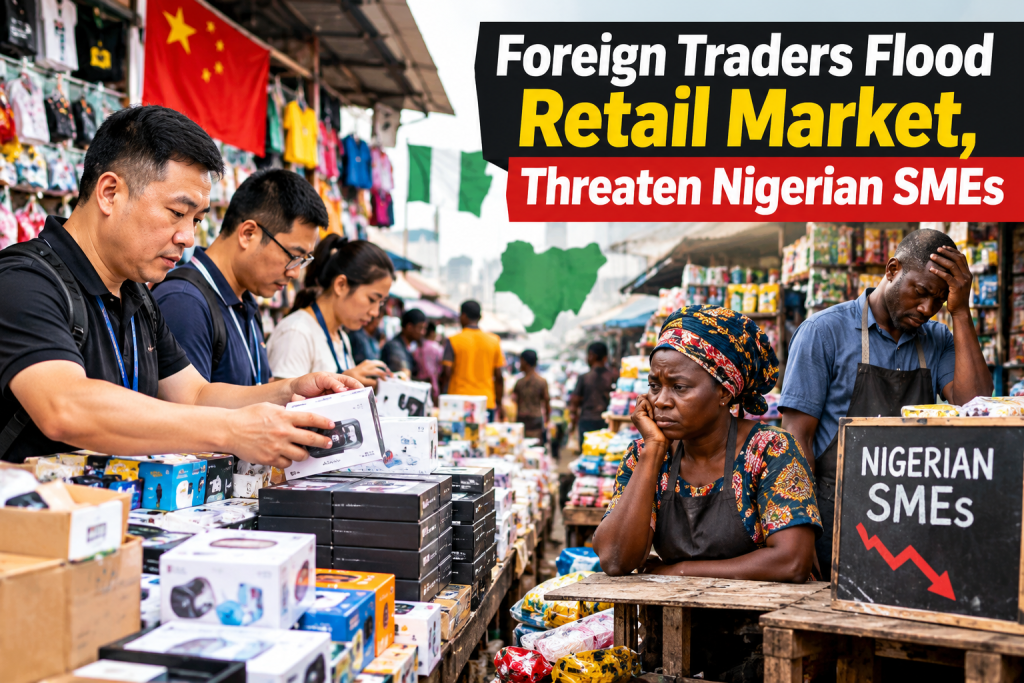
The Centre for the Promotion of Private Enterprise (CPPE) has raised the alarm over the growing participation of foreign nationals, particularly Chinese traders, in Nigeria’s retail and distributive trade, warning that the trend could intensify pressure on local businesses and employment.
The CPPE said, the increasing penetration of foreign operators into the retail segment requires urgent policy attention, particularly at a time when Nigerian businesses are contending with weak consumer purchasing power, high financing costs, unemployment and rising operating expenses.
In a policy statement signed by its Chief Executive Officer, Dr Muda Yusuf, the organisation said the concern was not about Chinese investment or Nigeria’s economic relationship with China, but about the growing movement of some foreign manufacturers, suppliers and traders downstream into retail activities where Nigerians already have substantial capacity.
According to the CPPE, Nigeria’s distributive trade sector employs an estimated 27.5 per cent of the country’s workforce, with millions of Nigerians depending on wholesale and retail businesses for their livelihoods.
The sector covers a wide range of activities, including textiles and fabrics, ICT products and accessories, automobile spare parts and tyres, electrical products, plumbing materials, household goods and other consumer and industrial products..
Foreigners Moving Downstream
The CPPE noted that China remains one of Nigeria’s most important trading partners and a major source of imports, adding that, Nigerian businesses have established longstanding relationships with Chinese manufacturers, exporters and distributors.
It stressed that foreign investment remains critical to Nigeria’s economic development where it brings capital, technology, industrial capacity, employment, exports and new capabilities.
However, the organisation said concerns arise when overseas manufacturers or major suppliers move beyond supplying Nigerian importers and distributors to establish direct retail operations that compete with the same businesses that constitute their customer base.
“A situation where overseas manufacturers or major suppliers sell products to Nigerian importers and distributors, and subsequently establish operations that compete directly with those same businesses at the retail end of the market, creates legitimate concerns about market structure and fair competition,” the CPPE said.
SMEs Under Pressure
The organisation warned that the development could further expose small businesses and self-employed Nigerians to displacement, given the relatively low barriers to entry into retail trade and the sector’s importance to household incomes.
It said operators had raised concerns about foreign participation in several segments, including textiles and fabrics, computers and telephone accessories, automobile spare parts, tyres and plumbing materials.
The CPPE also pointed to protests and complaints by traders in some major commercial markets, urging government not to ignore the emerging concerns.
It argued that policy should be particularly sensitive to developments capable of displacing domestic enterprises in sectors where Nigerians have already demonstrated substantial entrepreneurial capacity.
Review Expatriate Quotas, Permits
The CPPE called for a comprehensive review of the regulatory framework governing foreign participation in Nigeria’s retail economy.
It urged relevant government agencies to examine the integrity and enforcement of business permits, expatriate quotas, immigration approvals and other authorisations granted to foreign nationals operating in the country.

The organisation said expatriate quotas should primarily facilitate the entry of skills, expertise and capabilities that are scarce or unavailable locally.
“Retail trading is generally not a specialised activity requiring scarce foreign expertise,” it said, adding that the growing presence of non-nationals in such activities raises questions about the effectiveness of Nigeria’s regulatory and immigration architecture.
The CPPE, however, clarified that it was not advocating arbitrary restrictions or hostility towards foreign investors.
Rather, it called for consistent enforcement of existing laws, transparent rules and a clearly defined investment policy.
Nigeria Needs Calibrated Investment Liberalisation
According to the organisation, Nigeria should remain open to foreign investment but must ensure that such openness is aligned with its employment, enterprise-development and industrialisation priorities.
It said foreign participation should be particularly encouraged in sectors such as manufacturing, infrastructure, technology, agro-processing, mining and energy, where the country requires substantial capital and technical capabilities.
The retail segment, it argued, requires a more calibrated policy approach because of its strategic importance to employment, entrepreneurship and SME development.
The CPPE noted that several countries maintain regulatory boundaries around certain economic activities to protect domestic enterprise, preserve jobs or promote indigenous participation.
CPPE Lists Measures
To address the situation, the organisation called on government to:
Review foreign business permits and expatriate quotas associated with retail and distributive trade.
Strengthen enforcement of immigration and investment regulations governing foreign participation in reserved or restricted activities.
Investigate complaints from Nigerian traders regarding direct foreign competition at the retail level.
Ensure expatriate quotas are tied to demonstrable skills gaps and specialised competencies.
Strengthen coordination among immigration, investment, trade and labour authorities.
Establish clearer guidelines defining permissible foreign participation across the distributive trade value chain.
Encourage foreign businesses to invest upstream in manufacturing, processing, technology, logistics and other productive activities rather than displacing indigenous businesses at the retail end.
Protect Jobs Without Killing Foreign Investment
The CPPE advocated what it described as a balanced approach, stressing that Nigeria should continue to deepen its economic and investment relationship with China and other countries.
It said, Chinese investors have significant opportunities to support Nigeria’s industrialisation through manufacturing, infrastructure, technology transfer, local sourcing and export-oriented production.
However, it called for clearer boundaries between productive foreign investment and participation in basic retail activities where domestic capacity is already abundant.
The organisation warned that Nigeria needs foreign investment but must equally protect the entrepreneurial space that sustains millions of domestic businesses and livelihoods.
“The objective should not be protectionism for its own sake. It should be fair competition, regulatory integrity, employment protection and strategic investment policy,” the CPPE said.
It added that Nigeria could not afford a situation where foreign manufacturers and major suppliers progressively integrate downstream and compete directly with the small businesses that originally constituted their customer base.
The CPPE therefore urged the Federal Government to urgently review the regulatory framework governing foreign participation in retail trade and ensure that business permits, immigration approvals and expatriate quotas are being used strictly for their intended purposes.





