
Journalists Must Become More Human In AI Era — Fagbule
BY SAMUEL OPEYEMI
Journalists must deepen their human connection, critical thinking and original reporting to remain relevant in an era where artificial intelligence is rapidly transforming content production, Bureau Chief, West Africa, CNBC Africa, Temitayo Fagbule, has said.
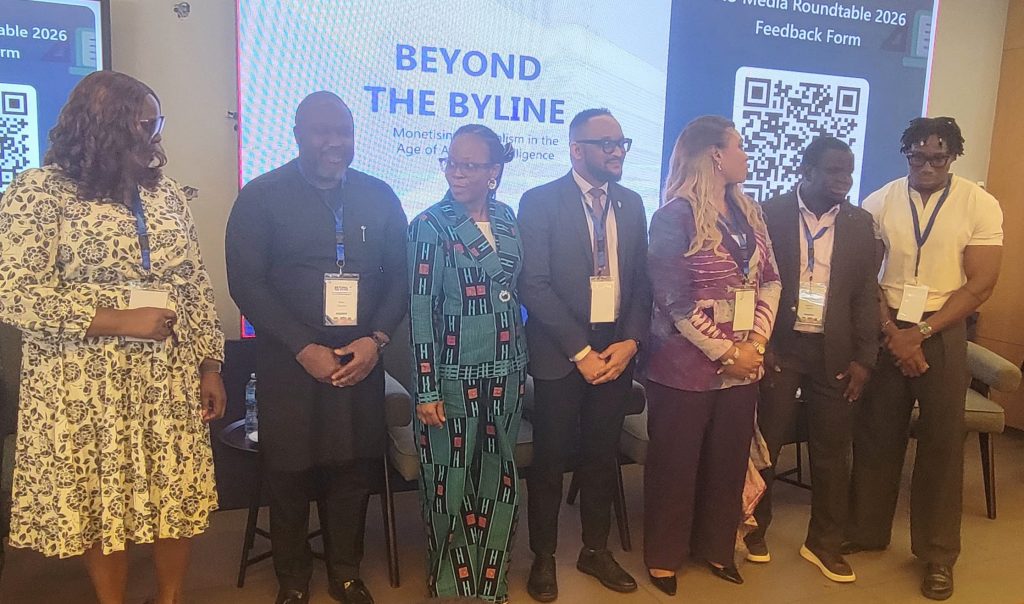
Fagbule spoke at a media roundtable organised by the Centre for Journalism Innovation and Development (CJID) in partnership with Pan-Atlantic University, Lagos, where media professionals examined the theme, ‘Beyond the Byline: Monetising Journalism in the Age of Artificial Intelligence.’
He said, journalists could not compete with AI on the basis of speed, volume or computing power, stressing that, the profession must instead focus on qualities that distinguish human journalism from machine-generated content.
According to him, original reporting, context, critical questioning, human interaction, trust and the ability to understand people would become increasingly valuable as AI systems become more sophisticated.
I cannot compete and I will not compete with AI. But the best competition against AI is to be more human, Fagbule said.
He noted that, AI could produce articles, summaries and explainers at a scale that would be difficult for individual journalists or traditional newsrooms to match.
However, he said, the technology could not replace the value a journalist derives from being physically present, interviewing people, observing their reactions and asking follow-up questions based on the interaction.
Fagbule said, journalists should therefore place greater emphasis on ground reporting, arguing that, the ability to read body language and pursue an unexpected line of questioning remained an important advantage of human reporters.
“You get something from human interaction that you don’t get from, for example, AI. I can read your body language, I can read your reactions to my question. It will tell me if I should go on with that line of question,” he said.
He also warned journalists against surrendering their professional judgment to AI by simply prompting the technology to produce stories and passing off the results as journalism.
According to him, AI should be used to support journalists in areas such as data analysis and research, while reporters retain responsibility for asking the right questions, challenging information and establishing context.
He said journalists could, for instance, use AI to analyse complex government budgets, identify relevant figures and turn the findings into accessible explainers, rather than allowing the technology to replace the reporting process.
Fagbule also identified verification as a major area where journalism could distinguish itself from social media influencers, content creators and AI-generated material.
He said, when unverified information emerges, journalists should investigate its origins, establish whether it is true, identify what happened and explain its implications instead of merely amplifying the information.
“Rather than simply amplify fake news, we can now step in and say, no, this is wrong, this is fake, for so and so reason. We can explain that,” he said.
Fagbule said, the rapid circulation of misinformation could therefore create an opportunity for journalism, provided journalists reclaimed their role as independent verifiers and providers of context.
He urged journalists to close the gap between when an event occurs and when professional news organisations investigate and explain it.

He also pointed to the growing importance of live communication and journalism beyond written articles, saying the emergence of AI-generated text would increase the value placed on human presentation, storytelling and oratory.
“Anybody can prompt AI and come up with a wonderful 59-page report. But sit down now and talk me through it. Delight me with the content of your presentation, your preparation and your choice of words,” he said.
Fagbule also highlighted the subscription strategy of The New York Times as an example of how media organisations could build sustainable businesses by offering audiences more than conventional news.
He said, the newspaper had expanded its offering to include areas such as sports, cooking, puzzles and shopping advice, thereby creating a broader proposition around its journalism.
He said, Nigerian media organisations needed to similarly examine why audiences should visit their platforms rather than relying solely on social media and search platforms for information.
Before you can monetise, it actually has to be standout journalism, Fagbule said, stressing the need for original, independent, high-quality reporting that audiences can trust.
He further urged journalists to use AI as a tool rather than treating it as a substitute for professional judgment.
Responding to concerns about the ability of increasingly advanced AI systems to replicate human experiences, he acknowledged that, the technology could generate convincing representations based on the enormous volume of human experiences available online.
But he maintained that journalists should focus on producing unique experiences through reporting, travel, interviews and direct engagement with people.
“If I travel to Ghana, AI can go and analyse all the people that have been to Ghana before, but it cannot repeat that unique experience that maybe the Ghanaians now see as something that prompts me and I tell him or her that unique experience that I’ve had,” he said.
Fagbule also called for stronger protection of journalistic content as AI companies increasingly rely on published material to train and power their systems.
He cited The New York Times’ legal action against AI companies as part of the wider debate over access to copyrighted news content and the economic value of journalism.
The roundtable also featured a presentation by CJID on “Beyond the Byline: Leveraging AI and Civic Tech for Sustainable, High Impact Newsrooms,” including its digital tools and platforms aimed at improving newsroom efficiency, trust and sustainability.
A panel session moderated by Dr Margaret Offoboche Agada-MBA further examined opportunities created by AI for journalism and media businesses.
The panel featured Rosemary Egabor-Afolahan, market strategist and founding member of News Central TV; Wale Olajubu, Executive Director, Health Business Academy for Africa; Samson Folarin, award-winning investigative journalist and Editor of Weekend Titles at PUNCH Newspapers; and Dr Desmond Moru, Acting Head of the Department of Computer Science, School of Science and Technology, Pan-Atlantic University.
The panellists stressed the need for media organisations to diversify revenue, understand changing audience needs, embrace AI literacy and create products that offer value beyond conventional news content.
They also emphasised that journalism must go beyond content production, with trust, fact-checking, audience engagement and sustainable subscription models becoming increasingly important.
One of the key messages from the discussion was that news organisations should not simply ask how AI can make journalism faster, but how it can help journalists produce deeper, more useful and more trusted journalism.





