
When 2 Arms Of Economy Shake Hands: Gains From Monetary-fiscal Harmony
BY UMMIE KABIR
For decades, economists and policy analysts in Nigeria have made one consistent plea, that the monetary and fiscal authorities ‘talk to each other’.
Not in passing, not in press releases, but in a structured and honest collaboration that aligns the tools of economic management to achieve stability and sustainable growth for the prosperity of Nigerians. Fiscal policy, driven by the ministry of Finance, through spending, taxation and borrowing, is about growth and development while the monetary policy, under the purview of the Central Bank of Nigeria(CBN) , is about price stability and a sound financial system.
For long, the two ran on parallel tracks, sometimes in opposite directions. The result was predictable, resulting in high inflation despite tight monetary policy, high interest rates despite fiscal expansion, and a weakening naira despite huge oil earnings.
The classic Nigerian contradiction was the case of fiscal dominance. When the CBN raised the Monetary Policy Rate (MPR) to compress liquidity and anchor inflation expectations, expansionary fiscal operations injected offsetting liquidity through large FAAC disbursements and deficit spending unmatched by revenue.
The clearest manifestation was the Ways and Means facility, through which the CBN monetised deficits to the tune of over N23 trillion. Monetary financing of deficits expands base money, stokes inflation, depreciates the currency through expectations channels and erodes central bank independence.
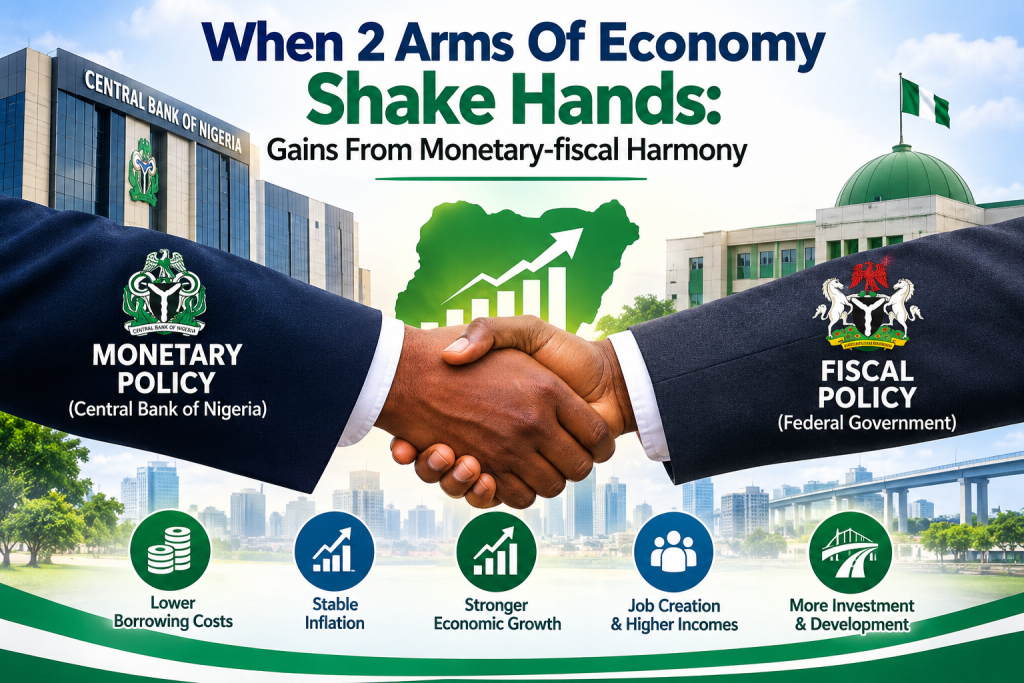
Today, that era of mutual suspicion appears to be ending. The recent agreement for deeper coordination between the fiscal authorities and the monetary authority, is perhaps the most important, though least celebrated, reform of the current economic management team.
If sustained, its gains will be far-reaching as it makes the tasks of the CBN much easier. Coordination solves this lacuna. Under the new understanding, both sides agree on a fiscal path consistent with the inflation target. When government decides to spend, it informs the CBN of timing and size, so liquidity can be managed. When CBN tightens, fiscal policy does not undermine it with unplanned liquidity injection or borrowing.
The result is policy potency. Monetary tightening now bites and fiscal stimulus now works because it is not immediately neutralized by rising interest rates. The pact enforces the Fiscal Responsibility Act 2007 and CBN Act 2007 Section 38 limit of 5.0 per cent of prior year revenue for temporary advances.
Fiscal deficit monetization is replaced with transparent market-based financing via FGN bonds and Treasury bills. This restores debt sustainability metrics. Debt service-to-revenue ratio, which exceeded 96 per cent in 2022, improves as risk premium compresses.

Lower sovereign risk, reflected in declining FGN bond yields and improved JP Morgan EMBI spread, reduces the cost of borrowing, creating fiscal space for capital expenditure which has a higher fiscal multiplier Nigeria’s inflation has been both monetary and structural. That is, too much money chasing too few goods, worsened by fuel subsidy, import dependence and insecurity.
The CBN alone cannot tackle these multi-faceted challenges. However, with coordination, fiscal authority now addresses the structural side such as infrastructure, agriculture and security while CBN addresses price and financial system stability at the monetary side.
This joint approach means inflation can fall without raising interest rates. That is good for manufacturers who need affordable credit, for farmers who need single-digit loans, and for households whose purchasing power has been eroded overtime.
The new pact restores discipline. Fiscal authority has agreed to live within its means, improve revenue from non-oil sources, and borrow transparently but not from the CBN vault. In return, monetary authority has agreed to support government securities market and ensure orderly debt issuance.
The gains are enormous as public debt becomes more transparent, enhanced investors’ confidence and the country’s risk premium reduces. Lower risk premium means lower interest on government borrowing and more money for capital projects.
A major reason for naira volatility was the disconnect between fiscal dollar inflows and monetary dollar management. Coordination now means joint management of external reserves. Fiscal authority saves more in the Excess Crude Account when oil prices are high, while CBN uses reserves strategically to smooth volatility, not defend an artificial rate.
Both agree on a realistic exchange rate that reflects fundamentals. For investors, nothing is more reassuring than seeing finance minister and CBN governor on same page. It signals predictability. Predictability attracts Foreign Direct Investment, which brings jobs.
When policies align, government can run targeted fiscal interventions such as student loans, consumer credit, CNG buses, and agricultural support. While the CBN facilitates complementary low-interest facilities through development finance without fueling inflation.
Because spending is targeted and financed from revenue, not money printing, growth is inclusive and inflation-free. This agreement must not be a photo-op. It must be institutionalized through a formal Monetary-Fiscal Coordination Committee (FLAC) that meets monthly, shares data in real time, and publishes a joint statement.
The law must also be respected. The Fiscal Responsibility Act and CBN Act set clear limits for deficit financing. Adhering to them should sacrosanct and not optional.
In conclusion, the gain is not just lower inflation or stable naira. It is a signal that economic policy in Nigeria is no longer contradictory, but complementary. And trust is the foundation of all prosperity. Flourishing economies are not built by one hand clapping. Both hands must clap together.
UMMIE KABIR is a public affairs analyst and writes from Abuja.





