
Stanbic IBTC, GTCO, Fidelity Bank, 2 Others Sustain Control In Management Of N31.8trn Pension Assets
BY ZAKA KHALIQ
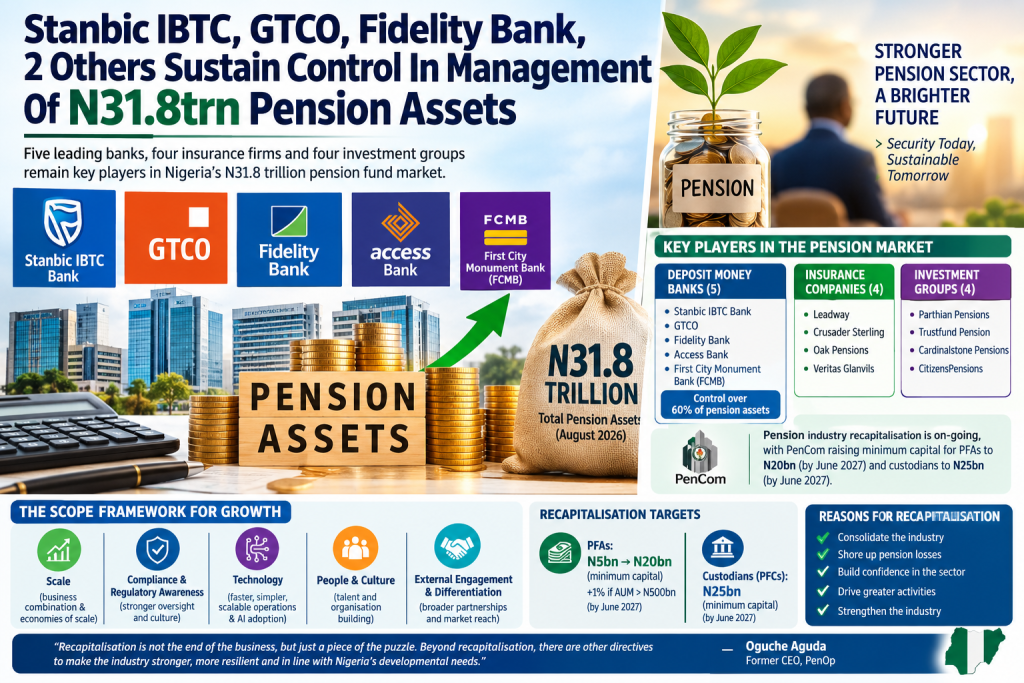
Stanbic IBTC Bank, Fidelity Bank, GTCO, Access Bank and First City Monument Bank(FCMB) continue to sustain control in the management of the nation’s N31. 8trillion pension fund assets, BUSINESSDIARY learnt.
Recall the total pension assets climbed from N31.51trillion in July to N31.80trillion in August, 2026.
While Stanbic IBTC Bank owns Stanbic IBTC Pensions, Access Bank owns Access ARM Pensions; GTCO owns GTCO Pension Managers; Fidelity Bank owns Fidelity Pension Managers Ltd and FCMB owns FCMB Pensions.
The subsidiaries of the five deposit money banks control over 60% of the pension assets, according to findings.
Similarly, four insurance companies maintain controlling stakes in Leadway Pension Managers, Crusader Sterling Pensions, Oak Pensions Limited and Veritas Glanvils Pensions .
Moreover, four leading investment groups in the country own Parthian Pensions, Trustfund Pension, Cardinalstone Pensions and. Citizens Pensions.
Speaking on this development, while delivering a paper titled ‘Post Recapitalisation and Market Dynamics in Nigerian Pension Industry’ at the 11th Annual National conference of Nigerian Association of Insurance and Pension Editors( NAIPE) in Lagos recently, the former chief executive officer(CEO) of Pension Fund Operators Association of Nigeria(PenOp), Mr Oguche Aguda said, overview of the entire market shows that the banking sector, insurance sector and investment managers are core owners of the market.
He added that, while the pension industry recapitalisation exercise is still on going, the operators have adopted an acronym titled SCOPE : meaning Scale, Compliance and regulatory awarenesss, Organisational adoption of technology, People strategy and culture and External engagement and differentiation.
The need for scale, he said, manifested in business combination witnessed in pension sector some of which are the combination between Trust- fund Pensions and Premium Pension and the combination between Leadway and PAL Pension.

Aguda, who is the founder and managing Partner of HRISP Partners, highlighted the advantages of these as gaining economics of scale by the various firms involved, increasing complexity of operations, streamlining costs and competing effectively in the market place.
On compliance and regulatory awareness, Aguda noted that, pension was the most rejected sector and this has made the regulator to be at the centre of the industry, ensuring that operators have sound compliance and culture.
On adoption of technology, he said, operators must ask themselves the question on how to leverage technology to make their operations quicker, simble and help them to scale.
According to him, they should also meditate on how to use Artificial Intelligence to compete as well as how to manage cyber security threat.
Aguda highlighted fact about the on going recapitalisation exercise in the industry, as PenCom, having mandated all licensed pension fund administrators to raise their minimum capital from N5 billion to N20 billion and one percent more if their Asset Under Management is above N500 billion by June 2027.
Aguda said, second fact about recapitalisation in the pension sector is PenCom mandating all licensed pension fund custodians ( PFCs) to raise their minimum capital to N25 billion by June 2027.
He gave reasons for the pension sector recapitalisation as consolidation of the industry, need to shore up pension losses, to create confidence in the sector, to shape the industry for greater activities and to strengthen the industry.
Aguda warned the pension sector operators that recapitalisation was not the end of the business but just a piece of the puzzle pointing to them that in addition to the minimum recapitalisation directive there were other surrounding directives meant to make the industry stronger, more resilient and in line with the developmental needs of the country.
“Beyond recapitalisation, there are guidelines for cross- boarder pension contribution such as review of investment guidelines to allow for more investments in sectors that promote economic growth, guidelines for agents to deepen personal pension plan coverage and include minors, guidelines for improved corporate governance of licensed pension fund operators, framework for payment of additional benefit for retiring civil servants as well as framework for pension compliance certificate and contribution,” he highlighted.





