
Rising Costs, Falling Demand Threaten Nigeria’s Ride-Hailing Industry
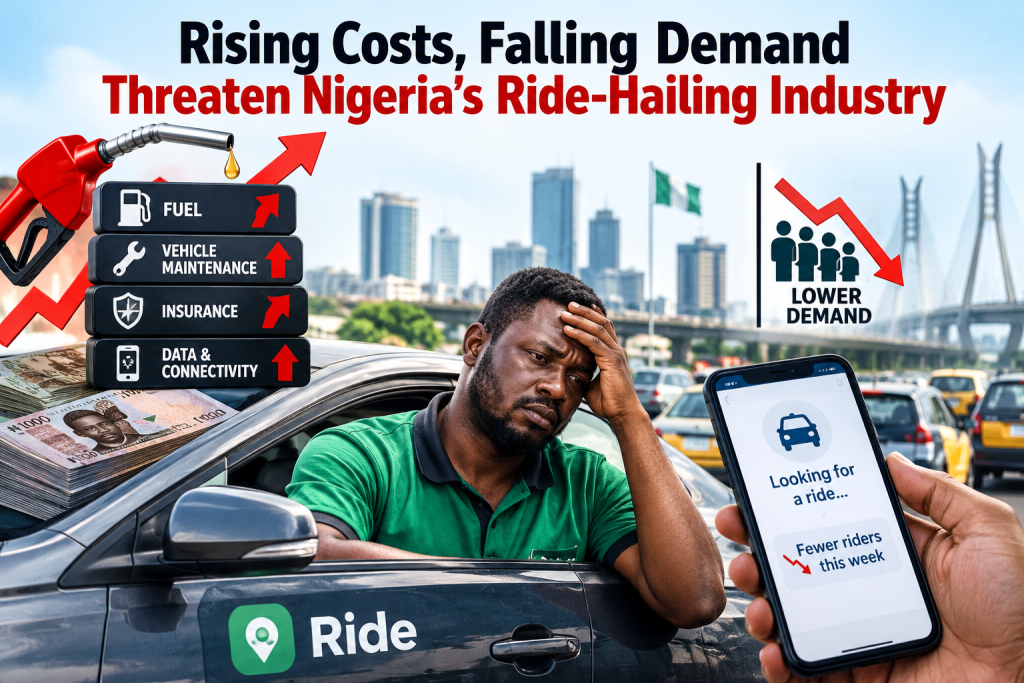
Bolt, inDrive Struggle As Passengers Flee Over High Fares
More Exits Loom After Uber, Moove Departures
BY CEES HARMON, Lagos And GBENGA ELIJAH, Abuja.
Nigeria’s ride-hailing industry is facing a mounting survival crisis as soaring fuel prices, rising vehicle maintenance costs and platform commissions squeeze drivers’ earnings, while cash-strapped passengers abandon expensive app-based rides for cheaper alternatives.
With operators such as Bolt and inDrive caught between keeping fares affordable and ensuring drivers remain profitable, the industry faces a dangerous cycle of rising prices, falling bookings and declining service availability, BUSINESSDIARY can reveal.
The pressure is intensifying following the exit of Uber from Nigeria on September 2, 2026, after 12 years of operations, and Moove’s withdrawal from the market after six years, earlier in the month.
Their departures have raised fresh questions about the long-term viability of app-based mobility businesses in an economy where operating costs continue to outpace many consumers’ ability to pay.
Although Uber attributed its decision to a review of its business priorities, the departure comes amid mounting competition, rising costs and persistent tensions over driver earnings and fare structures.
FUEL COSTS EAT INTO EARNINGS
For drivers, the squeeze starts at the petrol pump.
Petrol prices in Lagos climbed from about N800 per litre at the end of February 2026 to between N1,300 and N1,330 by mid-April, an increase of more than 60 per cent in less than two months.
The burden extends beyond fuel to vehicle servicing, tyres, spare parts, insurance and depreciation. Drivers who rent their vehicles or repay vehicle-financing loans must also meet those obligations, irrespective of the number of trips completed daily.
Consequently, a growing share of trip revenue is being consumed by operating expenses, leaving drivers with diminishing returns despite working longer hours.
The situation triggered a three-day protest in March by members of the Amalgamated Union of App-Based Transporters of Nigeria, who demanded better fares and improved earnings from platforms, including Uber and Bolt.
The protesters argued that, existing fare structures and platform commissions no longer reflected the realities of operating in the prevailing economic climate. Reports identified commissions of around 25 per cent among the issues raised.
PASSENGERS FLEE HIGH FARES
But while drivers struggle to protect their earnings, passengers are battling their own financial squeeze.
A BUSINESSDIARY survey of commuters in Lagos, Abuja and Port Harcourt found that some passengers were cutting back on ride-hailing services in favour of public buses, Bus Rapid Transit (BRT) and other cheaper transport options.
For many, the convenience of booking a ride through an app is increasingly difficult to justify when fares consume a substantial portion of their daily budgets.
One commuter, Chiamaka Abonde, told BUSINESSDIARY that a journey from Abule Ado on the Lagos mainland to Lekki, which previously cost about N4,000, had risen to more than N10,000.
Another commuter, Paul Ochei, said a trip from Ogudu to Victoria Island had cost almost N20,000, forcing her to rely more frequently on public transport.
The trend highlights the industry’s central dilemma: raising fares to reflect operating costs risks driving away passengers, while keeping fares low threatens drivers’ livelihoods and the sustainability of the platforms themselves.
For an increasing number of commuters, ride-hailing is becoming a service reserved for emergencies, late-night journeys, important appointments or occasions when convenience outweighs cost.

That shift threatens trip volumes, a critical component of the industry’s business model. Fewer bookings mean less work for drivers and potentially lower platform revenue, even when the average fare increases.
BOLT DEFENDS PRICING MODEL
Bolt has acknowledged the challenge of balancing passenger affordability with sustainable driver earnings.
Zakari Mohammed, a financial economist at Auchi Polytechnic, said, “Riders remain sensitive to fares, making it important to balance affordability with the need to support sustainable driver earnings.”
Bolt has said ,it reviews market conditions, pricing, incentives and product features to balance the interests of passengers and drivers.
In February, the company defended its pricing model, stating that drivers received more than 75 per cent of the fare on a typical N5,000 trip in Lagos. It said its share supported services such as safety systems, customer support, insurance and technology.
However, the proportion of a fare retained by a driver does not necessarily represent actual profit.
A driver who receives 75 per cent of a fare must still pay for petrol, vehicle maintenance and other operating expenses from that amount. For those operating rented or financed vehicles, the remaining income must also cover rental payments or loan obligations.
As costs rise, even a seemingly substantial share of trip revenue may leave drivers struggling to make a decent living.
EFFICIENCY, FINANCING KEY TO SURVIVAL
Industry analyst, Benjamin Atuma said operators must improve efficiency without transferring the entire burden of rising costs to passengers.
“The industry must find ways to improve operating efficiency without transferring the entire burden to passengers. Potential measures include more transparent fare and commission structures, better matching of drivers with nearby passengers, reduced empty mileage, targeted incentives during periods of weak demand and financing arrangements that make vehicle ownership and maintenance more affordable,” Atuma said.
He added that, affordability was central to long-term business viability, particularly in a market where passengers could readily switch to cheaper alternatives.
For regulators and policymakers, the challenge is to promote a sustainable transport market without undermining competition or making app-based mobility inaccessible to ordinary Nigerians.
More predictable energy costs, improved urban transport infrastructure and access to affordable vehicle financing could help ease pressure on drivers and operators.
Kayode Omotosho, a Lagos-based banker and ride-hailing passenger, said the industry could not survive on passenger demand alone.
“It needs a model in which commuters can afford regular journeys, drivers earn enough to cover their costs and platforms generate sufficient revenue to maintain reliable services,” he said.
“If operating costs continue to rise faster than passengers’ willingness or ability to pay, the industry risks a cycle of higher fares, fewer bookings, declining driver participation and weaker service availability,” Omotosho added.
A TEST OF SURVIVAL
Uber’s departure and Moove’s withdrawal have sharpened concerns about the commercial pressures confronting app-based mobility businesses in Nigeria.
For Bolt, inDrive and other operators still in the market, the challenge goes beyond attracting passengers. They must keep fares within reach of consumers, ensure drivers earn enough to remain on the platforms and generate sufficient revenue to sustain their operations.
Failure to achieve that balance could trigger further market withdrawals, leaving passengers with fewer options and drivers with reduced earning opportunities.
The industry’s survival may ultimately depend on whether operators can break the cycle of rising costs, higher fares and shrinking demand before more players are forced to reconsider their presence in Nigeria.





