
Protecting Lake Chad Basin, Economic Imperative For Nigeria
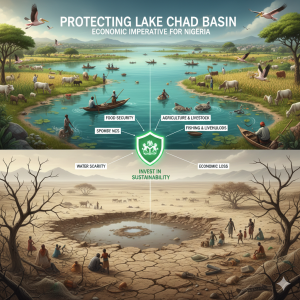
The steady decline of the Lake Chad is no longer just an environmental concern. It is an economic emergency for Nigeria.
Once one of Africa’s largest freshwater bodies, Lake Chad has shrunk dramatically over the past five decades due to climate change, upstream water diversion, and poor resource management.
For Nigeria, which shares the basin with Chad, Niger and Cameroon, the consequences are profound. The Lake Chad Basin is not merely a body of water; it is an economic ecosystem supporting agriculture, fisheries, livestock, trade, and millions of livelihoods across Borno, Yobe and parts of Adamawa states.
If Nigeria is serious about economic recovery, food security, and regional stability, protecting and restoring the Lake Chad Basin must become a national economic priority.
The basin supports more than 30 million people across the four countries, with millions of Nigerians directly dependent on it for farming, fishing and pastoral activities. In Borno State alone, irrigation farming around the lake has historically contributed significantly to local grain production, while fishing communities once thrived on what was considered one of Africa’s most productive inland fisheries.
As the lake recedes, fish stocks decline, arable land becomes desertified, and pastoral routes collapse. This is not just an environmental loss; it is a contraction of Nigeria’s rural economy.
Reduced agricultural output fuels food inflation, already a persistent challenge in Nigeria. As supply tightens, prices rise in urban markets from Maiduguri to Lagos, placing additional pressure on household incomes and worsening poverty levels.
The implications extend further. The shrinking lake has intensified competition over scarce water and grazing resources, aggravating farmer-herder conflicts and contributing to instability in the North-East. Economic deprivation, unemployment and displacement have created fertile ground for insurgency and criminal networks.
Security spending has soared as a result, diverting scarce fiscal resources from infrastructure, health and education.
In effect, environmental degradation in the Lake Chad Basin feeds directly into Nigeria’s fiscal stress. Billions of naira that could fund productive investments are instead channelled into emergency relief, security operations and humanitarian interventions.
The humanitarian cost is equally staggering. Millions have been displaced across the basin due to a mix of environmental collapse and insecurity. Camps and host communities strain under the burden of migration, increasing public expenditure requirements for shelter, food aid, and social services. Without environmental stabilisation, displacement will continue, compounding economic fragility.

There is also a trade dimension. The Lake Chad region historically functioned as a commercial corridor linking Nigeria to Central and North Africa. Cross-border trade in fish, livestock, grains and textiles once sustained vibrant markets. As ecological decline deepens insecurity and reduces production, regional trade flows weaken, undermining Nigeria’s economic integration ambitions under continental trade frameworks.
Protecting the Lake Chad Basin therefore aligns squarely with Nigeria’s economic interests.
First, restoration efforts must be integrated into national economic planning. Water management, reforestation, irrigation modernisation and climate-resilient agriculture should not be treated as donor-driven environmental projects but as core economic investments. The return on such investments would include improved agricultural productivity, reduced food imports, lower inflationary pressures and stronger rural incomes.
Second, Nigeria must strengthen cooperation through the Lake Chad Basin Commission. Water resource management cannot be unilateral. Coordinated policies on irrigation, dam construction and environmental conservation are essential to prevent further shrinkage. Diplomatic engagement in this area is economic diplomacy.
Third, climate adaptation financing should be aggressively pursued. Global climate funds exist to support vulnerable regions like the Sahel. Nigeria must position the Lake Chad Basin as a priority zone for climate resilience funding, ensuring transparency and accountability in project execution to attract sustained support.
Fourth, private sector participation should be encouraged. Sustainable irrigation technology, solar-powered water systems, agro-processing facilities and fisheries value chains can create jobs while protecting resources.
Environmental protection and economic growth are not mutually exclusive; they can reinforce each other.
Finally, data and research must guide policy. Accurate environmental monitoring, agricultural mapping and demographic data will help policymakers design targeted interventions. Without reliable information, restoration efforts risk inefficiency.
Nigeria’s economic future is tied to the stability of its ecological foundations. A shrinking Lake Chad means shrinking livelihoods, shrinking trade, and expanding insecurity. Conversely, a protected and revitalised basin could anchor agricultural revival in the North-East, ease inflationary pressures, reduce conflict drivers and strengthen regional commerce.
The choice is stark. Continue treating Lake Chad’s decline as a distant environmental issue, or recognise it as a frontline economic challenge demanding urgent, coordinated and sustained action.
For Nigeria, protecting the Lake Chad Basin is not optional. It is an economic necessity.





