
Addressing Flood For Food Security
The annual arrival of the rainy season should ordinarily bring hope to farmers and consumers alike. It is a season associated with planting, renewed agricultural activity and the promise of abundant harvests.
Increasingly, however, it has become synonymous with destruction, displacement and food shortages.
Across Nigeria, flooding has evolved from a seasonal environmental challenge into one of the gravest threats to national food security.
Each year, thousands of hectares of farmland are submerged, crops are washed away, livestock perish and rural infrastructure is destroyed.
The consequences are felt not only in farming communities but also in markets and households across the country through rising food prices and worsening hunger.
For a nation battling persistent inflation and a high cost of living, the growing frequency and intensity of flooding should be treated as an economic emergency rather than merely a humanitarian concern.
Agriculture remains a major pillar of Nigeria’s economy. It employs a significant share of the country’s labour force and supplies food to more than 200 million people. Yet the sector is becoming increasingly vulnerable to climate-induced disasters.
States that constitute Nigeria’s food basket, including Benue, Niger, Kogi, Kebbi, Taraba, Adamawa, Nasarawa and parts of Jigawa, Yobe and Borno have repeatedly suffered devastating floods in recent years. Rice fields, maize plantations, cassava farms, vegetable gardens and fisheries have all been affected.
The destruction extends beyond crops. Floodwaters damage rural roads, bridges, storage facilities and irrigation infrastructure, making it difficult for farmers to transport produce to urban markets. In many instances, harvested crops rot before reaching consumers, while transportation costs rise sharply.
The result is predictable: reduced food supply, higher prices and increased food insecurity.
The National Bureau of Statistics has consistently identified food as the largest contributor to inflation in recent years.
Although inflation has multiple causes, including exchange-rate volatility, insecurity and rising transportation costs, recurrent flooding has become an increasingly important driver of food shortages.
Climate experts have repeatedly warned that Nigeria is among the countries most vulnerable to the effects of climate change. Yet the nation’s preparedness remains grossly inadequate.
Flood warnings issued by relevant agencies often receive insufficient attention. Drainage systems remain poorly maintained. Illegal construction continues to block natural waterways. Urban planning regulations are weakly enforced, while many communities in flood-prone areas remain without effective protection.

The challenge is compounded by insecurity. Farmers displaced by violence are frequently forced to cultivate marginal lands that are more susceptible to flooding.
Others abandon farming altogether after repeated losses, further reducing national food production.
Nigeria cannot continue responding to floods only after disaster strikes.
The country needs a fundamental shift from disaster response to disaster prevention.
First, government must significantly strengthen flood-control infrastructure. Investments in dams, embankments, drainage channels and river basin management should become national priorities. Existing dams must be properly maintained and operated to minimise uncontrolled water releases, while greater cooperation with neighbouring countries is needed on transboundary river management.
Second, early warning systems must be transformed from routine announcements into effective community-based action programmes. Flood forecasts should be communicated in local languages through radio stations, mobile alerts, extension workers and traditional institutions. Farmers need timely information that enables them to adjust planting calendars, harvest early where necessary and relocate vulnerable assets.
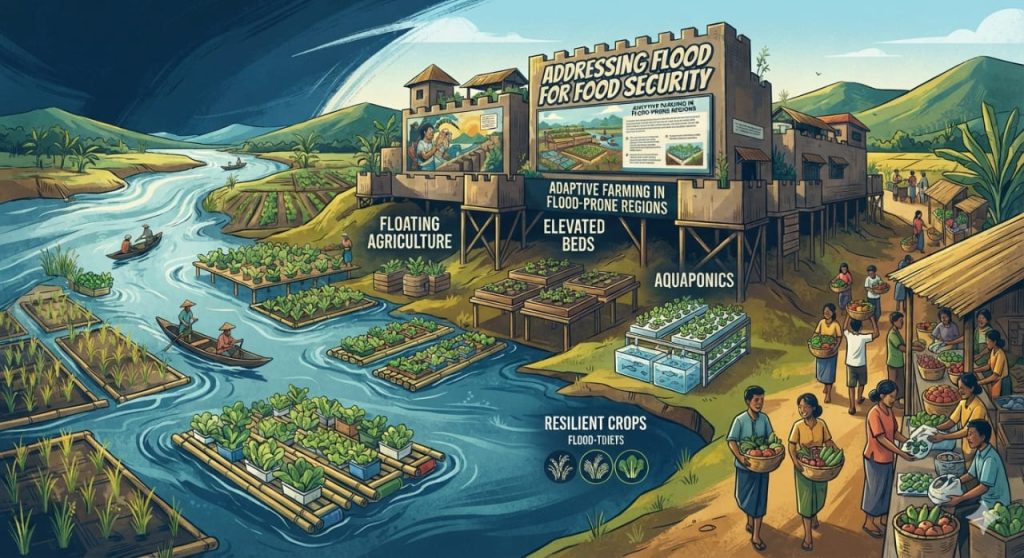
Third, Nigeria must accelerate investments in climate-smart agriculture. Farmers should be supported with flood-tolerant crop varieties, improved irrigation systems, raised-bed farming techniques and modern drainage technologies.
Agricultural research institutes must intensify efforts to develop crop varieties that can better withstand extreme weather conditions.
Fourth, agricultural insurance should become more accessible. Most smallholder farmers currently bear the full financial burden of flood losses. Expanding affordable crop and livestock insurance would reduce vulnerability and encourage continued investment in farming.
Fifth, governments at all levels must enforce environmental regulations more rigorously.
Illegal developments on flood plains should no longer be tolerated. Drainage channels and waterways must be cleared before every rainy season, while erosion control and watershed management should receive sustained funding.
There is also an urgent need to improve rural infrastructure. Better feeder roads, storage facilities, cold-chain systems and processing centres would reduce post-harvest losses and ensure that food reaches consumers even when some transport routes are disrupted.
Private-sector participation should equally be encouraged. Investments in irrigation, mechanisation, agro-processing and resilient supply chains can help strengthen the agricultural sector against climate shocks.
Nigeria must treat climate adaptation as an economic strategy rather than solely an environmental issue.
Every naira invested in flood prevention saves far more that would otherwise be spent on emergency relief, reconstruction and food imports.
The country’s ambition to achieve food sufficiency cannot be realised if floods continue to wipe out harvests year after year.





