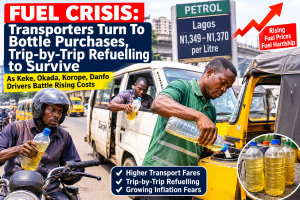
The labour groups as well as experts were furious over the decision of the gfederal overnment to further hike fuel to N855 through the Nigerian National Petroleum Company Limited (NNPCL).
This is even as experts have called on government to roll out incentives to ameliorate the suffering Nigerians will be passing through as a result of fuel price hike.
While calling on government to increase its support toward enhancing adoption of renewable energy in the country, they called on companies and individuals to adopt renewable energy as a source of power supply, as reliance on fuel for energy will trigger high cost of operation of companies and cost of living for Nigerians.
Earlier yesterday, there was reports that the NNPCL is about to raise ex-depot price to N850 a liter which will force independent retailers to sell at above N900 to N1,000 a liter, considering other costs.
The adjustment, it was learnt, is connected with disclosure by the NNPCL that petrol importation has caused financial strain on it and has placed considerable pressure on the company and poses a threat to the sustainability of fuel supply.
Reacting to the issue on behalf of Labour, the general secretary of Federation Informal Workers of Nigeria (FIWON), Comrade Gbenga Komolafe, described the jacking up of fuel as incredible and unacceptable by the general public that have already been pushed to the wall by series of anti-masses activities.
“Now, the cart has been let out from the bag with new price hike after few hours that NNPC came out with the alarm of owing marketers huge sums of money. And few hours after their open confession, they now increase the pump price without any challenge from Labour with engagement of NLC by the police.,” he said.
Furthermore, Komolafe said, “the situation with the Nigerian oil and gas industry is an extremely sad one. It derives from swallowing the big lie that it is only a mythical private sector alone that can invest and perform basic economic functions. It is easily forgotten that these refineries ab initio were built with public funds and run as a public corporation fairly efficiently until the Babangida era when we started this endless gyrations of endless ‘reforms’ that has now translated to continuous privatisation and commercialisation of all public enterprises, including the social sector; education, healthcare and potable water supply.”
In addition, he said, “we were told that subsidy removal would free public resources used to ‘subsidize’ imports of petro products. But nobody wants to address the issue of why we are the only OPEC country importing refined products in the first place. That is precisely where the fundamental contradictions bedeviling our oil and gas sector become unresolvable.
“As long as we have to import with foreign currency, while local currency value has been ‘reformed’ to gyrate in relation to these foreign currencies, the government will have no choice other than to continue to subsidize. In an economy where hydro carbons remain the main source of energy for industries and private use, not to talk of transportation, government refusal to subsidize this key social and economic good, would amount to economic suicide.”
Similarly, the director-general of Lagos Chamber of Commerce & Industry (LCCI), Dr. Chinyere Almona said, “with the official price of petrol now at N855, it is a clear indication that there is a reduction in the shortfall between the landing cost and the former price level of N568 charged by NNPC. The burden of the shortfall has accumulated to a debt of N10 trillion.
“Clearly, petrol subsidy is not sustainable but it is not also easy at all for the government to remove the subsidy totally and subject Nigerians to a fuel price of about N1,200 per liter. At such a price and knowing the usual impact that will have on prices, we may be going back to Inflation rate acceleration, after seeing some form of easing in the inflation figures of last of July.”
According to her, the impact on businesses will be severe with fuel prices affecting supply and logistics, power generation, transportation, and factory operations. Cost of doing business will skyrocket, prices of goods will rise, and some firms may shutdown due to low demand in the face of weakening purchasing power of consumers. And of course this will be followed by job losses.
“The situation is critical when considered against the background of NNPC owing suppliers about $6 billion (which is about N10 trillion).
“The coming on stream of the Dangote Refinery now refining fuel and diesel for sale may likely bring about some relief in the short term. We definitely need a game changer intervention to restore some sanity to the oil and gas distortions we have battled with since this year.”
Almona added that the more sustainable way forward is to support more local refineries to refine our crude for local consumption and eventual export across Africa.
“For immediate intervention, it would be helpful if the Port Harcourt Refinery can start operations in addition to what is produced from the Dangote Refinery. Since the importation of refined fuel is likely not feasible at this time, the local alternatives may be the best option for now.
“Secondly, independent marketers can continue to import and sell at their most convenient price as alternative to NNPC pricing,” she said.
She also added that, “in all we advise that local supplies are sustained and hopefully demand will adjust to supply at some equilibrium prices along the different sources of supplies.”
However, the director/CEO of Centre for the Promotion of Private Enterprise (CPPE), Dr. Muda Yusuf said, “the reality is that this is a very difficult situation for the government and the NNPC and I hope that as citizens, we should show some understanding at this time. And if the situation improves, then may be the price can even be further moderated.”
Urging government to quickly roll out some fiscal policies to make life easier for the citizens to transit to other forms of energy, he added that, “Use of CNG, LPG and renewable energy solutions like solar power, wind power is essentially at this time. We should roll out incentives that will make it easy for citizens to move to this other energy solutions, in enabling us to have a choice.”
On his part, the Group executive chairman of Lancelot Group, Mr. Adebayo Adeleke, noted that the fraud that has characterised NNPC operations has fully matured. To him, “Why were they fighting Dangote over the Refinery. They know that one man’s success will demystify them. What do you do when you owe? You pay up. They should pay.”
On the way forward, Adeleke said: “NNPC’s operations are shrouded in darkness. How many hundreds of billions of naira has NNPC expended over the past five years on moribund refineries that refined nothing? We need to get private enterprise to run critical areas of our economy.”
Similarly, the vice president of Highcap Securities Limited, David Adonri said, “my worry is whether this new PMS price is market determined. NNPC has monopoly over the supply of PMS. An abuse of monopoly power may be what we are currently witnessing.”
He stated that, “several things have already gone wrong which signals a roll back on market reforms. Whenever prices increase astronomically like in this case, it fuels galloping inflation. The drive by NNPC to hike fuel price may be responsible for current excruciating fuel scarcity. Some people also think that the measure is geared towards preparing the market for entry of Dangote’s PMS at international price.
“If federal government can get their refineries to work, competition will eventually drive down the prices of petroleum products.”